AB Energy Positions Puerto Rico as Strategic Hub for Caribbean Expansion
The Italian cogeneration company, with 25 units already operating on the island, is expanding its local team and service base, eyeing opportunities across manufacturing and hospitality
With 25 cogeneration units already operating in Puerto Rico, AB Energy is expanding its footprint on the island with a target of 10 to 12 new units next year, as it works to position Puerto Rico as its regional hub serving the Caribbean.
The company is investing in local personnel, service infrastructure and technical capabilities as demand for reliable, cost-efficient power generation continues to grow among manufacturers, pharmaceutical companies and hospitality operators on the island.
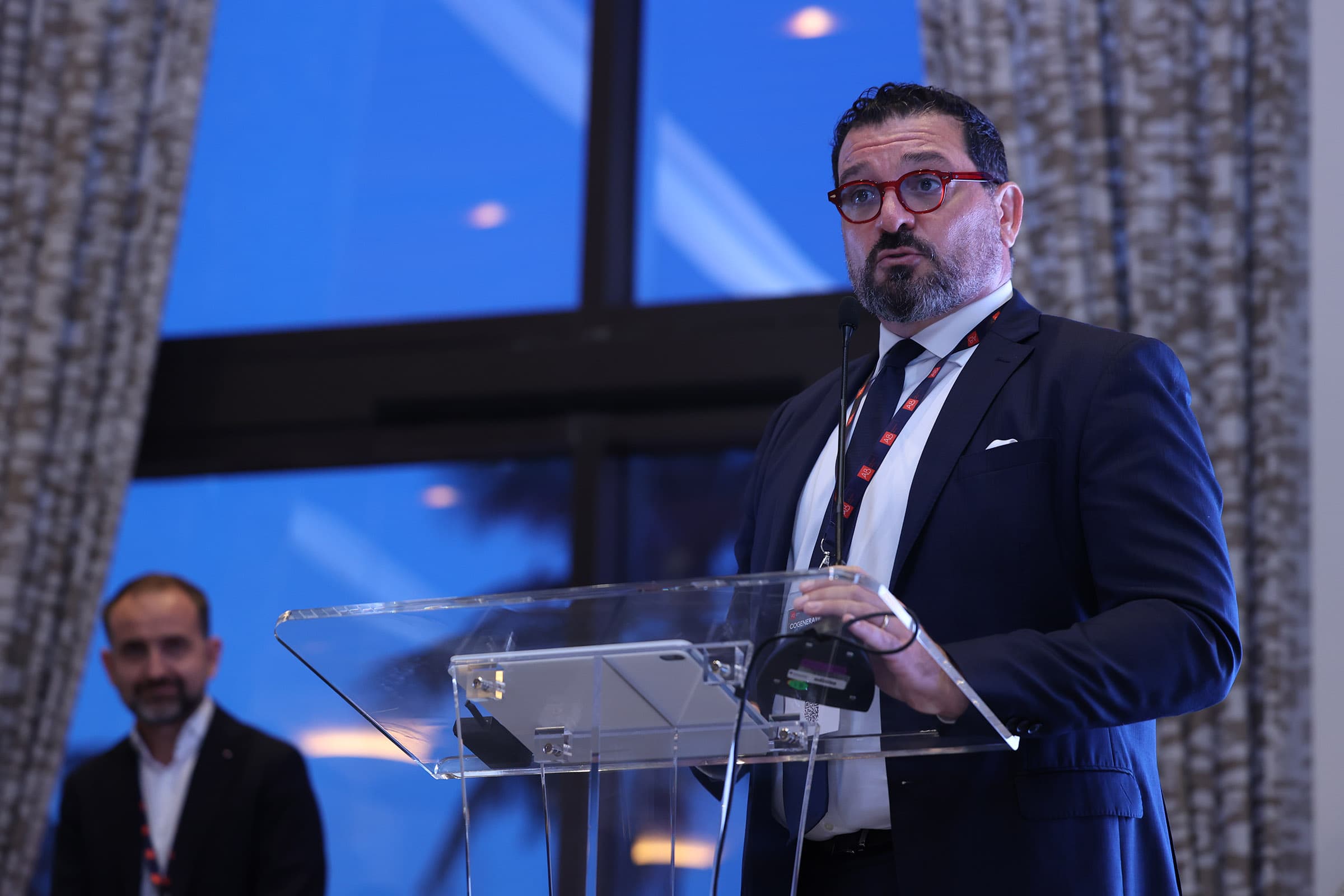
Giuseppe Fiorella, AB’s chief commercial officer and sales director for North America, also spoke at the company’s Cogeneration Day Puerto Rico, an industry conference at which fuel suppliers, financiers, engineers and customers discussed what it takes to make cogeneration work on the island, as CB reported Oct. 28.
“We knew Puerto Rico was about to boom because of its concentration of industrial and pharmaceutical companies. It was a little slow in the beginning, but we made a name for ourselves on the island,” Fiorella said in an exclusive interview with Caribbean Business. He is shown in the cover photo above speaking at Cogeneration Day.
When the Italian company began exploring the North American market in 2018, including Canada and the United States, Puerto Rico attracted company leaders because of its high concentration of pharmaceutical manufacturers. The scale of their operations and their constant need to stay up and running make pharmaceutical companies a perfect fit as potential clients, according to Fiorella.
Looking ahead, AB Energy expects Puerto Rico to play an increasingly important role in its Caribbean strategy, supported by continued investments in local personnel, infrastructure and customer relationships.
Investment in local infrastructure and workforce
Its very first project on the island was for a pharmaceutical company, and with it AB established a local LLC and began building a team of local personnel. For AB Energy, establishing offices in the places where it provides services is crucial for building long-term relationships that extend beyond the initial equipment installation.
The company has invested in a local warehouse, a spare-parts inventory, office space, service vehicles, equipment and technical tools, and it currently employs about 11 people in its local offices. It intends to continue investing in local employees and service capabilities as its customer base grows.
At the Oct. 28 event, Fiorella cited roughly $64 million in spare-parts inventory, around-the-clock monitoring and plans to expand technician training through AB’s Houston operations, and said the company has a local technical team and spare-parts warehouse in Ponce, CB reported.
Growing demand across industries
Since entering the market in 2020, AB has expanded into hospitality, resorts, paper manufacturing and other industrial sectors, as Puerto Rico’s grid instability and exposure to hurricanes have increased the importance of on-site power generation. The number of companies seeking to reduce energy costs grows each year, and solutions that improve operational efficiency and secure reliable electricity are gaining ground as alternatives.
“It is no longer a ‘nice-to-have,’ but it has become a need for industrial companies to maintain operations and lower electricity costs,” Fiorella added.
Four or five years ago, the company had to explain the advantages of its technology. Today, the market is more mature, and customers already understand the benefits. AB’s systems can operate independently of the electrical grid in island mode, allowing businesses to keep operating during outages, provided their systems are properly configured.
One example is Pan Pepín, the bakery company. As CB reported Oct. 28, it faced rising electricity costs, recurring outages and difficulty using production heat, considered solar panels, battery storage and hybrid microgrids, and chose a gas-powered cogeneration system, expecting fewer production interruptions, greater efficiency and lower operating costs, according to Jonathan Ramírez, its engineering director.
The technology also allows companies to generate electricity while recovering usable thermal energy, which improves overall efficiency. Fiorella added that all of the units on the island can accommodate different fuel configurations, including liquefied natural gas (LNG) and propane, depending on the installation.
He explained that access to LNG can provide additional fuel options for industrial customers, while propane can serve as a backup in certain dual-fuel configurations. He pointed to the expansion of LNG infrastructure as an important development for the island’s energy sector.
That expansion is under way. At the Oct. 28 event, José Maeso of Crowley said the company plans a second LNG vessel, more container-loading capacity and a possible floating storage unit, and panelists stressed that LNG’s economics depend on transportation, equipment conversion, maintenance and generation efficiency, not just fuel prices.
What AB Energy does
AB Energy sells, installs and services cogeneration systems, also known as combined heat and power (CHP). A cogeneration unit burns fuel in an engine to generate electricity on site and captures the heat the engine would otherwise waste, using it as useful thermal energy. That improves overall efficiency and can lower a customer’s energy costs, and because the unit sits at the customer’s facility, it can keep running when the grid does not.
AB Energy is part of Italy’s AB Group, founded in 1981 in Orzinuovi, near Brescia, which says it employs more than 1,400 people in 22 countries. The group’s North American arm says AB has installed more than 2,100 energy systems worldwide.
Its ECOMAX line packages a natural gas or biogas cogeneration system in a container, and the group describes itself as a single point of contact for design, construction and maintenance.
In Puerto Rico, that means AB designs the container-based units for the island’s climate, installs them and then services them. It also has an operating-lease arm, and Fiorella said its financing arrangements are flexible.
In power purchase agreements (PPAs), which AB works on with partners, a third-party developer invests in the installation and the customer buys the electricity under a long-term contract, which preserves the customer’s capital for production, panelists said at the Oct. 28 event.
The customers so far are mostly energy-intensive operations that cannot afford to stop, starting with pharmaceutical manufacturers and extending to hotels, resorts and a paper manufacturer. That is why the company’s service capability, including spare parts, monitoring and local technicians, matters as much as the equipment itself.
Puerto Rico’s unique opportunities
Puerto Rico’s unique position in the Caribbean presents particular challenges for equipment installation. AB engineers design containerized solutions that account for humidity, salt exposure, high winds and hurricane conditions, customizing the equipment for the island’s tropical climate.
Among AB’s most significant projects is a 10-megawatt cogeneration installation at Dorado Beach, made up of four containerized units. Fiorella described it as the company’s largest single-site installation on the island. The project is expected to begin receiving equipment before the end of the year, with energization targeted for July 2027.
The Dorado Beach project, developed by Puerto Rico Energy Partners, aims to improve the quality and reliability of electricity at resort facilities, CB reported Oct. 28. It is financed with private and institutional capital that includes FirstBank, and it uses LNG as its primary fuel, with propane as an alternative.
Fiorella also pointed to a volatile economic environment as another challenge, saying the company’s financing arrangements are flexible and depend on the customer’s needs. AB also works with engineering firms and power purchase agreement (PPA) providers.
Puerto Rico as a hub for Caribbean expansion
With installations in Jamaica, the Bahamas and Haiti, Fiorella sees Puerto Rico as a strategic base for expanding the company’s Caribbean operations. He said the company’s local workforce, service infrastructure and industrial client base provide a solid foundation for regional growth.
The company expects demand for distributed generation and cogeneration to continue as Caribbean businesses prioritize resilience and energy efficiency, and it aims to become a leading reference for cogeneration technology in the region.
“In 10 years, I see Puerto Rico as an important hub for the Caribbean, with more mature LNG infrastructure. I only see opportunities,” Fiorella added.
The panelists at the Oct. 28 event reached a similar conclusion, with a caveat: cogeneration can improve operational continuity, competitiveness and independence from the grid, but success depends on coordinated investment in fuel supply, financing, infrastructure and long-term maintenance.
Looking ahead, AB Energy expects Puerto Rico to play an increasingly important role in its Caribbean strategy, supported by continued investments in local personnel, infrastructure and customer relationships.
For Fiorella, the island’s concentration of manufacturers, evolving energy infrastructure and growing demand for reliable power present opportunities that extend well beyond the company’s current portfolio.
Law lets businesses spread overdue balances up to 36 months and fuel-cost jumps over six months; fuel adjustment behind the rise in pymes bills stays in place through December
Taveras says the filing confirms months of Pymes Power Cliff warnings, as a private-sector coalition takes its proposals to the Oversight Board and Legislature and awaits an answer from La Fortaleza