Buying Local Receives a Boost From Cómprale campaign, But Needs Institutions, Not Just Shoppers, to Go Bigger
Local spending keeps more money and jobs on the island, but research shows that the places around the world moving the needle far more pair campaigns with procurement rules, public data and supplier capacity
Puerto Rico’s case for buying local is stronger than any holiday slogan suggests, and harder to put into practice than any campaign can manage on its own. That is the backdrop as Cómprale al de Aquí returns for its 11th year under the slogan “This is my team,” with a new alliance with the Centro Unido de Detallistas (CUD), its first sporting events and its annual Orange Wednesday on Nov. 25, the day before Thanksgiving.
To be sure, the economics favor the campaign. Money spent with locally owned businesses and on island-made goods circulates more times through the local economy and supports more jobs than money that leaves on the next ship.
But research conducted for this story by Caribbean Business, including how other jurisdictions around the world get local buying done, reveals that the places that have turned that logic into measurable results have done it by changing how governments and large institutions buy, not only by asking consumers to change their habits.
Puerto Rico has had a local-purchasing preference and set-aside law since 2004, yet CB could not find public data on how much government spending it steers to island firms.
Still, Cómprale al de Aquí proponents press on. “For eleven years, we have promoted the importance of shopping at local businesses. This year, we want every Puerto Rican to recognize that they are part of a team and that their purchasing decisions have a direct impact on our economy. When we support a local business, we support jobs, families and opportunities for our people,” said Elliot Pacheco Beauchamp (pictured below), president of Empresarios por Puerto Rico, the business group behind the initiative.
An 11th edition with new partners
Orange Wednesday encourages consumers to get a head start on holiday shopping at local businesses and take advantage of their deals, while recognizing the economic and social contributions those businesses make.
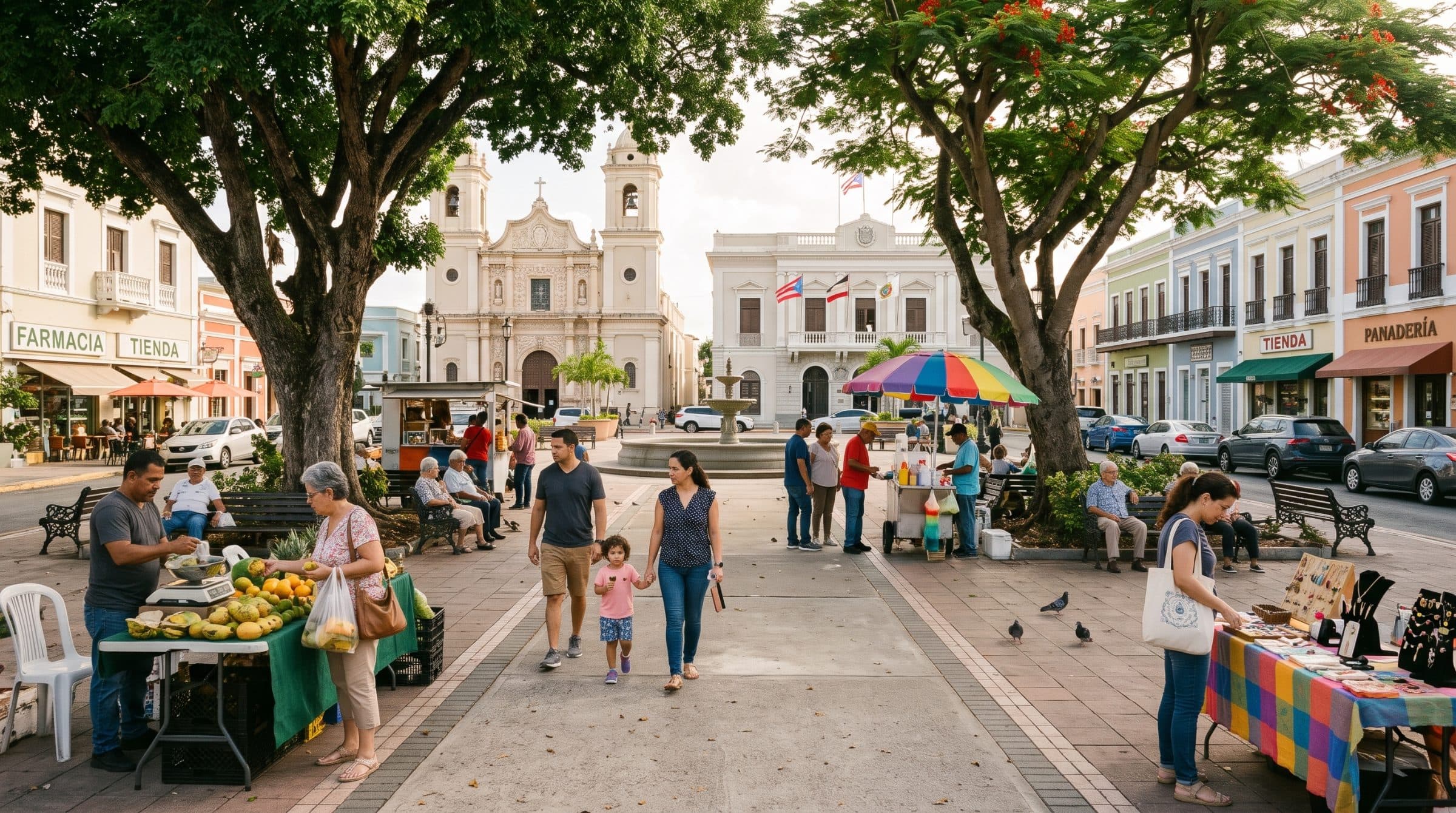
On Nov. 25, the Cómprale al de Aquí Market will bring together local products and businesses, including agricultural entrepreneurs and farmers, at the Puerto Rico Lottery plaza on Chardón Avenue in Hato Rey.
The Municipality of Camuy returns as a campaign sponsor and will host the first Orange 5K, bringing together runners, families and business owners.
“Every purchase at a local business represents an opportunity for our business owners, support for Camuy families, and a direct investment in our town’s future,” said Camuy Mayor Gabriel Hernández Rodríguez. “This Orange Wednesday, choose to shop in Camuy.”
The sports lineup also includes a pickleball tournament at the Puerto Rico Lottery courts at The Mall of San Juan. Both events are meant to carry the “This is my team” message to new audiences.
Eleven years of asking consumers to choose local have built the brand. What would make the effort far more successful is turning it from a holiday appeal into a purchasing policy, measured in public and backed by the institutions that spend the most.
The Lottery’s involvement reflects its own network, said Heidi M. Hernández Olivo, assistant secretary of the Puerto Rico Lottery Bureau.
“Supporting small businesses is especially meaningful because most of our lottery sales agents are small businesses that contribute every day to Puerto Rico’s economic development,” she said.
The campaign will run in traditional and digital media, along with other outreach, through early January 2027.
Why local spending matters for Puerto Rico
The campaign does not quantify its claim that local purchases create jobs, but the research points that way. Studies by the consulting firm Civic Economics, compiled by the American Independent Business Alliance, found that independent local businesses recirculate an average of 48% of each purchase in the local economy, compared with less than 14% for chain stores.
Puerto Rico-specific estimates are older but consistent. In 2016, studies by Advantage Business Consulting and Ipsos for the Puerto Rico Products Association estimated that if each household spent $1 a day on island-made goods and services, the island would gain about 2,300 jobs and $450 million in local production, and that replacing 5% of imported goods with local ones would add about 5,000 jobs and $985 million more, according to the association.
Food is where the gap is clearest. Puerto Rico imports more than 75% of the food it consumes, according to a study by University of Puerto Rico economist José Caraballo-Cueto published in August in the journal Agriculture & Food Security. It found that local farmers undercut import costs on 30 of 74 crops analyzed and estimated that replacing imports of just five high-volume products (corn, pepper, tomato, grapefruit and yautía) would generate $73.6 million in direct economic activity, or $117.8 million including multiplier effects.
The room for substitution is large. A 2022 study by the firm Inteligencia Económica found that 77% of consumer spending in 2020 went to goods and services produced on the island, a share lifted by services that are local by nature, which means the contest is over the remaining 23%, concentrated in goods.
For an economy with a shrinking population, limited fiscal room and a recently restructured public debt, the appeal is that import substitution grows the economy with money already being spent. A dollar that stays with a local producer supports a local payroll, local suppliers and local tax revenue. A dollar spent on an imported product supports the island mainly through the retail margin.
Why buying local is hard
If it’s so favorable, why is buying local not bigger in Puerto Rico? Because the obstacles are structural, not just habitual. Price and scale come first. Caraballo-Cueto’s study found that, overall, local farmers do not beat importers on price, and it pointed to supermarkets’ strict purchasing terms, the lack of an official weekly agricultural price system, and family farming traditions that limit crop diversification. National chains and online retailers also buy at a scale few island producers can match.
Shipping cuts both ways. The same study estimated that the Jones Act and agricultural tariffs raise import costs by about 11.9%, which may explain local price advantages in at least seven products, but island producers pay many of the same costs on the inputs, fuel and equipment they import.
Consumer goodwill helps less than it seems. In the 2016 Ipsos study, 74% of Puerto Ricans said they would pay more for a product labeled “Hecho en Puerto Rico,” but quality ranked first among reasons to buy (42%), and only 11% cited keeping money on the island. Goodwill opens the door; quality and price close the sale.
The largest leaks are institutional. After Hurricane María, about 90% of more than $5 billion in federal contracts awarded between September 2017 and August 2018 went to firms based outside Puerto Rico, with nearly $500 million going to local companies, according to the Center for a New Economy.
On paper, Puerto Rico has tools to push back. Act 14-2004, the law for investment in Puerto Rican industry, lets government agencies, public corporations and municipalities give local products a price preference of up to 10%, with up to 5% more for agricultural products and extraordinary cases. It requires purchasing officers to report monthly to a board that must keep statistics on the law’s progress and beneficiaries. Yet, CB could not find those statistics published, which leaves no public measure of whether one of the island’s largest buyers, the government, is buying local.
The same gap appears in school food. A 2021 agreement between the departments of Education and Agriculture for school cafeterias to serve island-grown produce, bought and distributed by the Agricultural Enterprises Development Administration, set no public purchase target.
What other places are doing
Jurisdictions that have moved results share a trait: they target institutional spending and measure it. In Preston, England, the city council led a “community wealth building” strategy that persuaded public anchor institutions, including the council, the police and local colleges, to buy locally.
Spending those institutions retained in Preston rose to £112.3 million, up £74 million from 2012-13, and spending kept in the wider Lancashire region reached £448.7 million, up £200 million, according to a 2019 review by Co-operative News.
Canada moved in December with a Buy Canadian Policy for federal procurement, effective Dec. 16, 2025. It awards extra bid-evaluation points for Canadian suppliers and Canadian content on contracts of 25 million Canadian dollars or more, a threshold falling to 5 million by spring 2026, and requires Canadian-made steel, aluminum and wood in large construction and defense contracts where a Canadian source is available. Exceptions require a minister’s approval and documentation.
Mandates alone are not enough. Hawaii’s Act 175 of 2021 requires its Department of Education to source 30% of school food locally by 2030, yet local purchases were 6.1% of the $64.1 million in food it bought in the 2022-23 school year, Hawaii Public Radio reported, as farms struggled to reliably supply about 100,000 meals a day.
Campaigns create the demand signal, but procurement rules, public data and producer capacity (aggregation, financing, food-safety certification and predictable contracts) turn it into results.
Where Cómprale al de Aquí fits
Against that panorama, Cómprale al de Aquí has done what is hard to sustain anywhere: keep a private-sector buy-local message alive for 11 straight years, with a recognizable brand, municipal partners such as Camuy, public agencies such as the Lottery and now a retail network of 18,000 businesses.
That is, in fact, the biggest addition this year. Under a collaborative agreement, CUD member businesses will be able to use the campaign’s digital kit and brand, with authorization and in coordination with the organization, which will offer the materials to its members for a nominal fee. According to figures the CUD released in September, it represents about 6,300 members affiliated with some 18,000 businesses in 169 business and professional categories.
“Its broad representation of local businesses strengthens Cómprale al de Aquí‘s reach and reinforces its message about supporting businesses that create jobs, drive economic activity and contribute to Puerto Rico’s development,” Pacheco said.
“Shopping local is about much more than making a purchase; it is an investment in Puerto Rico’s future. Every dollar spent at a Puerto Rican business strengthens our economy, creates jobs and opens up opportunities for our people,” said CUD President Alan Taveras Sepúlveda. “Through Cómprale al de Aquí, we invite everyone to turn their purchasing power into a tool for progress in Puerto Rico.”
The timing gives the alliance added weight. The CUD has warned that as many as 12,000 small and medium-sized businesses could close, putting some 70,000 jobs at risk, if energy costs do not come down, a scenario CB has called the Pymes Power Cliff. For merchants squeezed on costs, a stronger demand signal in the holiday season is one of the few levers within their reach.
But as our research shows, as long as the campaign does not expand to impact how institutions buy even more than how consumers buy, the effect will likely remain limited.
Eleven years of asking consumers to choose local have built the brand. What would make the effort far more successful is turning it from a holiday appeal into a purchasing policy, measured in public and backed by the institutions that spend the most.
The Toa Baja expansion buys 3 km of fiber, new dispatch systems, inspection tech, tracking global shift in which forecast accuracy and real-time visibility set limit on parts availability, a critical constraint for an island supplied by ocean freight
Five finalists in an accelerator run by Plaza Las Américas and Banco Popular show how small local brands try to scale from the island to export markets
Banco de Alimentos lit the Capitol, La Fortaleza, the Department of State, Plaza Las Américas and Puerto Rico Supplies Group last week, in part to call out hunger as a drag on the food market