The developers behind the ambitious Hostos Energy Corridor, a first-of-its-kind binational energy project that would link the Dominican Republic and Puerto Rico via an underwater transmission cable, say the initiative is entering its most critical phase yet.
With engineering work advancing, regulatory milestones secured, and financial structuring underway, executives at Caribbean Transmission Development Corp. (CTDC) submitted an unsolicited power purchase proposal to Puerto Rico’s Public-Private Partnerships Authority (P3A)—a step they describe as pivotal to unlocking the project’s long-term financing and construction timeline. The P3 Authority has already put the project in a 60-day evaluation process.
In an extended interview with Caribbean Business, principals Tirso Selman, project director, and Rafael A. Vélez Domínguez, company founder, outlined a detailed roadmap for the $2.5 billion energy project, which they said will fundamentally reshape Puerto Rico’s energy landscape by providing a stable, flexible and resilient baseload source capable of supporting the Island during major grid failures. “This project is about resilience first,” Selman emphasized. “The most expensive energy is the one you don’t have.”
Financing Structure: 70/30 Project Finance, With Local and International Banks
The team expects to reach financial close in the first quarter of 2027, with construction beginning immediately afterward.
“We have the financial close scheduled for the first quarter of 2027,” Selman said.
“From a development perspective, that is considered close.” The financing structure will follow a 70% debt and 30% equity model typical of large-scale energy infrastructure. “It will be a normal project finance structure,” Vélez Domínguez said.
The developers are working with Citibank and J.P. Morgan as financial advisors, though a final selection has not been made.
They have also held discussions with Banco Popular de Puerto Rico, Oriental Bank and Banco Popular Dominicano. “We believe both banking sectors must have skin in the game,” Selman said. “It’s important for both countries to be involved.”
Multilateral lenders, such as Inter-American Development Bank (IDB), have also been approached, though participation is complicated by the project’s cross-border nature and equipment sourcing requirements.
DLA Piper and Pietrantoni, Méndez y Álvarez serve as local legal advisors to the project in Puerto Rico, while Perellano Nadal Law & Consulting are the legal advisors to the project in the Dominican Republic.
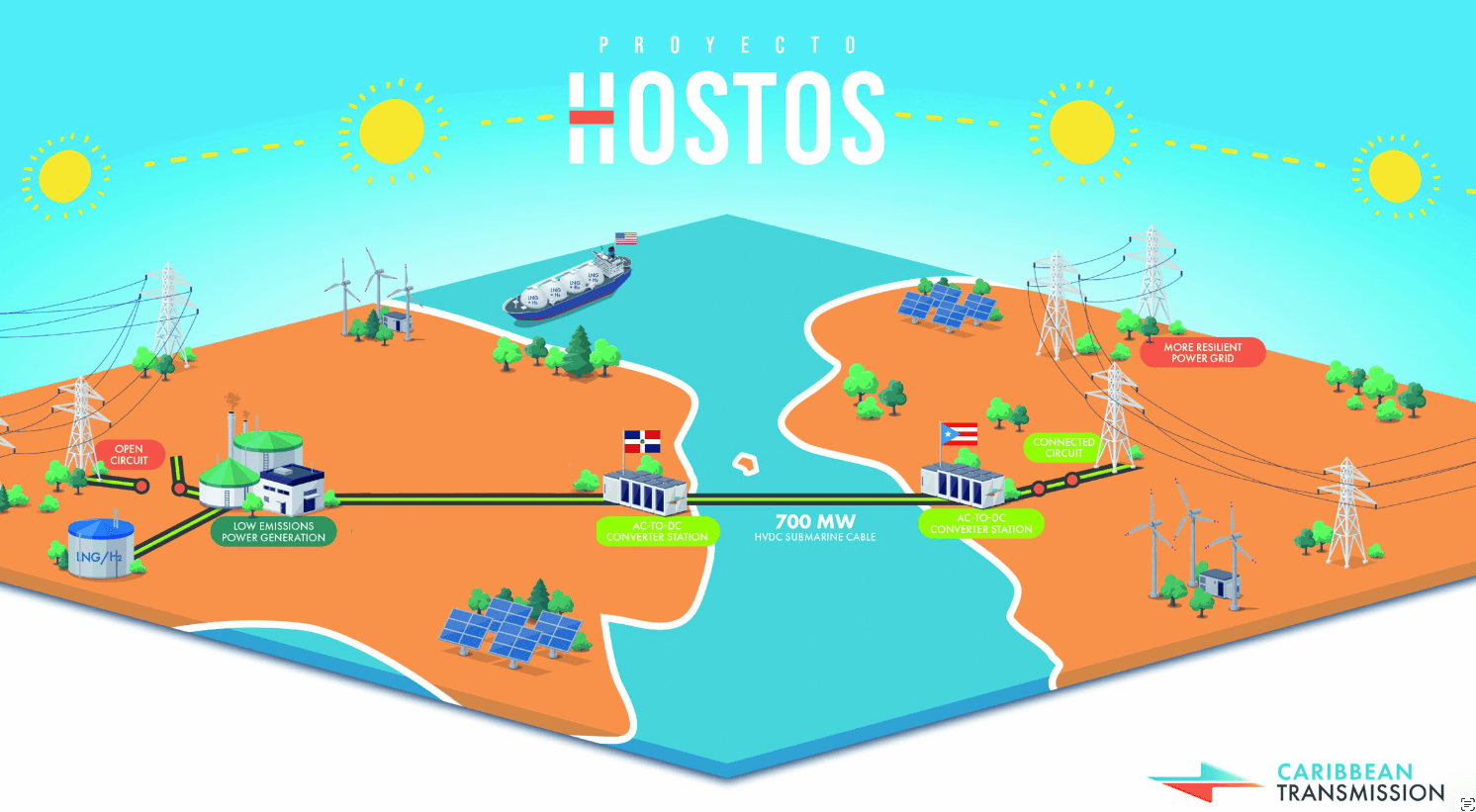
At the heart of the Hostos project is a 700-megawatt (MW) combined-cycle natural gas plant to be built in San Pedro de Macorís, Dominican Republic. The developers clarified that earlier public reports describing a 500 MW plant were outdated.
“The plant is 700 megawatts, combined cycle,” Selman said.
The facility will operate exclusively for Puerto Rico during its first phase, supplying power through a 345 kilovolt (kV) terrestrial transmission line and a 320 kV high voltage direct current (HVDC) submarine cable stretching approximately 93 miles (150 kilometers) across the Mona Passage.
Although the plant will initially run on natural gas, it is already engineered to burn green hydrogen without requiring future retrofits. “There is no need to convert it later—the plant is already prepared,” explained Vélez Domínguez, who is also president of the Puerto Rico Manufacturers Association. “It’s just a matter of bringing the hydrogen.”
The project is designed to unfold in two phases. In the first, the Dominican plant will operate independently from the Dominican grid. No energy will flow into or out of the Dominican system, and Dominican energy regulators will not oversee dispatch.
“Because we are not part of the Dominican national grid in the first phase, no Dominican energy regulator has to approve the project,” Vélez Domínguez said. Environmental, industrial and construction permits will still be required, but the plant will not be integrated into the country’s Sistema Eléctrico Nacional Interconectado.
The second phase envisions a fully bidirectional energy exchange between both jurisdictions once regulatory frameworks are established. “If Puerto Rico produces excess solar during the day, that energy could be sent to the Dominican Republic,” Vélez Domínguez noted.
The HVDC converter stations will act as electrical buffers, preventing disturbances in either country from propagating across the corridor. “These converter stations serve as filters,” Selman said. “They prevent any disturbance in Puerto Rico from affecting the Dominican system, and vice versa.”
The developers said that this project will give Puerto Rico a powerful tool for rapid recovery after major outages.
Puerto Rico’s grid has suffered multiple islandwide blackouts since Hurricane Maria of 2017, including recent outages on New Year’s Eve and Easter.
Engineering simulations, they said, show Hostos could dramatically accelerate energy restoration. “If Hostos had been operating during those events, the Island could have been re-energized in 30 minutes,” Selman said. “Hospitals, airports, the Superaqueduct—all could have been brought online quickly.” The Superaqueduct is a pipeline that carries water from Arecibo to San Juan, providing the precious liquid to the San Juan metro region.
interactions with all these agencies,” Vélez Domínguez said. In Puerto Rico, the primary regulators are the Energy Bureau (PREB) and the Energy Policy Advisor.
The developers estimate the project’s cost at $2.5 billion, with the generation plant representing roughly $1.2 billion, the submarine cable and converter stations about $1.1 billion, and the terrestrial transmission line, engineering and soft costs accounting for the remaining $300 million.
The tariff model will mirror existing Puerto Rico Public-Private Agreements (PPAs), such as those with EcoEléctrica and AES, with a projected price of $155–$165 per megawatt-hour (MWh). Selman emphasized that Hostos will not replace Puerto Rico’s entire generation fleet but will improve the system’s average cost.
“We will contribute energy below PREPA’s [Puerto Rico Electric Power Authority) current average of $180 to $200 per MWh,” he said. “We improve the average—we don’t set the entire price.”
The next major milestone is the submission of the unsolicited PPA proposal to the P3A, expected within 60 days. The proposal follows extensive technical discussions with PREPA and the Energy Bureau regarding the plant’s hybrid configuration.
“You can get very cheap energy that is not flexible, or very flexible energy that is not efficient,” Vélez Domínguez said. “We are proposing a hybrid that balances both.”
Selman added that the first step was ensuring regulators understood the technology. “We needed them to understand how this system operates and how it differs from other proposals,” he said.
As the Hostos Energy Corridor moves toward its next phase, the developers insist the project’s value lies not only in cost but also in the stability it promises. For an Island that has endured years of grid failures—not to mention PREPA, a public utility, going bankrupt—they argue, the ability to re-energize critical infrastructure within minutes could redefine Puerto Rico’s economic future.
Siemens as Co-Developer; EPC Selection Underway
On the technical side, Siemens is acting as a co-developer, providing engineering support and securing manufacturing slots for turbines and converter equipment to meet the 2031 operational target. “Siemens is ensuring we have the manufacturing slots for the turbines and converters,” Vélez Domínguez said.
Meanwhile, Jacobs, one of the world’s largest engineering firms, serves as the Owner’s Engineer, reviewing Siemens’ work and guiding technical development. The developers recently issued a request for proposal (RFQ) for a full Engineering, Procurement and Construction (EPC) contractor, with proposals expected soon.“These firms will handle construction of the plant, the lines and the submarine cable,” Selman said.
On the U.S. side, the project has already secured the Presidential Permit, delegated to the U.S. Department of Energy (DOE). The developers have spent three years coordinating with the DOE, Environmental Protection Agency, U.S. Fish and Wildlife Service, U.S. Coast Guard, and U.S. Army Corps of Engineers, and obtained a non-objection from the Departments of State and Defense. “We have had three years of interactions with all these agencies,” Vélez Domínguez said. In Puerto Rico, the primary regulators are the Energy Bureau (PREB) and the Energy Policy Advisor.
The developers estimate the project’s cost at $2.5 billion, with the generation plant representing roughly $1.2 billion, the submarine cable and converter stations about $1.1 billion, and the terrestrial transmission line, engineering and soft costs accounting for the remaining $300 million.
The tariff model will mirror existing Puerto Rico Public-Private Agreements (PAs), such as those with EcoEléctrica and AES, with a projected price of $155-$165 per megawatt-hour (MWh). Selman emphasized that Hostos will not replace Puerto Rico’s entire generation fleet but will improve the system’s average cost.
“We will contribute energy below PREPA’s [Puerto Rico Electric Power Authority) current average of $180 to $200 per MWh,” he said. “We improve the average—we don’t set the entire price.”
The next major milestone is the submission of the unsolicited PPA proposal to the
P3A, expected within 60 days. The proposal follows extensive technical discussions with PREPA and the Energy Bureau regarding the plant’s hybrid configuration.
“You can get very cheap energy that is not flexible, or very flexible energy that is not efficient,” Vélez Domínguez said. “We are proposing a hybrid that balances both.” Selman added that the first step was ensuring regulators understood the technol-ogy. “We needed them to understand how this system operates and how it differs from other proposals,” he said.
As the Hostos Energy Corridor moves toward its next phase, the developers insist the project’s value lies not only in cost but also in the stability it promises. For an Island that has endured years of grid fail-ures—not to mention PREPA, a public util-ity, going bankrupt-they argue, the ability to re-energize critical infrastructure within minutes could redefine Puerto Rico’s economic future.