At 93, Puerto Rico’s grande dame of fashion, Carlota Alfaro, is preparing what she calls her “last great project”: a book that will document her life’s work in haute couture.
The decision comes at a moment when most would have stepped away from the industry, yet Alfaro continues to work daily—teaching, supervising, and designing—despite living with a non‑painful bladder cancer that she describes with calm clarity. “I will die with it. It has never bothered me,” she said. She even named it: Angelito.
Alfaro preserves a monumental archive of her work. She has kept every design she has ever made, stored in boxes organized by year and month. At the start of the interview, this reporter showed her a photograph of a debutante gown she made for my sister, Lily Lloréns, in 1974—a dress she still treasures. The gown, a piece of haute couture that reflects Alfaro’s elegance and technical mastery, was crafted in delicate, flowing white chiffon that falls in soft pleats. It features a deep V‑neck bodice adorned with intricate hand‑embroidered beadwork, seed pearls, and rhinestones forming floral motifs. Today, the beadwork has naturally changed color with time.
She recognized it immediately. “I can find that dress,” she said. Then, without hesitation: “Tell her to bring it… I’ll fix it.”
Alfaro’s professional story began at age ten, when she was already sewing uniforms for her classmates. Her rise solidified in the 1950s, when designer Pedro Zorrilla included her in a fashion show at the Sheraton Hotel showcasing Puerto Rican designers. “That day I was no longer a seamstress. I became a designer,” she recalled. Soon after, she dominated the historic Destellos en la Moda event, winning four of its five major awards. “I always stole the applause,” she said with a mix of pride and humility.
Her career expanded beyond Puerto Rico. For a decade, Alfaro sold her collections in Neiman Marcus, Bloomingdale’s, Saks Fifth Avenue and other major U.S. retailers. That chapter began thanks to her daughter, who, while living in the United States, saw store windows and thought, “My mother’s dresses are more beautiful than this.” Determined, she pushed to sell Alfaro’s work abroad. Alfaro took out a $5,000 loan so her daughter could participate in a buyers’ fair. Their booth—nicknamed the Dreaming Booth for the beauty of the garments—drew immediate attention. “Everyone came to buy,” Alfaro said. Buyers asked who represented her, and after several recommendations, her daughter met Rod Owens. “When she opened the suitcase, Rod Owens signed the contract immediately,” Alfaro recalled. For ten years, they sold to the most prestigious stores in the country, until Owens’ death ended the partnership.
In Puerto Rico, Alfaro once employed 52 embroiderers, before imported fabrics transformed the market. “Ever since the Chinese arrived with those beautiful, embroidered fabrics, we stopped doing our own embroidery because we lose money,” she explained. “You have to adapt to what’s modern.”
Beyond her work as a designer, Alfaro created a method that revolutionized haute couture education on the island: the five‑step method. She discovered it after Carmen Reyes Padró, president of the now‑defunct newspaper El Mundo, contacted her to ask whether she could publish a weekly dress model and explain how it was made.
While preparing the patterns for the newspaper, Alfaro realized she could explain any design using a basic pattern and five steps—always the same. “That’s when I discovered them,” she said. The weekly work later became a book, and her students named the system “the revolutionary method.” “They were the ones who gave it the name,” she added.
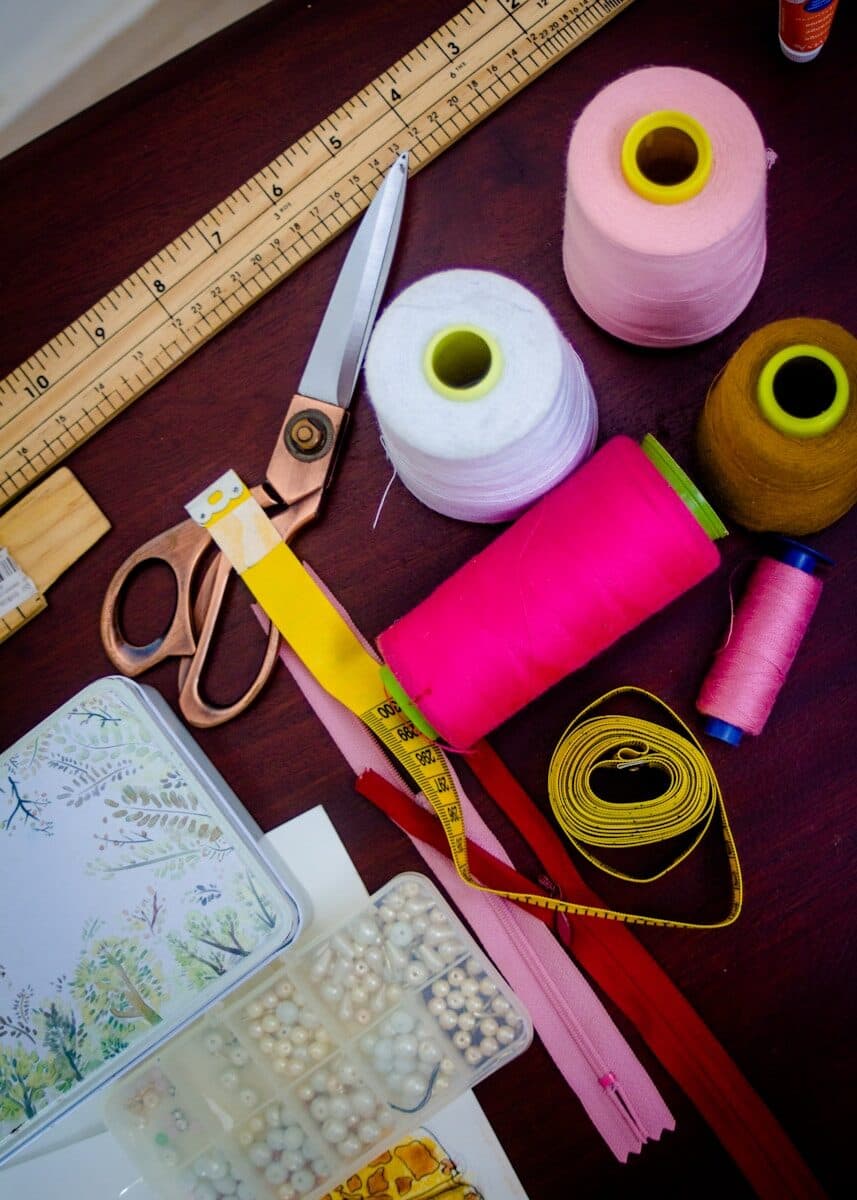
The method is based on two tools she designed: the magic ruler, which allows patterns to be squared with precision, and the boot, a template containing all the curves needed for basic patterns. With these tools, Alfaro can take measurements, create a pattern, and fit it in under 15 minutes. “When I put it on her, the pattern fit perfectly,” she said, recalling a demonstration she gave to professors from Parsons and Altos de Chavón, who were astonished by the speed and accuracy of the process.
The method—and a phrase from President John F. Kennedy—led her to found her sewing school. Kennedy once said: “Ask not what your country can do for you, but what you can do for your country.” “And that stayed with me,” Alfaro said. “I thought: the only thing I can do is teach, so people can earn money at home and not depend on the government.”
Today, the school that bears her name remains active, with approximately 250 students per semester. Her grandson, Carlos Benítez, has managed the business since 2010 and oversees daily operations. Benítez explained that the repeal of Section 936 indirectly affected the family and the academy. As factories closed and industrial jobs disappeared, the profile of students changed. In the past, students learned to sew to secure employment. Today, they want to start their own businesses.
“The country changed, and we had to adapt,” he said. Still, the school has remained stable and continues to train designers.
For Alfaro, Puerto Rico remains fertile ground for haute couture. “Puerto Rico is the ideal country for this profession,” she said. “Here we have contests, debutantes, weddings, senior proms, first communions, galas… there is work for everyone.” Although she recognizes that times have changed—“Now it’s Bad Bunny,” she said laughing—she insists that creativity and technique remain indispensable. “You have to adapt to what’s modern,” she said, without nostalgia or resistance.
Her influence is deep. Designers such as Carlos Alberto and Harry Robles trained in her atelier, many of them working for years without pay, simply to learn. “I have never had an enemy,” she said. “Wherever I go, people applaud me.”
Carlos Alberto, known as the “Designer of the Beauty Queens,” said he spent 14 years visiting Alfaro’s academy and learned to sew for free. “I had talent, but I didn’t know anything. She would tell me, ‘Help me hem this,’ or ‘Help me glue these stones,’ and that’s how I learned,” he said. He still follows Alfaro’s method faithfully, ever since he launched his own business in 2006 after dressing Miss Universe Zuleyka Rivera.
“She solves everything with something positive,” he said. “Once I was accused of making a dress that wasn’t in season, and she told me, ‘Well, you’re going to bless it.’ Once a fabric went missing and she told me, ‘We’re going to pray for it to appear,’ and it did.”
Alfaro says she always listens to the client. She has dressed figures such as singer Lucecita Benítez, the late singer Carmita Jiménez and Spanish singer Rocío Jurado, and designed for theater productions including Father Willy’s Anna and the King of Siam. In 2009, she won a Barbie Couture competition, presenting three designs later included in a book.
But what occupies her now is legacy. Alfaro has classified thousands of designs—debutante gowns, wedding dresses, jackets, pants, gala pieces—and wants to turn them into books that will serve as guides for future generations. “Because they are guides,” she said. “That is what I leave.”
Her cancer does not stop her. She continues to enjoy champagne and pitorro, continues teaching, continues working. “I receive so many blessings,” she said. And as she organizes her archive, prepares her book, and continues training designers, she shows that her story is not closing—it is being written with the same discipline and joy that have accompanied her since age ten.