The U.S. Army Corps of Engineers Expands in the Region; for Firms in Puerto Rico, That Means a Growing Procurement Pipeline and Federal Contracting Opportunities
Puerto Rico is no longer just home to a regional office of the U.S. Army Corps of Engineers (USACE). It is now the headquarters of an entire hemisphere-spanning command.
On June 23, 2026, in a ceremony held at the historic Castillo San Cristóbal in San Juan, USACE officially redesignated its Caribbean District as the Latin America & Caribbean (LAC) District, closing one chapter and opening a far larger one.
Lt. Col. Nathaniel “Nate” Weander took command as the district’s first leader under its expanded mission, succeeding Col. Charles Decker, who had guided the organization’s growth from a task force into a full USACE district.
The redesignation is more than symbolic. The LAC District now oversees USACE engineering engagement not only in Puerto Rico and the U.S. Virgin Islands, but across 33 partner nations throughout Latin America and the Caribbean.
Weander’s own background, with service stretching from Peru to Iraq to New Orleans, reflects the kind of hemispheric reach the district is now expected to project.
Headquarters, however, remains firmly planted in San Juan, anchoring the Corps’ expanded footprint in the island that built it.
The story behind this transformation matters. What is now the LAC District began as Task Force Virgin Islands Puerto Rico (TF VIPR), formed to coordinate the massive rebuilding effort that followed Hurricane Maria.
As the district settles into its expanded mission, the firms that engage now while the contracting pipeline is still taking shape stand to benefit the most.
That task force evolved into the Caribbean District, the first new permanent USACE civil works district established since 1948, a historic milestone in itself. Now, less than a decade later, that district has grown again, this time into a command responsible for a multi-billion-dollar portfolio spanning civil works, military construction, emergency response, and international engineering support across the Western Hemisphere.
For Puerto Rico, this progression carries real weight. A base that started as disaster recovery infrastructure has become the seat of hemispheric engineering strategy. This means decisions, contracts, and coordination for projects in Central America, South America, and the wider Caribbean will now flow through San Juan.
Opportunities: A Larger Pipeline on the Island
The expanded mission brings with it an expanded procurement pipeline, and much of it is already visible in public contracting data. Recent and upcoming solicitations illustrate the scale.
A market research notice for Architect-Engineer Surveying and Mapping Services, structured as a Multiple Award Task Order Contract (MATOC) with a ceiling of $30 million over a potential five-year term, covering surveying and mapping work across Central America, South America, the Caribbean, Puerto Rico, and the U.S. Virgin Islands.
An Indefinite Delivery Indefinite Quantity (IDIQ) contract for Quality Assurance Services supporting Civil Works, International Interagency Services, and Military Construction in Puerto Rico and the U.S. Virgin Islands.
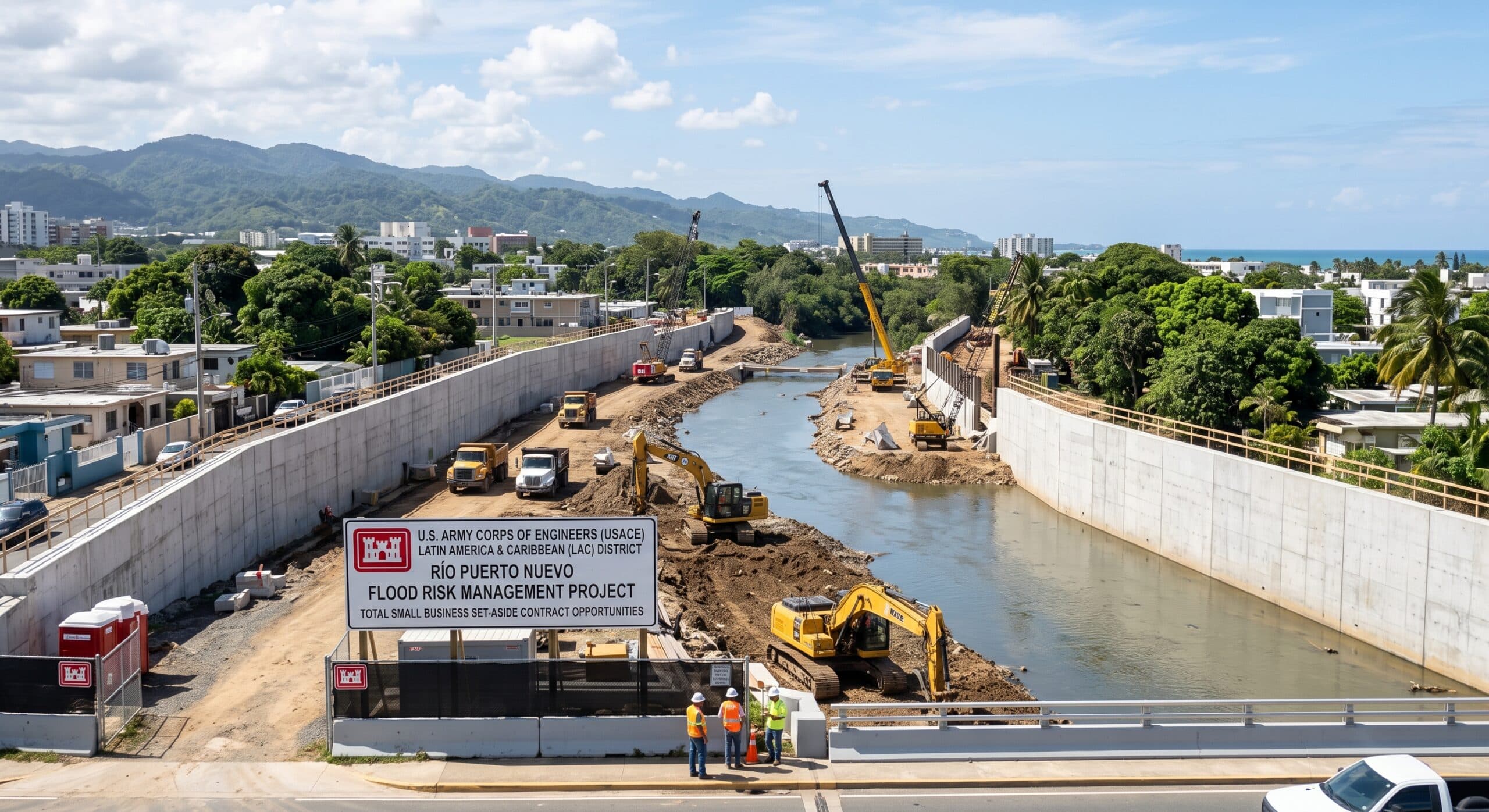
The long-running Río Puerto Nuevo Flood Risk Management program (in the main photo above), whose associated construction support and material management contracts run in multi-year ordering periods.
An industry outreach event scheduled for July 28-29, 2026, tied to the Guajataca Dam Permanent Repair Project, a reminder that legacy Puerto Rico infrastructure work continues alongside the district’s new regional scope.
Environmental and ecosystem work, such as the Caño Martín Peña Ecosystem Restoration Project, estimated between $25 million and $100 million.
Taken together, these figures point to a procurement environment where hundreds of millions of dollars in engineering, construction, surveying, environmental, and support-services work will move through a San Juan-based contracting office over the coming years. Much of this work must be performed locally or regionally, giving island-based firms a natural logistical advantage.
Work for Puerto Rican Firms
Beyond the general contracting pipeline, Puerto Rican companies benefit from policy tools designed specifically for them. Federal legislation has, in the past, granted agencies the ability to count contracts awarded to Puerto Rico-based small businesses at double their value toward federal small-business prime contracting goals.
This incentive is meant to draw more federal dollars toward island firms and encourage large primes to bring local companies in as subcontractors or mentor-protégé partners.
Puerto Rico has continued to lobby Congress to press the Small Business Administration to expand contracting access on the island, arguing that federal procurement policy can be a direct engine for local job creation.
For a USACE district now headquartered in San Juan and responsible for a hemispheric portfolio, that combination is notable: a bigger workload plus policy incentives favoring island-based firms.
A Puerto Rican company with the right certifications and past performance is positioned to compete not just for local Puerto Rico and U.S. Virgin Islands work, but potentially for a share of contracts tied to projects reaching into Central and South America and the wider Caribbean, simply by virtue of proximity to the district’s headquarters and familiarity with its processes.
Openings for Small Businesses
USACE’s own solicitations make clear that small businesses are not an afterthought but a stated target audience. Recent notices have explicitly invited responses from small businesses, HUBZone firms, 8(a) participants, Service-Disabled Veteran-Owned Small Businesses (SDVOSB), and Economically Disadvantaged Women-Owned Small Businesses (EDWOSB).
Some current opportunities are structured as total small-business set-asides under federal acquisition rules, and 8(a) sole-source and competed awards appear regularly among active Puerto Rico contracts.
Much of this work must be performed locally or regionally, giving island-based firms a natural logistical advantage.
Practically, this means a small engineering, surveying, environmental, construction-support, or professional-services firm on the island has multiple entry points.
Sources-sought and market research notices. These are explicitly the government’s way of identifying capable small firms before a formal solicitation is issued, so responding early can shape how a contract is eventually structured.
Set-aside task orders under larger IDIQ and MATOC vehicles, which are often reserved specifically for small businesses even when the umbrella contract is large.
Subcontracting under primes, particularly where mentor-protégé arrangements and Puerto Rico-specific incentives make local subcontractors attractive partners for larger firms bidding on hemispheric-scale work.
Looking Ahead
The LAC District’s redesignation reflects a broader strategic bet: that Puerto Rico’s engineering, contracting, and logistics base can serve as a hub for U.S. engagement across Latin America and the Caribbean, not just as a recipient of federal rebuilding dollars.
For local firms, from established engineering houses to small, newly certified businesses, the practical takeaway is to monitor SAM.gov and the district’s industry outreach announcements closely, pursue the relevant small-business certifications, and position themselves early in market research phases.
As the district settles into its expanded mission under Lt. Col. Weander’s command, the firms that engage now, while the contracting pipeline is still taking shape, stand to benefit the most as it matures. The local government, meanwhile, can leverage these federal project schedules to drive sustained infrastructure investment and economic development.
Four Seasons, Vanderbilt, The Icon and now The Legacy are reshaping the island’s high-end market, but without middle-market supply, the entire chain reaction may halt