Italian Tile Specialist Opens New San Juan Showroom, Betting on Construction’s Long Game
For now, Tile Boutique’s launch in Puerto Nuevo arrives as builders face a housing shortfall and an economy the Oversight Board says is growing slowly and leaning on federal money
Stone & Tile, a San Juan tile and stone company operating in Puerto Rico since 1985, has opened a new showroom, Tile Boutique, on Avenida De Diego in Puerto Nuevo. The new space is a smaller, curated “Lab Showroom” devoted to high-end ceramic slabs from Italian manufacturer Sant’Agostino. Its founder, Alejandro Longo, also owns Stone & Tile.
The opening is a rare piece of expansion news in a construction sector that is recovering but still far below its past scale. Construction employment stood at 39,900 jobs in July, well under the 69,100 reached in 2004, and the island’s housing industry has not produced 1,000 units a year in five years, according to CB’s recent reporting here and here.
That makes the decision to open a new location a signal worth reading. A company with four decades in the market is committing new space and a premium brand to Puerto Rico at a time when the economy’s growth is slowing and its builders are asking for permitting and financing reforms.
A curated bet from a four-decade player
Longo describes Tile Boutique as the “younger brother” of Stone & Tile. Both share a commitment to quality, service and design but serve different needs. Stone & Tile offers a wide range of materials for residential and commercial projects of every size, while Tile Boutique is more specialized, with Sant’Agostino as its lead brand.
The showroom is meant for architects, interior designers, decorators, developers and construction professionals, as well as the general public. Small-format samples carry QR codes that show the slabs installed in different settings, and an outdoor area, El Patio, displays larger-format collections so clients can judge texture and scale before choosing. Sant’Agostino’s collections reinterpret stone, cement and travertine, and the showroom features lines such as Sable, Lógico, Invictus, Gravel and Baystone.
“Tile Boutique was born from our relationship with Sant’Agostino and from the inspiration we found in its showroom in Milan, where we saw a different way of interacting with materials,” Longo said. “We knew the market on the island needed that exhibition concept, and today we are proud to bring that philosophy to Puerto Rico.”
The opening also brought Sant’Agostino’s management team to the island for the first time. Daniele De Risio, the company’s sales manager, called the project “an important milestone” and an opportunity to share “the quality of our Made in Italy” with Puerto Rican customers. Longo said the buyer he is targeting “appreciates design as a personal expression” and “understands the value of a differentiated proposal.”
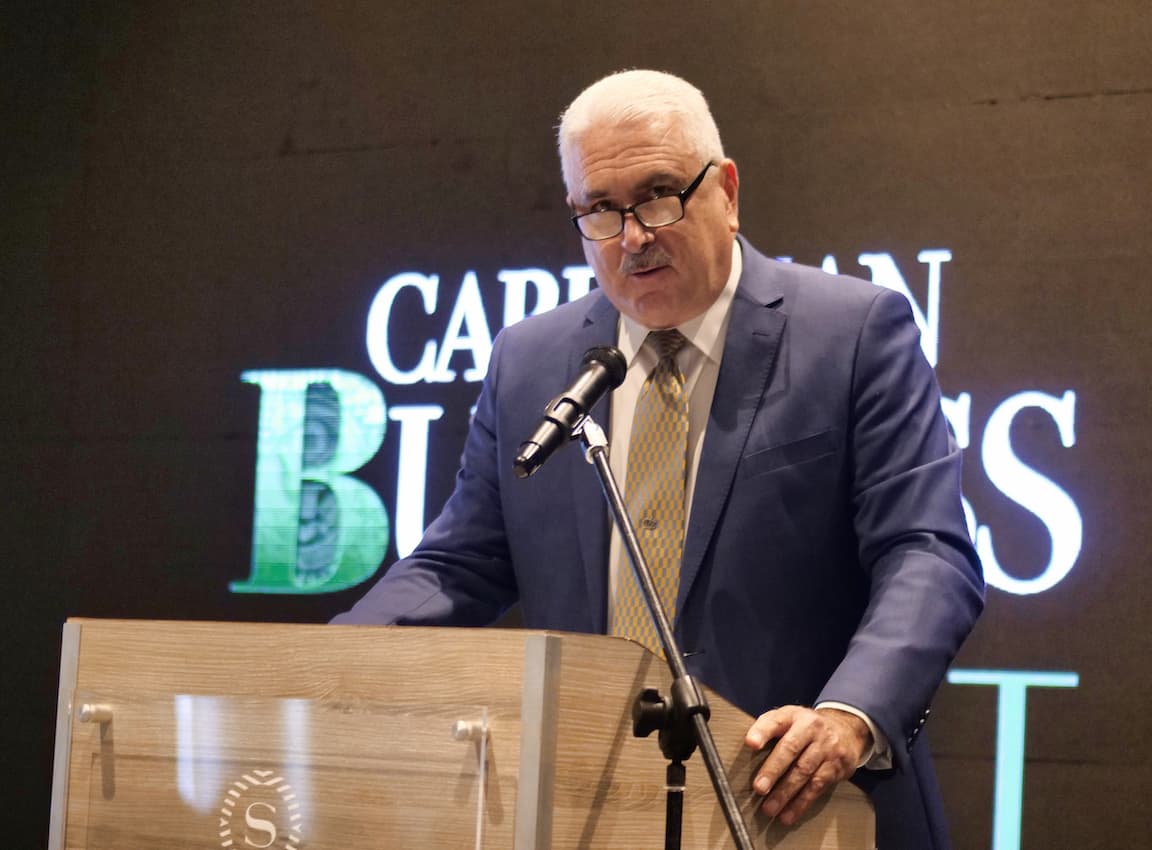
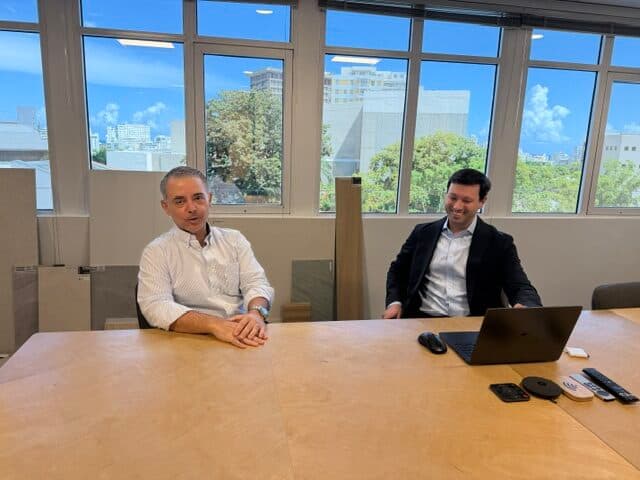
At Tile Boutique’s opening, leaders spoke of opportunities despite the island’s construction struggles.
A sector rebuilding from a deep hole
The market Tile Boutique is entering has rebounded from its worst moment but not recovered its former size. Construction employment fell about 70%, from 69,100 jobs in July 2004 to 20,200 in October 2017, one month after Hurricane María, according to federal labor data CB cited in August. At 39,900 jobs in July, the sector has roughly doubled from its trough but remains below 60% of its peak.
Output is moving in the right direction. CB reported that the construction sector generated nearly $8 billion in 2025, up 5.6% from the year before. Cement sales rose 1.2% in fiscal 2026, to about 15.4 million sacks, while local production rose 5.7%. About 40% of the cement the island consumed in fiscal 2026 came from outside Puerto Rico.
The industry is also composed largely of small operators. Planning Board data show about 4,551 construction establishments, 96% of them small and midsize firms. That structure makes the trade sensitive to financing conditions, permitting delays and swings in public spending, and it shapes the customer base for suppliers such as Stone & Tile.
Demand that is not being served
The clearest evidence of unmet demand is in housing. Puerto Rico Builders Association President Pinsy Rivera Ortiz told CB the island is short more than 5,000 units, and that “the market is much larger than what we’re currently serving.” A recent 92-house project drew 2,553 sign-up forms, nearly 28 for each home.
Luxury projects continue to advance, but developers say the supply for middle-class and working professionals is not keeping pace. Rafael Rojo, president and CEO of development company VRM and co-owner of Vision News Media (publishing company of Caribbean Business), said the little housing being built, “five years without reaching 1,000 units a year, has the market stuck.” Builders are expected to press for reforms in permitting, financing and regulation.
Permitting is a central obstacle. A government task force found in December 2025 that the permitting framework spans nearly 100 legal instruments and 45 separate laws, and the Oversight Board has urged the governor and legislative leaders to begin joint technical work on a unified planning and permitting code. For a materials seller, each housing unit that clears those hurdles is a potential customer, which is why a bottleneck in permits becomes a bottleneck in showroom traffic.
Growth that leans on federal money
The wider economy gives builders less room for optimism. The Financial Oversight and Management Board reported in this CB story that the Economic Activity Index fell 0.2% in the first nine months of fiscal 2026 and that real gross national product growth is about 0.4%.
The board described the outlook as “slower, more measured growth rather than a downturn,” and cited labor shortages, slow deployment of federal funds and weak labor force participation as constraints.
Federal recovery money remains the sector’s main support. Federal disaster, COVID-19 and reconstruction programs have disbursed roughly $62.2 billion since fiscal 2018, with another $56.2 billion available. The board warned that this money may be masking structural weaknesses, and the General Contractors Association’s own analysis found that construction has grown below its potential despite those billions.
The board also lists possible effects of new tariffs among its risk areas, which matters to any business that imports its product from abroad, as Tile Boutique does with its Italian product.
What the opening signals
Tile Boutique is, in effect, a bet on the quality end of the market. By pairing a specialist Italian brand with a professional audience of architects, designers and developers, Longo’s company is positioning itself to serve the projects that are getting built now: higher-end residential, commercial and renovation work, rather than the middle-income housing the island lacks.
The 5,000-unit shortfall describes a need for affordable and workforce homes, and Tile Boutique’s premium focus does not directly address it. But a company that has operated since 1985 and chooses to add inventory, space and a European partnership in a slowing economy is expressing confidence that construction activity will remain strong beyond the current wave of federal spending.
The deciding factor will be whether the housing and permitting reforms builders are seeking take hold. If they do, the rooms, apartments and offices that go up will need finishes, and a specialist showroom will be well placed. If they do not, expansions like this one will depend increasingly on a narrow base of high-end projects, and on the pace at which federal money is spent.
Public land, streamlined permits and public-private partnerships shape Madrid’s model; Resident Commissioner Pablo José Hernández presented ROAD Housing Act
Asset manager is adding hotels and fast casual to private credit and real estate businesses, with its Guaynabo luxury project selling to Puerto Rican buyers