RioBlanco Targets $100 Million for New Credit Fund, Plans Two Hotels, Dining Ventures, Pushes Affordable Housing
Asset manager is adding hotels and fast casual to private credit and real estate businesses, with its Guaynabo luxury project selling to Puerto Rican buyers
RioBlanco Capital is entering one of the most expansive phases as it celebrates its 10-year history, marked by the launch of RioBlanco Fund III, a private credit vehicle designed to raise about $100 million, and by the firm’s formal move into the hospitality sector with two planned hotel projects, including one in the heart of Santurce.
The hotels arrive as tourism gains momentum on the island, and the firm is also expanding in fast-casual dining through its investments in the Qdoba and Slim Chickens franchises, the latter of which recently opened its first Puerto Rico restaurant in San Patricio. Fund III, launched earlier this year, reflects a shift in how businesses seek financing in a changing capital environment.
Real estate remains the core of the business. The Legacy, a $45 million, 44-unit luxury project in Guaynabo, has pre-sold more than 40% of its inventory, and cofounder and principal Gabriel Jiménez says all of the buyers are Puerto Rican, including Guaynabo residents who want to downsize and diaspora families who plan to return in 2029. The firm would also like to move into more affordable housing, and Jiménez is pressing for the public-sector help he says is needed to make the numbers work.
A credit fund that buys into loans
The fund has already completed its first close and begun deploying capital, with a target of reaching $100 million as it continues fundraising.
“We don’t originate loans directly,” Jiménez said. “We participate in loans with other entities. Originators invite us into transactions, and we buy a piece of the loan. It’s a strategy that lets us see all kinds of opportunities, in and outside Puerto Rico.”
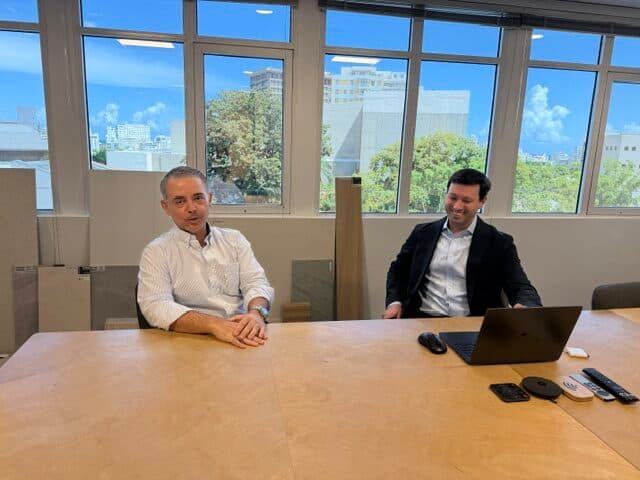
“We raise the capital, we develop the projects, and we operate vertically,” said RioBlanco cofounder and principal Gabriel Jiménez (left). “Our strategy is clear: tourism, luxury housing, fast casual, and private credit. And we’re just getting started.” With him is Guillermo Fortuño Vela, vice president of Real Estate.
The new vehicle complements RioBlanco’s existing structure as a registered investment adviser regulated by the Securities and Exchange Commission and Puerto Rico’s Office of the Commissioner of Financial Institutions.
“We raise the capital here. We are the fund,” Jiménez said, noting that RioBlanco operates as a vertical investment manager rather than outsourcing decisions to external advisors. “All those decisions are made here. We’re regulated by the SEC and OCIF, and we work directly with local banks.”
Hotels in Santurce, Aguadilla
As the fund advances, RioBlanco, which also owns the Centro Europa building in Santurce, is simultaneously preparing to break ground on two hotel projects that will mark its entry into the tourism sector after years studying opportunities.
The first, a Moto by Hilton, will rise in Santurce’s Parada 22 at the De Diego and Ponce de León intersection, across from Centro Europa, in the building currently occupied by Banco Popular.
The project will convert the existing structure into a 100-room urban lifestyle hotel. “It’s the perfect brand for the area,” Jiménez said. “Moto is designed for urban surroundings, for older buildings that get transformed. It fits Santurce exactly.”
The firm’s first hotel, a Moto by Hilton, will rise in Santurce’s Parada 22 at the De Diego and Ponce de León intersection, across from the RioBlanco owned Centro Europa property (pictured), in the building currently occupied by Banco Popular.
The project represents an investment of more than $25 million, financed through a combination of RioBlanco equity and local bank financing. “Hilton doesn’t put in capital,” Jiménez clarified. “It is equity from us and financing from the local banking sector.”
The second hotel will be developed in Aguadilla, on a parcel near the town center with elevated views. The project, planned at 135 to 140 rooms, will operate as a hotel rather than a resort.
“It’s not waterfront, but it’s very close and has a spectacular view,” Jiménez said. “It’s better that way. You avoid the problems that come with being directly on the water.”
Financing will follow the same model: equity from RioBlanco and debt from banks. The brand has not yet been selected, and the project remains in planning, but it forms part of a long-term strategy to expand into hospitality.
“We’ve been looking at opportunities in tourism for years,” he said. “This is the first hotel we’re doing, and Aguadilla will be the second.”
Hotels land in a visitor economy gaining momentum
The timing coincides with a surge of optimism around the island’s visitor economy. The Foundation for Puerto Rico’s Visitor Economy Performance model projects that the number of visitors will grow sharply from roughly six million a year today to eight million in 2030, with total spending rising from more than $8 billion to about $12 billion, and it estimates that the sector directly employs more than 115,000 people.
Current and projected growth of the island’s visitor economy per Foundation for Puerto Rico’s Visitor Economy Performance model.
An Aguadilla hotel would also add lodging outside the San Juan metro area, in line with the push to spread visitor spending across the island.
Two organizations are working to build on that momentum, as CB has reported. The Rebook coalition of independent hotels is spearheading an integrated network of local attractions, shops and inns across the island to draw visitors beyond traditional corridors like Old San Juan and Condado, while the Puerto Rico Chamber of Commerce has moved to mobilize the private sector, creating a permanent Tourism Committee that works with the public sector to accelerate growth.
Fast casual a deliberate bet
While hospitality and credit represent new frontiers, RioBlanco is working in another sector it considers strategically important: fast-casual dining.
The firm has invested in the franchise operations of Qdoba and Slim Chickens, the latter of which recently opened its first Puerto Rico location in San Patricio. Jiménez said the category aligns well with the firm’s investment philosophy.
“Fast casual is a sector we like a lot,” he said. “Slim Chickens has been a huge success. It’s a higher-quality product than typical fast food, and the model resonates with consumers.”
He described fast casual as a space with strong fundamentals, predictable demand, and operators who understand how to scale efficiently, qualities that make it attractive for private equity investors seeking stable returns.
Slim Chickens recently opened to long sustained lines in San Patricio’s former Arby’s location.
Jiménez noted that the firm’s involvement in fast casual is not incidental but part of a deliberate strategy to diversify into consumer-facing businesses with strong brand recognition.
“It’s a sector we want to continue investing in,” he said. “The economics make sense, and the operators we partner with are excellent. It’s an area where we see long-term opportunity.”
The firm’s partnership with Grupo Jové, operators of Ponderosa and other restaurant brands, has been central to this expansion.
“They’re strategic operators,” Jiménez said. “We invest alongside them, and they run the day-to-day. It’s a hybrid model that works.”
Luxury housing, sold to Puerto Rican buyers
Even as RioBlanco diversifies, real estate remains the core of its business. The Legacy, its newest residential development in Guaynabo, is a $45 million project of 44 units that has already sold more than 40% of its inventory in pre-sales.
“The reception has been very positive,” Jiménez said. “We’ve sold over 40 percent, and it’s all been organic. People hear about the project and contact us directly.”
Financing for The Legacy follows a structure increasingly common in Puerto Rico’s luxury residential market: local banks finance roughly half of the cost, while the remaining capital comes from RioBlanco’s equity and buyer deposits.
“Banks today don’t finance even 50 percent,” Jiménez said. “So it’s roughly half bank financing and half between our equity and the buyers’ deposits.”
The Legacy’s buyer profile is particularly notable. “They’re all Puerto Rican,” Jiménez said of the upscale Guaynabo development.
Units start at $1.2 million and remain below $1,000 per square foot, a benchmark the firm considers essential for attracting knowledgeable buyers. “When a buyer sees a product under $1,000 a foot in a prime location like this, it’s attractive,” he said.
The buyer profile is particularly notable. “They’re all Puerto Rican,” Jiménez said. “Many of them live in Guaynabo, Beverly Hills, Torrimar, Villa Caparra, and want to downsize from a house to something easier to maintain. And some are Puerto Ricans living abroad who plan to return in 2029 when the project is finished. A lot of them are doctors.”
The project’s location, near San Patricio and WAPA Television, has been a major draw for buyers who grew up in the area and want to return.
RioBlanco is also working on the $60 million The Icon, a 35-unit project in Condado that will begin delivering units at the end of the year, and developing The Grove, a four-unit residential project in Ocean Park.
Financing for these projects follows the same pattern: equity from RioBlanco, bank financing, and buyer deposits.
Affordable housing hinges on costs and public-sector help
Though the firm would like to expand into affordable housing, Jiménez said current cost structures make it nearly impossible.
“More than 25 percent of every dollar invested in a project goes to the government,” he said. “Construction costs are extremely high, and when you add local taxes, it becomes very difficult. We would love to do affordable housing if the numbers worked.”
The topic will be central at this week’s affordable housing forum at the Puerto Rico Builders Association Convention, where Jiménez will participate Friday alongside a representative from Madrid’s municipal housing agency, EMVS Madrid, which manages more than 10,000 affordable rental homes and works with private developers on part of its pipeline.
“We want the mayors to listen and take note,” he said. “Eventually the state and municipalities will have to do something to help make affordable housing viable.”
A decade in, a growing base of local investors
RioBlanco celebrated its tenth anniversary earlier this year and now employs about 15 people at its headquarters, in addition to the indirect jobs generated by its projects. Its investor base consists primarily of family offices and high-net-worth individuals from Puerto Rico, the United States, Europe, and the Middle East.
“As we grow, we’re seeing more local investors,” Jiménez said. “They see what we’re doing and want to invest with us.”
Jiménez will push for affordable-housing policies this Friday at the Puerto Rico Builders Association Convention.
With Fund III underway, two hotels preparing to break ground, a growing fast-casual portfolio, and multiple residential projects advancing, RioBlanco is positioning itself as one of the most active and diversified investment platforms in Puerto Rico.
By CB’s tally, the projects with disclosed costs (the Santurce hotel, The Legacy, The Icon and The Grove) alone add up to at least $155 million, before counting Fund III’s $100 million target and the undisclosed budget for Aguadilla.
“We raise the capital, we develop the projects, and we operate vertically,” Jiménez said. “Our strategy is clear: tourism, luxury housing, fast casual, and private credit. And we’re just getting started.”
Airport operator weighing more projects; the master plan behind them understates how fast the climate is worsening, keeping LMM vulnerable to big risks
At the upcoming PRBA annual convention, builders are expected to call for reforms to permitting, financing and regulations to unlock the housing market for the middle class and working professionals
The U.S. Army Corps of Engineers Expands in the Region; for Firms in Puerto Rico, That Means a Growing Procurement Pipeline and Federal Contracting Opportunities