Aerostar Has Invested Over $50 Million to Make San Juan’s Airport Resilient, but Warming May Outrun Its Plan
Airport operator weighing more projects; the master plan behind them understates how fast the climate is worsening, keeping LMM vulnerable to big risks
Aerostar Airport Holdings, the company selected by the Puerto Rico Ports Authority to manage Luis Muñoz Marín International Airport (LMM), has invested more than $50 million over the past 10 years in projects to protect the facility against flooding, hurricanes, power disruptions and other climate risks, and it is weighing more.
Climate science, though, seems to be moving faster than current plans. Rising temperatures are running ahead of the scenarios most infrastructure planning still relies on, raising a question the next decade will answer: whether the plan is enough.
Handling over 13.6 million passengers a year as of 2025, the airport is a medium hub compared with others, which, according to Sustainability Director Jaime Pabón, makes sustainability and resiliency efforts a challenge.
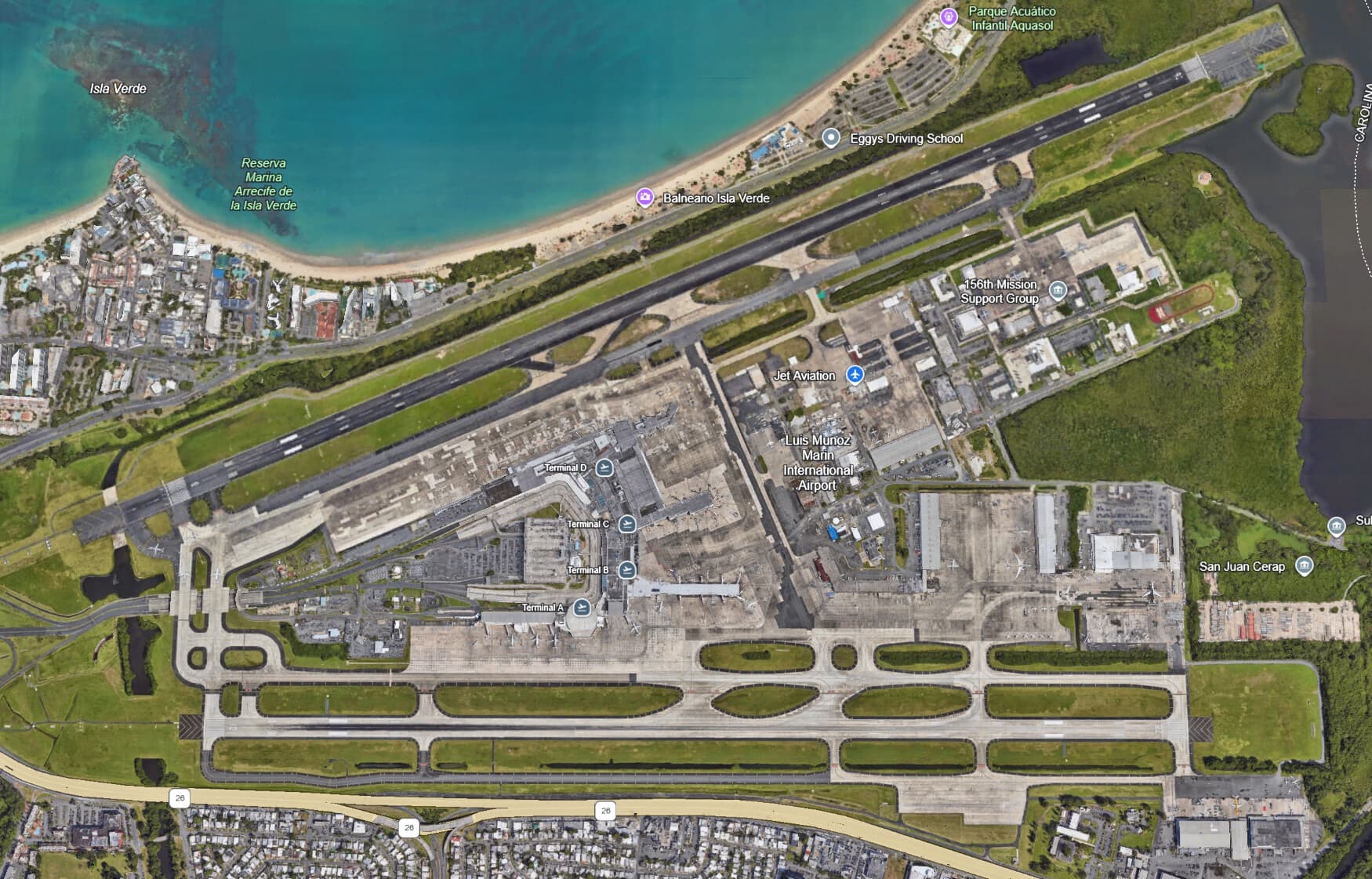
Its location adds another layer. LMM sits within the San Juan Bay Estuary watershed, a network of lagoons, wetlands, mangroves and waterways that stretches across the metropolitan area, which makes resilience work particularly important.
Graphic by Gemini, directed by Caribbean Business. The places where the arrows point are purely for illustration purposes and do not reflect actual locations where improvements are being made or planned.
“We cannot be sustainable without first being resilient,” Pabón said in an exclusive interview with Caribbean Business.
He began working on climate resilience and mitigation when he joined the company in 2013, when Aerostar first took over operations. Since then, he has focused on preparing the facility for flooding, hurricanes, power disruptions and other climate-related risks.
In January 2024, Aerostar presented its formal Airport Sustainability Plan (ASP), developed to incorporate sustainability and climate resilience into the airport’s long-term planning, construction, operations and maintenance.
The effort began in December 2022 with an evaluation of the resilience and efficiency of critical infrastructure, future water and electricity needs, and the airport’s ability to maintain and expand capacity.
“We cannot be sustainable without first being resilient.”
LMM Sustainability Director Jaime Pabón
The assessment identified six main categories: climate resiliency, energy management and emissions reduction, water conservation and capacity, natural resources, waste management, and internal and external outreach. For each, the plan sets goals, measurable objectives, targets and specific initiatives, divided into short-, mid- and long-term projects.
Flooding and drainage
One of the short-term projects is a comprehensive hydrologic and hydraulic study (H&H), scheduled for completion next month, in November 2026. Flooding is currently one of the airport’s most pressing vulnerabilities, and the study aims to gather accurate drainage data to inform the next resilience projects. With two water-monitoring stations installed, the study is 80% complete. It will let Aerostar identify the areas most vulnerable to flooding, assess the capacity of existing drainage and determine where improvements are needed as rainfall patterns change.
Aerostar already knows the drainage system needs work. Existing channels are obstructed by fast-growing vegetation, which makes a hurricane a particularly dangerous scenario. If flooding occurs, underground electrical wiring and cabling areas could shut down, and arriving pilots might not be able to see the runway clearly for landing.
“We work with the Federal Aviation Administration (FAA) to apply for funding. Usually, if we qualify, they put down a 70%, and we put down 30%.”
Jaime Pabón
Crews have started dredging some of the channels. The Runway Object Free Area (ROFA) project is a longer-term initiative that, Pabón admits, will require additional funding and time, with the north side of the runway as its guinea pig. The goal is to finish vegetation removal across roughly 10 acres by 2030, though it could take longer because of the tedious data collection needed for federal funding applications. Federal money is Aerostar’s main source for these initiatives.
“We work with the Federal Aviation Administration (FAA) to apply for funding. Usually, if we qualify, they put down a 70%, and we put down 30%,” he said.
Pabón estimates the ROFA project will cost more than $10 million and take three to four years, starting in 2028. It involves more than clearing overgrown channels: crews would also install a geotextile lining and add concrete to keep vegetation from growing back and blocking water flow.
A longer-term, more complex option is a pumping system that would move water in only one direction, carrying excess water away from the airport and keeping surrounding water from flowing back in during heavy rain or flooding. The municipality of Carolina has already adopted such a system, Pabón said, and his team met with city officials to learn how it operates and how it could be applied at the airport.
Energy: from resiliency to redundancy
Energy resiliency is also at the top of the list. Among the most recent efforts are 24 new power generators, the replacement of 45,000 feet of outdated and damaged underground electric feeders, and a 12 MW power plant. The plant, estimated for completion by 2030 and now in design in collaboration with the Federal Emergency Management Agency (FEMA), will provide a resilient, continuous fueling system and reduce greenhouse gas emissions.
The entire airport operation needs 10 MW to keep running, according to Pabón. Add solar panels to the generators and the plant, and the result is energy redundancy. After Hurricane María, Pabón says, the airport would be more than prepared to keep operating through another disaster, a continuity that matters in a power system as strained as Puerto Rico’s.
“We know the airport is critical when it comes to managing emergencies on the island, that is why we work with various companies who are on call when the next disaster happens. We are covered with things like water supply, materials, and food, where if that service gets interrupted, we are prepared to meet the demand,” he added.
Runway and taxiway signs are also under evaluation for conversion to solar- and battery-powered LED lights, with results due within six to eight months. The goal is to stop relying on old circuit connections that can fail whenever power is interrupted.
Hurricane readiness
Hurricane María taught Aerostar that the airport cannot depend on a single energy source, a lesson already built into its strategy. Other preparations include reinforcing rooftop equipment by sealing components and adding tie-downs and anchoring systems so that hurricane-force winds cannot lift or blow it away. Passenger boarding bridges were also modified so they can be fully retracted and anchored to the terminal building, reducing the risk of wind damage.
The stakes of that work rise with temperature. According to the Fifth National Climate Assessment (2023), Atlantic tropical cyclones are projected to produce about 15% more rainfall and roughly 3% stronger average winds if global temperatures rise 2°C above present-day levels, and the number of Category 4 and 5 hurricanes is also projected to increase.
What climate science says now
Pabón said Aerostar uses climate studies from the Fifth National Climate Assessment, the National Oceanic and Atmospheric Administration (NOAA), the U.S. Geological Survey (USGS) and the Intergovernmental Panel on Climate Change (IPCC) to guide its infrastructure planning. The airport also draws on local expertise, including Puerto Rican coastal and climate specialist Ernesto Díaz, who works with the Puerto Rico Climate Change Council. The aim is to build future climate risk into infrastructure decisions rather than rely solely on historical conditions.
Among the projections informing that work is a 2022 federal sea-level rise assessment led by NOAA scientists, which identifies the Caribbean as tracking an intermediate scenario. But a more updated review of climate data suggests that the LMM plan may be underestimating the climate impacts the airport is likely to face, rendering the current investment program insufficient and placing the facility at risk.
The Copernicus Climate Change Service reports that 2025 was the third-warmest year on record, at 1.47°C above preindustrial levels, and that 2023 to 2025 was the first three-year period to average above 1.5°C.
Based partly on records from NOAA tide gauges in San Juan and Lajas, it projects about 0.28 meters (0.91 feet) of sea-level rise by 2050, about 1 meter (3.3 feet) by 2100 and 2 meters (6.6 feet) by 2150. Its high scenario reaches 2.1 meters by 2100.
Other credible assessments run higher, and sooner. The Fifth National Climate Assessment puts Puerto Rico’s sea-level rise at 0.6 to 1.4 feet by 2050 and 1.9 to 6.8 feet by 2100. The IPCC’s Sixth Assessment Report says that about 2 meters by 2100 and 5 meters by 2150 cannot be ruled out if ice sheets destabilize.
University of Puerto Rico oceanographer Aurelio Mercado projected a faster path for the island, as cited by The Resilience Journal in 2018: about 1.5 feet in the 2030s, 2.5 feet by 2050 and 1 meter by 2060, and he warned that airport operations “will be seriously compromised.” Mercado cites the work of climate scientist James Hansen, who warns that sea level could rise as much as 5 meters by 2100 if ice sheets melt faster than models assumed.
The temperature record explains why the faster projections cannot be dismissed. The Copernicus Climate Change Service reports that 2025 was the third-warmest year on record, at 1.47°C above preindustrial levels, and that 2023 to 2025 was the first three-year period to average above 1.5°C.
A Caribbean Business review of this research points to 2°C arriving around 2040 to 2045, well before the end-of-century horizon that anchors many planning documents.
The World Meteorological Organization’s 2026 to 2030 outlook gives a 91% chance that at least one of the next five years exceeds 1.5°C and a 75% chance that the five-year mean does, up from 47% in its 2024 outlook. NOAA’s Climate Prediction Center said in September that there is a better-than-90% chance of a very strong El Niño this winter, which typically pushes global temperatures higher the following year.
The Indicators of Global Climate Change 2026 update estimates human-induced warming at 1.37°C, rising about 0.27°C per decade, with a remaining carbon budget for 1.5°C of about 130 gigatons of CO2, roughly three years of current emissions.
The policy outlook offers little relief. A Caribbean Business review of this research, including tipping-point forcers and socio-economic pressures, points to 2°C arriving around 2040 to 2045, well before the end-of-century horizon that anchors many planning documents.
The Global Tipping Points Report 2025 adds that some systems, including warm-water coral reefs, are already crossing thresholds, and that others, such as the Atlantic overturning circulation and the Amazon, are at risk even below 2°C.
Some scientists, including Hansen, argue that international shipping regulations to secure cleaner air is unmasking additional warming and that 2°C could arrive even sooner, though that view is debated.
Puerto Rico is already warming. NOAA’s State Climate Summaries report that the island’s temperatures have risen almost 2°F, or about 1.1°C, since 1950, based on six long-term monitoring sites. San Juan, where the airport is located, is warming faster than the island overall, partly because of the urban heat-island effect. A Puerto Rico Climate Change Council station analysis found a San Juan trend of about 0.022°C per year, compared with 0.012°C to 0.014°C per year across the island. At that pace, San Juan warms roughly 0.9°C every four decades.
How other airports are preparing
Few airports design for the faster scenarios, but some are moving. Singapore Changi Airport is among the leaders in extreme-heat readiness. Singapore’s Ministry of Transport says Changi has added polymer additives to the asphalt on runways and taxiways so the pavement withstands higher temperatures, an approach similar to that used at Middle Eastern airports where temperatures can exceed 40°C (104°F). It has also introduced a Laser Crack Measurement System that uses lasers and sensors to catch tiny pavement abnormalities before they grow, and it combines that data with analytics and machine learning for predictive maintenance. Its Terminal 5 airfield is designed at an elevation of 5.5 meters above sea level.
Changi Airport in Singapore is among the international facilities around the world moving swiftly to prepare for the worst consequences of a fast-warming planet.
The comparison is instructive. In the plans Caribbean Business reviewed, none of these airports is publicly designed around 2°C of warming by about 2040. San Juan’s peer group is planning against a slower climate than the one the data now describe.
Where the plan stands
For now, Aerostar is focused on foundations. “Right now we are focusing our efforts on establishing sustainable design guidelines first, we are hoping to have them by next year, so that eventually we can work with the infrastructure and construction departments to start taking those actionable steps,” Pabón said.
Those guidelines are where the question of scenario choice will be settled, and with federal funding covering 70% of eligible projects, the scenarios behind each application matter. An airport on a low-lying estuary, in a territory with a strained power grid and a hurricane-exposed coast, has little room for a planning gap.
The coming years will show whether Aerostar’s strategies are enough. The investment already made is considerable, and the next step is to design for the climate the data now describe.
For Aerostar, sustainability cannot mean only lowering emissions. It means building an organization that keeps operating through events that are arriving sooner than planned.
At the upcoming PRBA annual convention, builders are expected to call for reforms to permitting, financing and regulations to unlock the housing market for the middle class and working professionals
The U.S. Army Corps of Engineers Expands in the Region; for Firms in Puerto Rico, That Means a Growing Procurement Pipeline and Federal Contracting Opportunities
Four Seasons, Vanderbilt, The Icon and now The Legacy are reshaping the island’s high-end market, but without middle-market supply, the entire chain reaction may halt