Housing Remains King; Riviera’s Owner Gains Confirms Industry’s Role in Creating New Resident Wealth to Fuel Economic Recovery
Tracing every resale in the Property Registry, VRM found its Bayamón homes rose 56% against a 10% island index and a neighboring complex doubled, a measure of how housing can fuel a recovery from the household up
Most housing announcements count units built and dollars invested. VRM Companies followed a more trendsetting approach: what its buyers’ homes are worth today.
Using sales recorded in the Property Registry, the developer calculated that families who bought in Riviera, its development in Bayamón, have gained $147.2 million in home value, $21 million of it already realized in resales and an estimated $126.2 million held by owners who have not sold.
To be sure, well-planned communities built on rehabilitated land tend to lift values for their buyers and their neighbors, as countless developments have done under similar conditions in Puerto Rico and around the world. What is unusual is that a developer traced it sale by sale and framed the result from the owners’ side of the ledger.
“These results allow us to look at development from the perspective of the owners and the value their homes can acquire over time,” said Rafael E. Rojo, president and CEO of VRM Companies.
The exercise also confirms the point made repeatedly and publicly by Rojo and others in the industry on the imperative to boost housing construction as a pillar of economic growth for Puerto Rico, at a time when the island is stuck in neutral.
As CB reported Nov. 4, economists told the Financial Oversight and Management Board that the economy is effectively stalled, with forecasts ranging from a 1.4% contraction to 0.3% growth, while household finances are under strain.
Amenities are a big part of a project’s success and wealth creation, including Riviera. “When there are places to gather, play sports and enjoy, families want to live there, and that demand is what is reflected today in the value of their homes and their neighbors’,” Rojo said.
Rojo has argued, on CB’s El Blueprint in September, that without housing there is no recovery. The Riviera numbers show one way housing provides more than shelter; it rebuilds the household wealth an economy needs to grow. (Rojo is also co-owner of Vision News Media, publisher of Caribbean Business.)
What the registry shows
Between 2020 and 2026, the five Riviera communities delivered 428 homes worth a combined $300.3 million, despite the 2020 earthquakes, the pandemic, Hurricane Fiona, inflation and two islandwide blackouts, according to VRM.
Its analysis of registry transactions from 2019 to 2026 found that owners of 57 of those homes resold them in 65 transactions, realizing $21 million in appreciation.
Those homes gained 56% over their original purchase price, while the Federal Housing Finance Agency’s house price index for Puerto Rico rose 10% over the same holding periods.
In Riviera Court and Riviera Village, the first two communities, resales nearly doubled the original price.
The larger figure is an estimate. VRM applied the resale values to the homes whose owners have not sold, arriving at $126.2 million in appreciation, and the company notes that what those owners actually receive will depend on an eventual sale and on market conditions.
If developers, lenders and policymakers began tracking housing by the resident wealth it creates and not just by the units it delivers, Puerto Rico would have a clearer way to judge which projects help households build the base a lasting recovery needs.
It is also appreciation, not equity in the strict sense: it measures the rise in value over the purchase price, before mortgages, closing costs or taxes.
By CB’s arithmetic, the average delivered home was worth about $700,000, the average gain on a resold home was about $368,000, and the estimated gain for each home still held by its original owner is about $340,000.
For those households, that is the kind of balance-sheet change that can finance a business, a child’s education or a retirement. For the economy as a whole, when multiplied across the new developments Puerto Rico needs and for which there is demonstrable pend-up demand, they’re numbers that can change the island’s fate, particularly when added to other growth sectors as the island moves toward a new diversified model.
Value that spilled over the fence
The gains did not stop at Riviera’s gates. In Valles de Torrimar, the neighboring complex, the median recorded sale price fell from $168,000 in 2012 to $120,450 in 2018, then climbed to $241,000 in 2024, according to VRM’s analysis.
That is an 87% rise from 2019 to 2024, against 42% for the FHFA index. The decline in the first half of that period is a reminder of how much household wealth Puerto Rico’s lost decade erased, and the rebound shows how quickly it can return when a neighborhood changes.
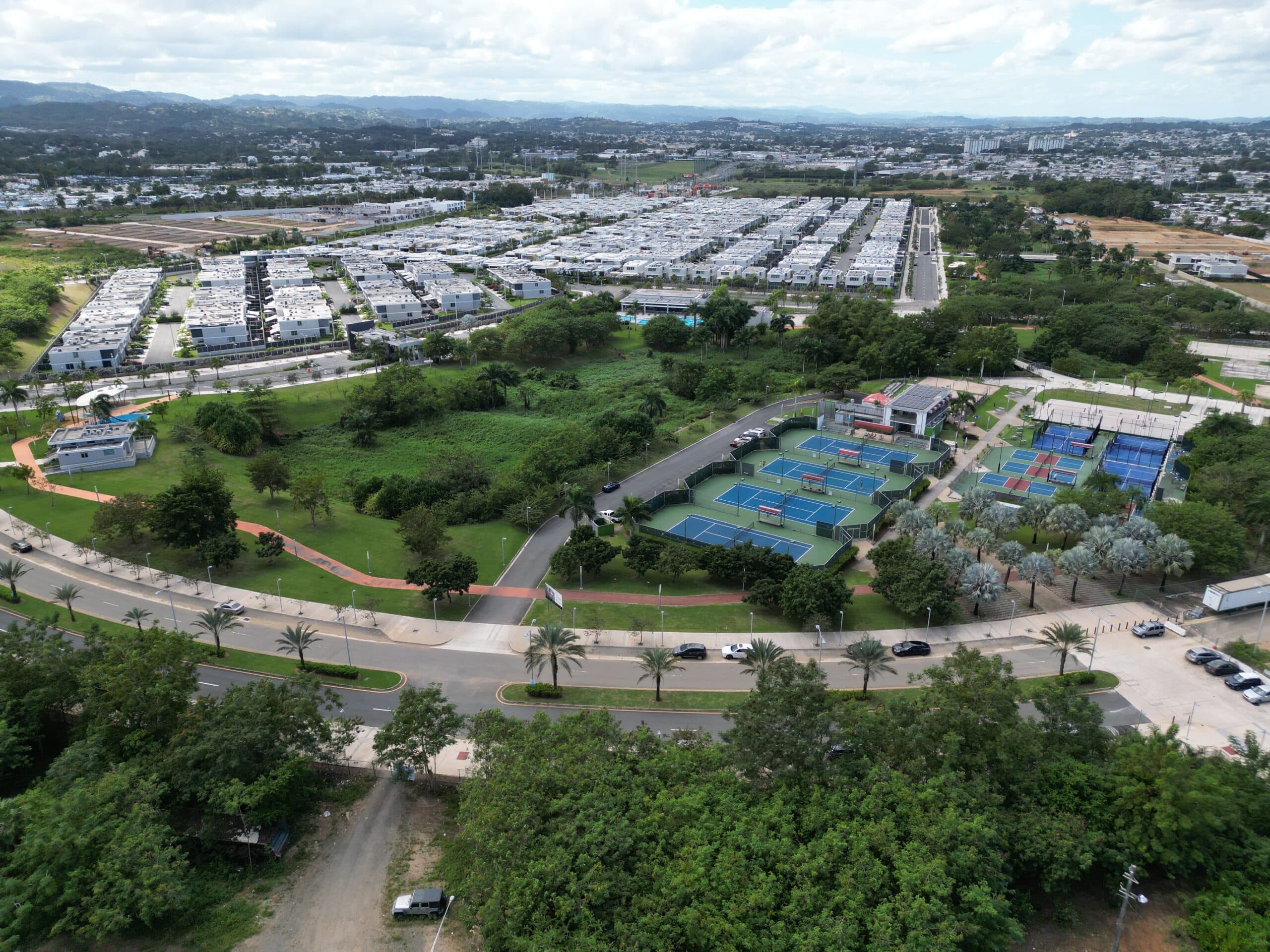
VRM attributes the result to building amenities for the surrounding area, not only for its buyers. The Riviera Tennis Center, built on courts that had never opened to the public, began operating on Jan. 20, 2019, before the first home was sold. It now has 19 courts for tennis, beach tennis, padel and pickleball, is open to the community and has hosted youth clinics with Venus Williams, Mónica Puig, Carlos Alcaraz and Frances Tiafoe.
A reminder of how it was pre-Riviera. The former Río Bayamón Norte community held publicly funded infrastructure that went unused for more than a decade, with vandalized courts and lighting, illegal dumps of tires and debris, abandoned vehicles, overgrown vegetation and soil that needed remediation.
For Valles de Torrimar, the developer also built a linear park, a 50-space parking lot and an access control on its own land.
“When there are places to gather, play sports and enjoy, families want to live there, and that demand is what is reflected today in the value of their homes and their neighbors’,” Rojo said.
The next phase, Riviera Marketplace, adds 21,303 square feet of restaurants and shops, with the first tenants expected to open before year-end.
From idle public land to private wealth
The site was a liability before it was an asset. The former Río Bayamón Norte community held publicly funded infrastructure that went unused for more than a decade, with vandalized courts and lighting, illegal dumps of tires and debris, abandoned vehicles, overgrown vegetation and soil that needed remediation.
VRM bought the land at auction in 2018 under the asset-liquidation plan of the Government Development Bank, then cleaned it, remediated the soil, reforested it and rehabilitated parks and courts before building homes.
Riviera also sits in an Opportunity Zone designated under Act 21-2019, the local law created to draw private investment to Puerto Rico’s most economically lagging areas. VRM presents the project as an example of the transformation that law was meant to encourage.
In CB’s reading, that sequence is the mechanism worth studying. A public asset that produced nothing for a decade became, with private capital, incentives and amenities built first, a base for $300 million in homes and roughly $147 million in owner wealth. The public cost had already been paid; the return arrived on household balance sheets.
“These results allow us to look at development from the perspective of the owners and the value their homes can acquire over time.”
Rafael E. Rojo, president and CEO of VRM Companies
No housing, no recovery
Rojo’s broader argument is about supply. He said in the El Blueprint interview that housing shortages are holding back the return of talent, hotel expansion and growth, that production is below 1,000 units a year, and that adding homes at every price point would set off a chain of movement through the market.
The Puerto Rico Builders Association has put the shortfall at more than 5,000 units, and much of the current pipeline is luxury housing, as CB reported Sept. 30.
The recovery debate usually counts jobs, capital investment and federal disbursements. The Riviera analysis adds a measure that is closer to how families experience an economy: what their largest asset is worth.
If developers, lenders and policymakers began tracking housing by the resident wealth it creates and not just by the units it delivers, Puerto Rico would have a clearer way to judge which projects help households build the base a lasting recovery needs.
The manufacturer has added capacity for solar projects and a new warehouse, even as a 50% U.S. steel tariff and a stalled economy test the market it is building for
The 65-year-old Carolina distributor joins others betting on building demand, even as a stalled economy and a 5,000-unit housing shortfall cloud the outlook