Fase1’s Fifth Cohort Takes Local Startup Pipeline to 46 Towns and Points to the Emerging New Puerto Rico Economy
Forty-three founders pitched products from agriculture to the creator economy as new incorporations climb, hiring concentrates in small firms and tax incentives reward selling beyond the island
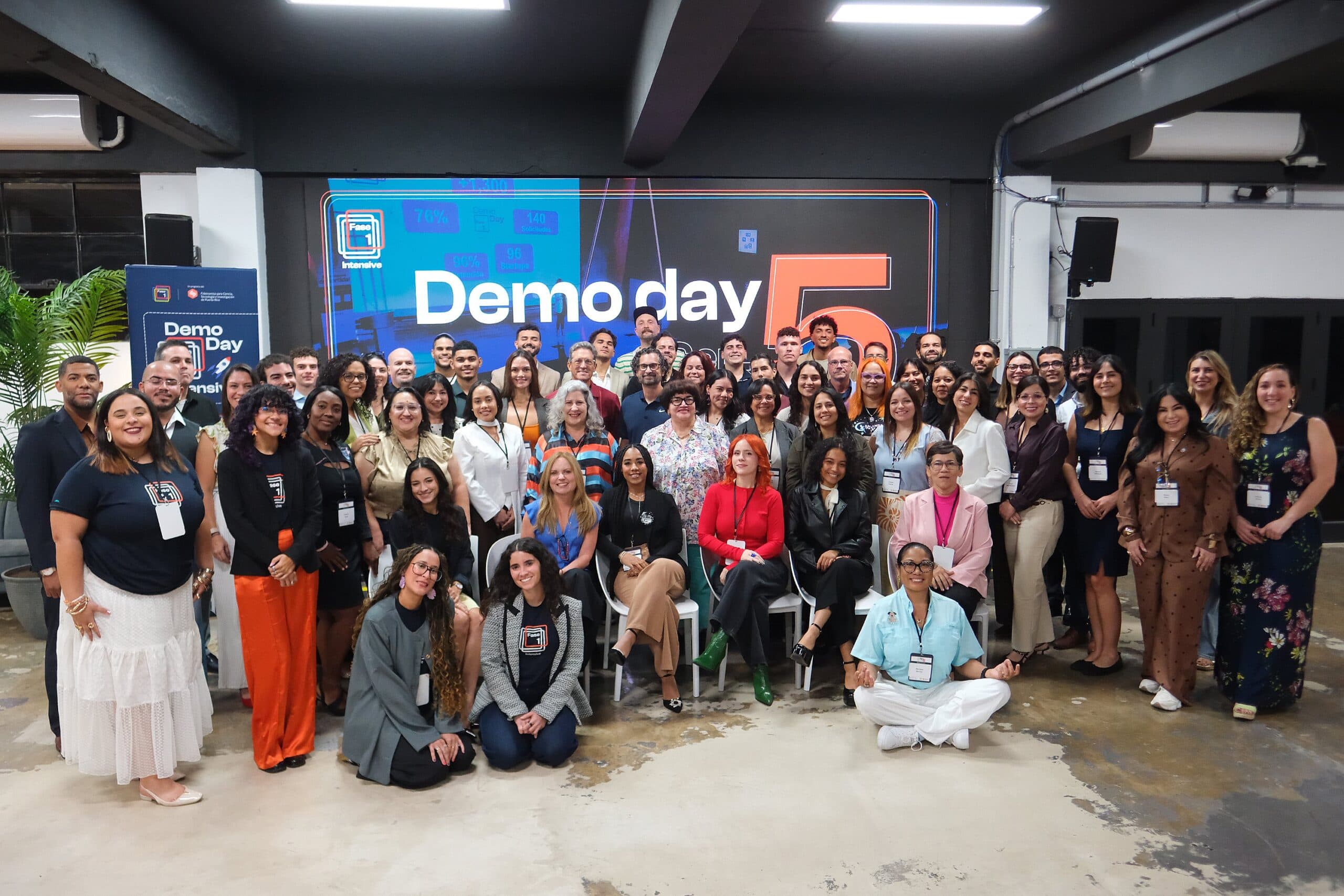
Forty-three founders took the stage Saturday at El Studio in Downtown Cupey for Demo Day, the close of the fifth cohort of Fase1 Intensive, the 12-week incubator run by the Puerto Rico Science, Technology and Research Trust.
In four minutes each, they pitched products, services and apps in manufacturing, information technology, tourism and hospitality, education, health care, agriculture, arts and culture and the creator economy, competing for $11,500 in prizes.
The cohort’s 49 participants come from 46 of Puerto Rico’s 78 municipalities, according to the Trust, up from 19 municipalities in the fourth cohort a year earlier. Women make up 57% of the group, and 53% meet the U.S. Department of Housing and Urban Development’s definition of low- and moderate-income individuals.
Small as the ideas are, they sit at the start of the pipeline CB described in September, when our headline read that Puerto Rico’s next big employers will not just arrive by plane but will grow from homegrown firms that start with a few employees and scale into global exporters.
Read against CB’s recent reporting on jobs, incorporations, remote work and taxes, the fifth cohort shows where that pipeline is widening, and where it still narrows.
“Fase1 is an important part of our entrepreneurship pillar because it makes that first step more accessible,” said Lucy Crespo, chief executive officer of the Trust. “In doing so, we are strengthening an ecosystem that supports entrepreneurs from their earliest stages and creates a pathway for continued growth.”
A cohort that looks like the new economy
The sectors in the room track where the economy is already adding activity. The visitor economy has overtaken manufacturing as the largest source of direct employment, according to a recent Foundation for Puerto Rico analysis, and the creative industries generate about $8.7 billion a year and support more than 87,000 jobs, according to Puerto Rico Creativo, as CB reported in September and October. Manufacturing, meanwhile, is drawing reshored investment that pays nearly double the island’s average wage.
New businesses are forming at a faster clip. The state registered 27,439 new corporations in fiscal 2026, up 16.9%, and the Economic Development Bank estimated in 2022 that about two in 10 labor-force participants had created their own source of income, the highest level in 40 years.
Coworking operators told CB in October that independent professionals, startup teams and creators are filling their desks and meeting rooms, from Santurce to Dorado.
The cohort spans every stage of that formation. About 37% of participants started with a basic idea, 30% had a basic prototype and 23% had already launched a product or service, according to the Trust.
“In just 12 weeks, I was able to complete the first version, and I’m already working on the second version of the platform I’m developing,” said María Rosa Puras, founder of Oye Boricua.
The top prizes went to Stratum, founded by Jovaniel Rodríguez and Génesis Rodríguez, which won the $2,000 Innovation Award, and to Nubody, Yenssi Uffre’s venture, named Overall Favorite. Tónica, led by Nayla Bezares, took a Best Pitch award and a $1,500 prize from an anonymous donor. Since 2021, Fase1 Intensive has supported 232 startups directly.
“If you have a business idea and don’t know where to start, Fase1 can help you learn, connect and validate your concept.”
Bárbara Rivera Chinea, Fase1’s program director
Reaching beyond the metro area
The jump from 19 to 46 municipalities matters because demand is not spread evenly. ManpowerGroup’s survey for the fourth quarter of 2026 puts the net hiring outlook at 43% in the metro region and 42% in the central region, against 32% in the east, 28% in the north and 23% in the south, as CB reported in September.
Founders outside the metro area are building where local demand is thinnest, which makes reaching customers beyond their own towns more important from the start.
Part of that reach is digital. Fase1 Lab, the program’s online academy, offers 12 free Spanish-language modules around the clock and has more than 2,700 users, and it is the first step to apply to the intensive program.
“If you have a business idea and don’t know where to start, Fase1 can help you learn, connect and validate your concept,” said Bárbara Rivera Chinea, Fase1’s program director.
Federal recovery money underwrites much of this scaffolding. Fase1 is part of the Puerto Rico Department of Housing’s Small Business Incubator and Accelerator Program, funded through the federal Community Development Block Grant for Disaster Recovery (CDBG-DR), which is why the cohort is measured against HUD’s income definitions.
The program turns hurricane-recovery dollars into business education in towns that large employers rarely reach.
Households are already stretched, with consumer prices up 3.8% in September from a year earlier, as CB reported Nov. 4.
The tax code also points outward. Under the Act 60 incentives code, qualifying companies that export services can be taxed at 4%, while a regular corporation selling to the local market can face a top rate of 37.5%, a gap the CPA study says decides which investments are profitable and leaves local retailers and service firms at a disadvantage.
The Government Accountability Office counted 3,899 export-services decrees granted from 2012 through 2024, as CB reported in October.
The Trust’s own ladder leads in the same direction. Parallel18’s Xpand program, subsidized by Banco Popular, accelerates Puerto Rican companies that have an active export strategy and either more than $250,000 in sales or a prior accelerator under their belt, according to Parallel18.
The latter counts more than 500 startups operating in Puerto Rico, nearly 40% founded since 2020, and their median revenue rose from $75,000 in 2022 to $500,000 in 2024. Apps and platforms like several of those pitched Saturday can sell beyond the island from the first version.
Where the pipeline narrows
The step that creates jobs is the one from micro to small. ManpowerGroup found the strongest hiring intentions at companies with 10 to 49 workers, at 55%, against 17% for microbusinesses with fewer than 10.
Most Demo Day ventures are one- or two-person operations, so their value as employers depends on how many make that jump.
The obstacles are well documented. In Colmena66’s 2025 survey of 555 entrepreneurs, a convenience sample, 44% named seed capital as an obstacle, 31% funded their businesses from personal savings, 26% waited more than six months for permits, 63% cited inconsistent electricity and 76% cited inflation. The largest single prize Saturday was $2,000.
“Fase1 is an important part of our entrepreneurship pillar because it makes that first step more accessible,” said Lucy Crespo, chief executive officer of the Trust. “In doing so, we are strengthening an ecosystem that supports entrepreneurs from their earliest stages and creates a pathway for continued growth.”
Taken together, the fifth cohort shows a pipeline that is wider and more geographically diverse than it was a year ago, and an economy whose growth now depends on many small bets rather than a few large announcements.
What happens next depends less on Demo Day than on the steps after it: seed capital that reaches founders outside San Juan, permits and power that let a two-person venture hire its tenth employee, and a tax structure that, for now, rewards those who look beyond the island first.
Thirty years after Ricky Adsuar founded it, Grupo Guayacán runs six local funds, a mentoring push for companies past the startup stage and a board that now includes banking and philanthropy leaders