Remote and Flexible Work Spreading Across Local Economy, Coworking Spaces Racing to Meet Demand
Hybrid employees of established companies, a growing self-employed and startup class, and creators are filling meeting rooms, sparking Piloto 151’s latest expansion
Remote work is no longer a pandemic holdover in Puerto Rico. It has spread through the economy in several directions at once: employees of established companies on hybrid schedules, self-employed professionals and small-business owners, creators who produce content for brands, and out-of-state workers who base themselves on the island.
All need somewhere to meet, work and produce, and the flexible workspace industry is expanding to supply it.
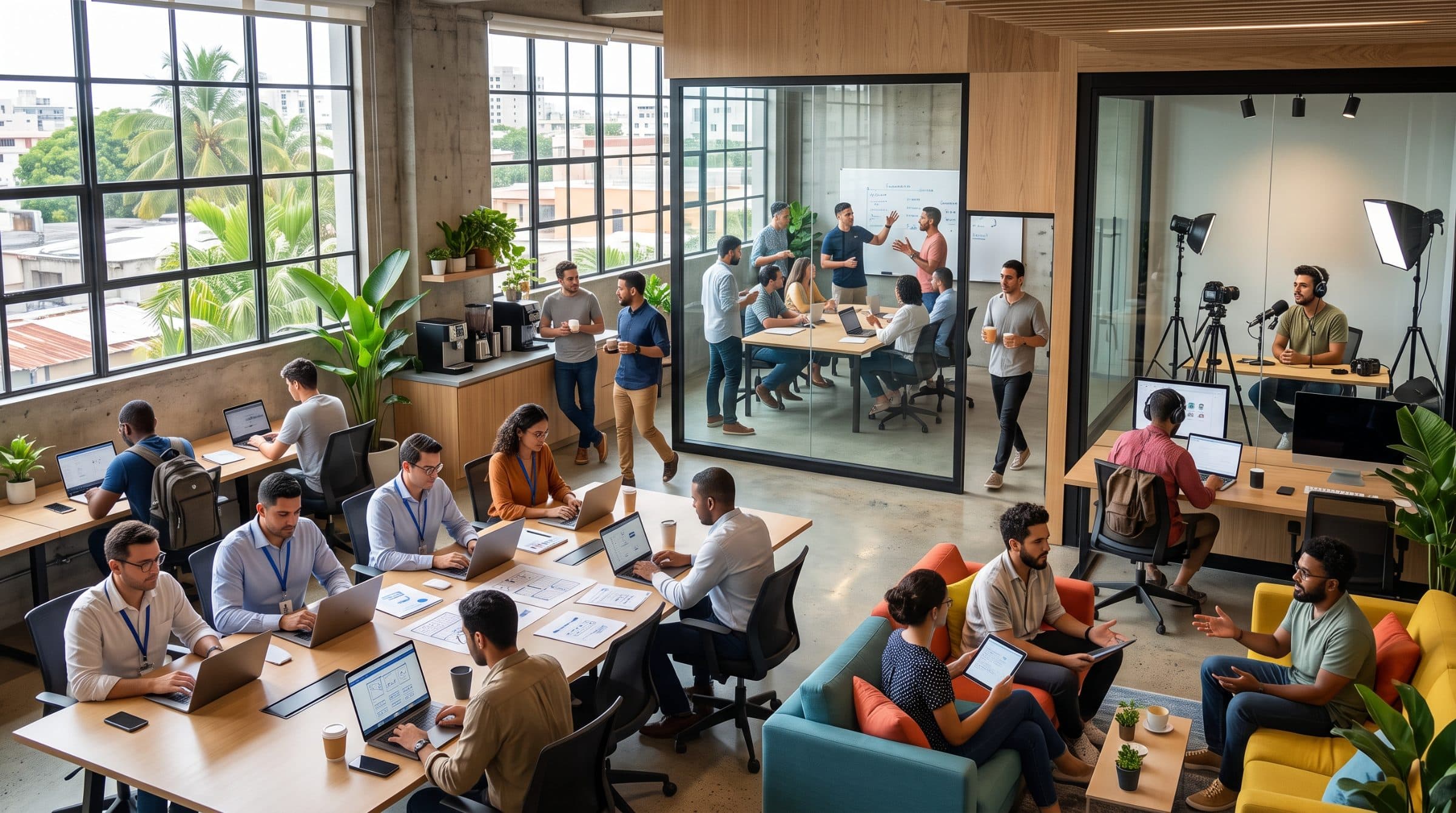
The latest example is Piloto 151, which announced Salon Memberships, monthly access to its network of nearly 20 conference rooms seating from four to 75 people, and Piloto Studios, new photography and podcast studios in Santurce available by membership or by the hour. A company statement said the services continue its evolution “beyond traditional coworking.”
The trend has two distinct strands, per an exclusive analysis by Caribbean Business. One is the mainstreaming of remote work among employees of established companies, which is less diversification than a change in how existing jobs are done.
The other is the growth of self-employment and new businesses across many industries, which is diversification in the plainest sense, a trend this newspaper is following closely. The available evidence suggests the second is behind most of the new demand for desks.
Piloto 151 is responding to the growth of coworking in Puerto Rico by adding Piloto Studios in Santurce, featuring photography and podcast facilities. Piloto’s other recent addition is Salon Memberships, with new conference-room options. Pictured is the firm’s Santurce Parada 18, from the company’s website.
Remote work goes mainstream
U.S. Census Bureau data show the share of Puerto Rico workers who mainly work from home rose from 2.4% in 2019 to 7.4% in 2021 and stood at 5.9% in 2022, compared with 15.2% for the United States that year. Research provided by Piloto CEO and cofounder Sofía Stolberg, based on the Census Bureau’s Puerto Rico Community Survey, puts the 2024 share at about 6%, or roughly 63,000 people.
That is a narrow measure, Stolberg said. The figure “only counts those who work from home most of the week. It excludes hybrid and occasional remote workers, coworking members, visiting digital nomads, and companies bringing distributed teams to the island.”
When we add those missing pieces, a more complete picture emerges. A publicly reported study by Aon found that 49% of Puerto Rico companies had adopted hybrid models by 2024 and 1% were fully remote. Of the 17% of office-based companies planning to change their work model, nearly 80% wanted hybrid.
For those employees, the need is a place to meet colleagues and clients, not a permanent desk. Stolberg made that point when Piloto announced its Milla de Oro location in 2024, when she was quoted publicly as saying that “as more companies adopt hybrid models, we created this space with both startups and larger teams in mind.”
A self-employed and small-business wave
The Economic Development Bank for Puerto Rico (EDB) said in 2022 that about two in 10 people in the labor force had created their own source of income, the highest level in 40 years. Newer figures are scarce, but other indicators point in the same direction.
Colmena66’s network reported 22,100 jobs created and 10,100 businesses created, launched or scaled in 2024, and says it has directly served more than 21,000 entrepreneurs, as CB has reported in this article. The state registered 27,439 new corporations in fiscal 2026, up 16.9%.
The growth of startups on the island, led by Colmena66, Parallel18 and the broader Puerto Rico Science Trust ecosystem (pictured here at a recent Colmena BE Fest annual event), is one of the primary drivers of coworking demand in Puerto Rico.
Parallel18’s ninth-year impact report counts more than 500 active startups in Puerto Rico, nearly 40% of them founded since 2020, with median revenue rising from $75,000 to $500,000 between 2022 and 2024. Many such firms cannot justify a lease but need a desk, and a conference room for investors, clients and hires.
Creative work is part of the mix. Puerto Rico Creativo says the island’s creative industries generate $8.7 billion a year and support more than 87,000 jobs, as CB reported September 2.
Nationally, Upwork’s 2026 Future Workforce Index found that 38% of skilled knowledge workers freelance, up from 28% a year earlier, and 58% of full-time workers are considering it.
Flexible space fills the gap
The pattern is visible across other coworking operators, as well. Mosaico Cowork, a 3,000-square-foot space in Santurce that opened in 2025, says its conference room is its most in-demand space, ahead of its recording studio and offices, according to published reports. Saffra Cowork on Kennedy Avenue counts Grainger, Kellogg’s, General Mills and Nielsen among its members, and Atelier CoWo says its private offices are full, according to the same reports.
Then there are the content creators and their need for creative studios. Edison Research’s 2026 Infinite Dial found that 57% of Americans 12 and older have both listened to and watched a podcast, according to information supplied by Piloto 151’s Stolberg.
Piloto has expanded to match. According to published reports, it invested $2.5 million in a 28,000-square-foot Milla de Oro location at Plaza 273, announced in October 2024, and $900,000 in a 7,000-square-foot Dorado space that opened in April 2025. Its website now lists six workspaces plus Piloto Venues.
The growth is also evident when looking at the more traditional office market. Cushman & Wakefield puts San Juan office vacancy at 12.85% at the end of the first quarter of 2026, with Class A at 7.07%, the lowest in eight quarters, and asking rents at $20.91 per square foot.
Caribbean Real Estate Services reported that office availability fell from 21.5% to 17.5% in the first quarter of 2025 and leasing rose nearly 150%, with coworking growth a major driver.
As quality space tightens and rents rise, flexible space becomes a hedge for companies that want a professional address without a long lease. That is CB’s analysis, not a finding by either firm.
Visitors, decree holders and creators
Yet another source of growth comes from Stolberg’s mention of uncounted workers, which include those under Act 27-2024. The latter exempts out-of-state workers who move to Puerto Rico to work remotely for covered employers from local labor laws. The Government Accountability Office counted 5,852 resident investor decrees and 3,899 export-services decrees granted from 2012 through 2024.
Business travel adds another layer. Discover Puerto Rico reported demand for 257,496 room nights from event participants in fiscal year 2024-25, with an estimated $165 million in economic impact.
Then there are the content creators and their need for creative studios. Edison Research’s 2026 Infinite Dial found that 57% of Americans 12 and older have both listened to and watched a podcast, according to information supplied by Stolberg.
An even clearer picture emerges
Reliability may be part of the draw. In Colmena66’s 2025 survey of 555 entrepreneurs, as CB reported, 63% cited inconsistent electric service and 41% had no alternate power source, pointing to the need for resilience as an addition driver behind the coworking surge.
The mix of members would add to the picture, or how many coworking members are independents, startup teams or employees of larger companies. That split would show how much of the growth is diversification and how much is the mainstreaming of remote work.
Either way, the direction is clear. Puerto Rico’s work is moving out of the traditional office and into a mix of homes, hybrid schedules and shared spaces, and the businesses that supply those rooms, desks and studios are growing with it.
Marking 20 years in Puerto Rico, the company invested $650,000 in a new facility, restoring operations nearly eight years after its previous location was destroyed by Hurricane Maria.