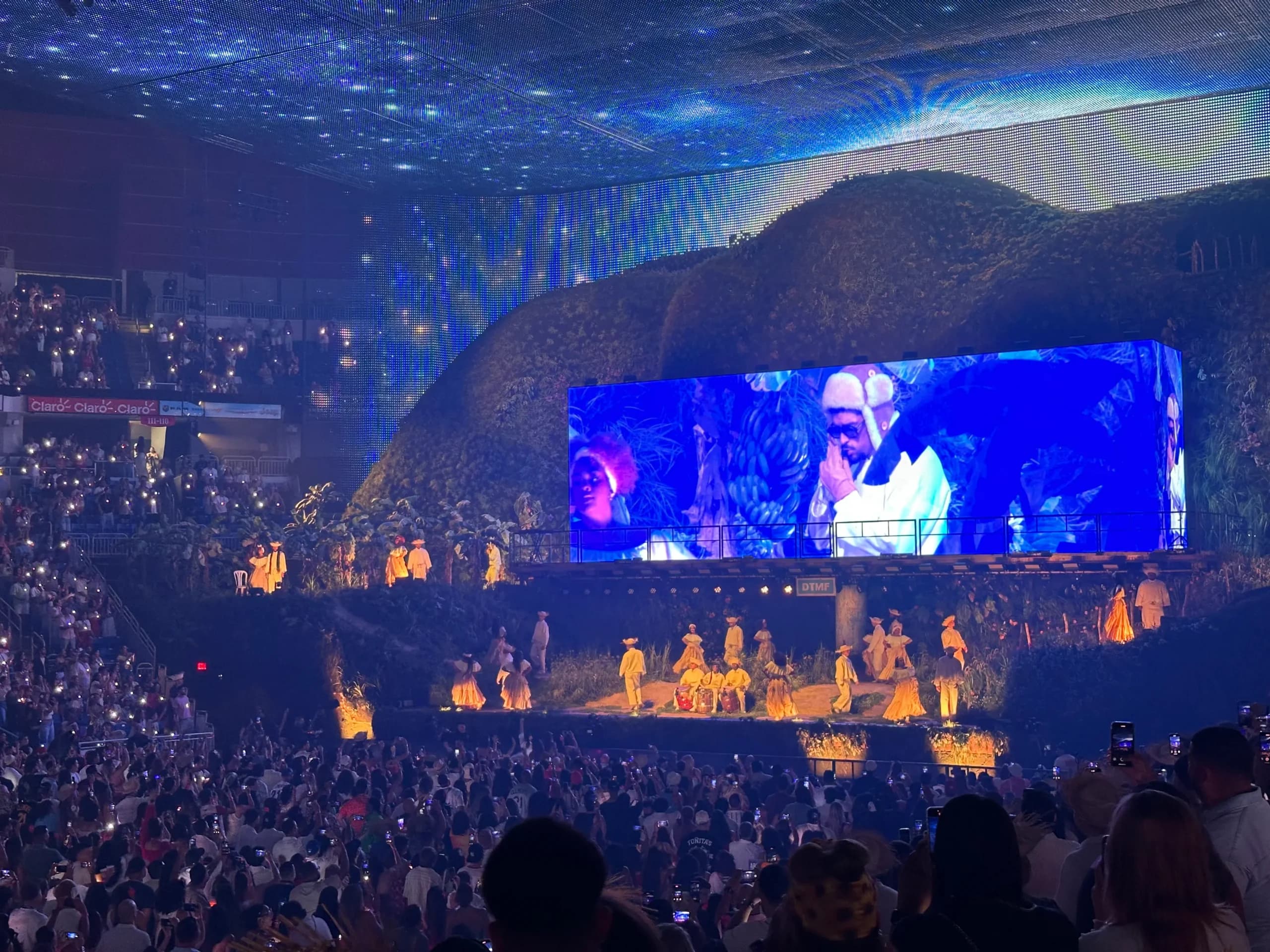
Puerto Rico’s creative industries generate $8.7 billion a year, support more than 87,000 jobs across roughly 4,125 businesses, and helped turn a three-month concert residency into one of the largest economic events in the island’s recent history.
By the account of the people who study the sector most closely, none of that is the hard part anymore.
“We’ve been doing this work in Puerto Rico for over 20 years now,” said Ricardo Burgos, cofounder of Puerto Rico Creativo, a research and advocacy organization focused on the sector. “We’ve been advocating for this among various [actors] and government agencies, especially those involved in Puerto Rico’s economic development.”
The obstacle, Burgos and cofounder Dyanis De Jesús argue, was never proving the island has creative talent. Bad Bunny’s “No Me Quiero Ir de Aquí” residency showcased that part, with estimates of its direct economic impact ranging from $200 million to $713 million, the high end modeled by Gaither International, with Moody’s Analytics landing near $250 million and roughly 600,000 attendees.
Ricardo Burgos
What’s missing, the cofounders say, is the machinery to convert that proven capability into a durable industry, one where government, academia and the private sector work from a single plan instead of three separate ones.
Beyond the music
Music remains Puerto Rico’s clearest example of global creative reach, and the island has the numbers to prove it. It became the world’s seventh-largest music-exporting country or jurisdiction in 2025, ahead of Brazil, Sweden and Japan. But Burgos was quick to frame music as the visible tip of a much larger industry.
“Countless things go into creating a musical product, and in many ways, these are also connected to the creative industries,” he said.
Composers, recording studios, video producers and social-media professionals all feed into a single song, and the same pattern holds for film, where dozens of creative professions converge to produce one movie or documentary.
That spillover, he argued, is why the sector shouldn’t be treated as a niche. “Creativity impacts every sector of the economy. There isn’t a single business or industry that doesn’t require some kind of creative service to raise its profile, stand out, and differentiate itself from the competition.”
Dyanis De Jesús
He pointed to coffee as an unlikely example: Puerto Rico grows a high-quality bean, he said, but without product design, branding and a promotional strategy behind it, “you won’t succeed with an agricultural product” in global markets.
He cited one Puerto Rican company that expanded into 16 Latin American countries while running its content strategy entirely from the island.
What Nashville and Medellín figured out
Two enlightening examples stand out. Nashville’s music industry, built around the dense commercial infrastructure of Music Row, generates a $10 billion annual economic impact and employs musicians at a concentration more than double Los Angeles’ and triple New York’s, according to the Nashville Area Chamber of Commerce.
The average music-industry job there pays $72,382 a year. That gap matters directly to Puerto Rico’s talent-retention problem. Burgos cited a study commissioned through the Puerto Rico Science, Technology and Research Trust showing musicians and other creative professionals here earning roughly half to two-thirds less than their U.S. counterparts, a figure CB was unable to independently verify in full but that is directionally consistent with Nashville’s premium wages.
Colombia offers a closer parallel in both timing and scale. Its national audiovisual incentive law, passed in 2012, predates Puerto Rico’s Law 173 (today Chapter 9 of the Act 60 Incentives Code) by two years, yet has since supported more than 130,000 direct jobs and roughly $449 million in verified production investment nationally.
Medellín built its own layer on top of that federal framework: a city-run film commission with its own cash-rebate incentive, now folded into a broader Creative Industries Cluster that deliberately links audiovisual production to the city’s tourism, digital-business and fashion clusters.
In its most recent funding round this year, the city fielded 133 applications, a 10 percent jump over all of 2025, for productions spanning film, series, animation and video games.
Neither Nashville nor Medellín got there by discovering talent Puerto Rico lacks. They got there by building the coordinated infrastructure, and the patient public investment, to keep that talent working locally.
The coordination problem
De Jesús said Puerto Rico has made genuine progress on the recognition side, strengthening academic programs and creating incentives for professionals to return to the island.
The next stage, she said, is folding that talent into the industries Puerto Rico is already trying to grow, particularly software, digital services, video games and audiovisual production.
“Puerto Rico has untapped potential for exporting digital services,” she said. “We offer greater specialization; it’s not the cheap labor that India or Latin America might provide, but rather a specialized workforce that understands both international and Latin American markets,” an edge she said is especially relevant to Hispanic markets in the U.S. and to Europe.
But neither cofounder believes Puerto Rico has assembled its pieces into a strategy. “In a post-Bad Bunny Puerto Rico, we’re ready for phase two,” De Jesús said, arguing the moment requires government, academia and private organizations to work in sync in a way they currently don’t.
She argued for narrowing focus rather than spreading resources across the entire sector. “Successful countries have a clear focus. We have enough information to say one, two, three, which three are we going to prioritize?”
Burgos suggested Puerto Rico’s Secretary of Economic Development is positioned to convene the relevant players.
“The strategy must be one in which all sectors come together in unison. We haven’t seen the private sector, the government and academia sitting down at the same table to discuss this issue,” he said.
De Jesús said the groundwork already exists. “We have the pieces, we have the master plan, but we haven’t made that final decision on how to get it off the ground.”
Freelancers, AI and a workforce hard to measure
Much of Puerto Rico’s creative workforce operates independently, a global trend De Jesús said the island needs to address by helping freelancers scale into employers.
“How do we promote the growth of creative businesses?” she posits. “By helping that freelancer, who is a graphic designer, suddenly become a real, established studio that starts hiring other creatives.”
Burgos tied the freelance pattern to limited local demand: “They go from one project to the next. Going from one project to the next, you can’t start a company.” More investment from every sector, he argued, would help freelancers formalize into corporations, particularly as more creative services are exported abroad.
Artificial intelligence complicates that math further, Burgos said, by making solo work more productive and, potentially, more attractive than building a company. “Why would you start a company just to deal with all the red tape, taxes, financial reporting, when you can do it efficiently without losing your freedom or your flexibility?”
Rather than discourage freelancing, both cofounders said Puerto Rico needs better tools to measure its economic footprint. “These are trends we’re overlooking,” De Jesús said. “We won’t be able to see the growth, the activity, or the economic impact.”
An outdated law, not a new one
Much of the conversation returned to Chapter 9. Burgos, who said Puerto Rico Creativo was involved in drafting the original Law 173, argued that much of what the law envisioned was never implemented.
It called for a $1 million allocation to develop the sector, a figure confirmed in the statute’s text, and for Puerto Rico to host an international creative-industries conference. “It has never taken place,” he said.
The law also called for creative-industry clusters and a dedicated office within the Department of Economic Development that, by Burgos’s account, never fully materialized either.
Neither cofounder wants new legislation. “We don’t need a law,” Burgos said. “What we need, honestly, is a Department of Economic Development that takes decisive and comprehensive action.”
De Jesús agreed the moment calls for execution over planning: “It’s time to see some action and put action plans aside.” Integrating the creative industries more directly into the island’s broader economic-development plans, she said, would be a bigger step forward than revisiting the statute itself.
Scaling the residency model
Burgos wants Bad Bunny’s residency treated as a template rather than a one-off. “Imagine if there were 20 residencies here each year, lasting three days, four days, a week, or a month, depending on the artist and what draws people in,” he said, describing an ecosystem where “restaurants benefit, tour companies benefit, hotels benefit, Airbnb hosts benefit, artisans benefit, and so on down the line.”
He sees the same logic applying to other creative sectors, pointing to video games, animation and music for film and television, as areas where Puerto Rico could build specialized hubs, the way Medellín has done with targeted incentives for its own animation and gaming projects.
Asked what progress would look like five years from now, Burgos returned to coordination. He wants to see the private sector, academia and government in active, sustained dialogue on strategies that promote Puerto Rico as a creative destination and highlight the export potential across sectors.
“Our preferred measure of success is hosting the international creative-economy conference,” he concluded. “In five years, we should be looking at what partnerships and alliances we have established between sectors, how universities are delivering the talent with the right competencies needed, how the local industry is leveraging this talent, the results from the current incentives from DDEC, and developing better metrics overall for the creative industries and freelancers.”