As Puerto Rico Races to a $14 Billion Visitor Economy, Rebook Bets on Decentralized Industry Leadership
A unified independent-hospitality movement is positioning itself to shape how the island distributes visitation beyond traditional attractions toward island-wide experiences
As Puerto Rico’s visitor economy surges toward $14 billion by 2030, propelled by last year’s record 8.1 million visitors and the Foundation for Puerto Rico’s call for island-wide experience distribution, the Rebook Hospitality Conference is positioning itself as the platform where independent operators, tourism businesses, and ecosystem partners align around that decentralization strategy.
The conference, scheduled for September 29 and produced by Incube Events, debuts a significantly expanded format that reflects how far Puerto Rico’s tourism landscape has evolved.
What began as a gathering for short-term rental operators has now widened to include boutique hotels, paradores, bed-and-breakfasts, agricultural tourism projects, restaurants, bars, tour operators, wellness providers, and cultural institutions.
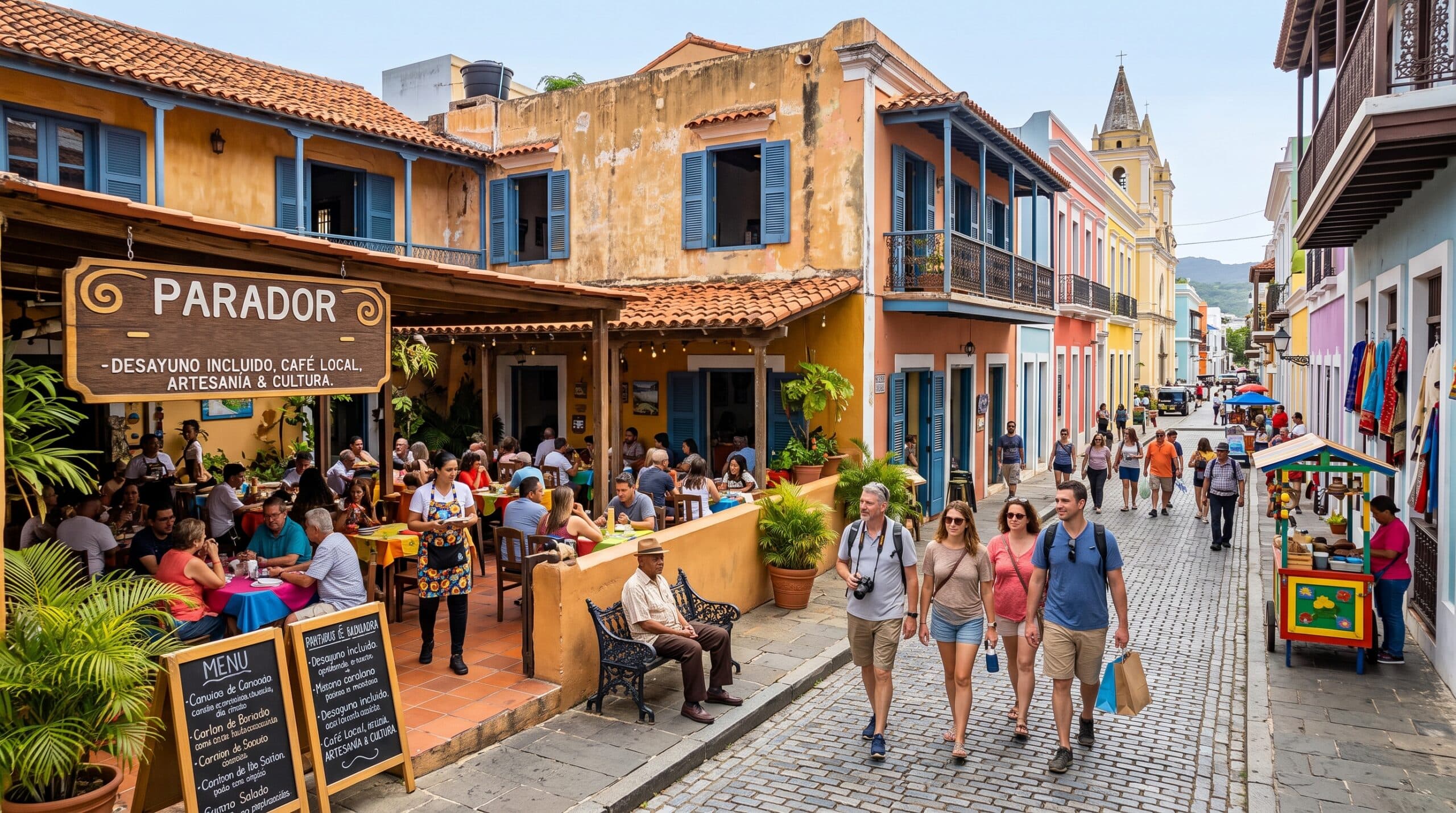
The expansion signals a unified movement toward distributed tourism leadership, one where independent players collaborate across sectors to capture visitor spending throughout the island, as depicted in the hypothetical community in the image above, rather than concentrating it in traditional tourist corridors.
“This year we’re adding hotels, paradores, bed and breakfasts, fincas with hospedería, restaurants, bars, tour operators, everything that surrounds the tourist experience,” said Pedro Fernández, the event’s producer.
“The idea is collaboration. We can’t keep seeing hotels on one side, paradores on another, and short-term rentals on another. If we’re competing separately, we lose. If we’re collaborating, we shape the future.”
That collaborative vision aligns directly with the Foundation for Puerto Rico’s late-2025 analysis, which identified decentralization as critical to Puerto Rico’s tourism competitiveness.
Short-term rentals now represent roughly 47% of the island’s total lodging inventory, a scale that enabled last year’s record visitor numbers and a $7.8 billion direct spend.
Per the Foundation for Puerto Rico’s recent study, distributing visitation across the island eases the pressure on Old San Juan, Condado and El Yunque, and is essential to maximizing economic benefit and ensuring tourism’s sustainability.
New Tech, Cross-Sector Collaboration
One of the most notable Rebook debuts is the launch of Liberty, a new digital directory service designed specifically for independent properties. The platform will allow boutique hotels, paradores, bed-and-breakfasts, and short-term rentals to offer guests personalized on-screen guides with local recommendations, nearby restaurants, transportation options, and curated experiences.
“It’s a new service Liberty is launching at the event,” Fernández said. “We’re going to have demos on site, and the public will have access to these digital directories that connect guests with their surroundings.”
The Liberty platform exemplifies the conference’s broader positioning: providing independent operators with technology and knowledge that lets them compete against large chains by offering what chains cannot: authentic, localized, community-connected experiences.
Another potential landmark is the presentation of a major new study on Puerto Rico’s short-term rental sector. Fernández confirmed that Viva Short-Term Rental Alliance and the Puerto Rico Tourism Company recently completed an extensive industry analysis, with organizers awaiting confirmation on whether findings will be unveiled at Rebook.
If presented, it would mark the first public release of data that could reshape the policy conversation around independent lodging.
International Expertise on Experience-Driven Hospitality
The conference will feature tourism strategist Dolores Semeraro as an international keynote speaker, whose work spans Asia, the Maldives, Italy, Germany, and Latin America. Her session will focus on the competitive advantage of experience-driven hospitality, an increasingly central theme for Puerto Rico’s independent operators.
Semeraro’s expertise is particularly relevant as travelers worldwide shift away from traditional luxury toward meaningful experiences rooted in culture and authenticity. Fernández sees Puerto Rico’s independent sector as uniquely positioned to deliver that value.
“If we’re competing separately, we lose. If we’re collaborating, we shape the future.”
Pedro Fernández
“Global travelers increasingly prioritize meaningful experiences over traditional luxury,” Fernández said. “Even sleeping well is considered a luxury today. You don’t need something ostentatious. You need something that makes you feel good. Puerto Rico’s independent operators are uniquely positioned to deliver experiences rooted in culture, community, and authenticity, elements that large chains often struggle to replicate.”
Gastronomy as a Tourism Asset
Food and beverage will also take center stage, with a dedicated session featuring some of Puerto Rico’s most celebrated culinary leaders: Natalia Vallejo of Cocinando al Fondo, Wilfredo Torres of Furtivo, and Roberto Perdecía of La Factoría.
Gastronomy has become one of the island’s strongest tourism assets, with James Beard finalists and global bar rankings elevating Puerto Rico’s profile. Fernández highlighted how awards and competitions help attract travelers on merit alone.
“We want to show how exposure, awards, and competitions help elevate Puerto Rico’s gastronomic and tourism profile,” he said. “While Puerto Rico’s beaches remain a major draw, the island must compete not only on natural beauty but on the experiences built around it.”
The conference will explore how independent operators can integrate design, storytelling, and curated activities to differentiate Puerto Rico from competing destinations like the Dominican Republic, Mexico, or Colombia.
Structural Challenges: Access, Capital, and Market Diversification
Despite its momentum, the independent hospitality sector faces structural challenges that Rebook aims to address.
Puerto Rico continues to rely heavily on U.S. travelers, a vulnerability in a competitive Caribbean market. “Tourism needs more air routes and new markets,” Fernández said. “We can’t depend on the same visitor profile forever.”
Fernández acknowledged concerns around housing affordability but argued that short-term rentals are one piece of a broader economic puzzle.
Access to capital remains a major hurdle for small operators, whether converting a home into a bed-and-breakfast or developing a boutique hotel. Rising construction costs, municipal taxes, and regulatory delays have slowed new development.
The conference will include sessions on financing models and community-aligned development, including insights from Iván Zavala of Grupo Inrialta, known for projects like Don Rafa Hotel.
Fernández acknowledged public concerns around housing affordability and gentrification but argued that short-term rentals are only one piece of a broader economic puzzle. Puerto Rico’s population decline, construction costs, and bureaucratic barriers play larger roles in limiting housing supply.
“Still, the conference aims to foster dialogue about responsible development and community integration,” he said.
A Unified Force Shaping Tourism’s Future
At its core, Rebook Hospitality Conference 2026 seeks to position Puerto Rico’s independent hospitality sector as a unified force capable of shaping the island’s tourism future. As the Foundation for Puerto Rico emphasized, distributing visitation across the island, away from Old San Juan, Condado, and El Yunque, is essential to maximizing economic benefit and ensuring tourism’s sustainability.
Fernández sees the event as a space where operators can learn, connect, and build resilience in an increasingly competitive global market.
“This industry generates most of the room nights and most of the tourism jobs in Puerto Rico,” he said. “Independent operators need to collaborate, share knowledge, and face challenges together. That’s what this platform is for.”
With new technologies, new sectors, new data, and international expertise shaping the conversation, this year’s edition of Rebook signals a turning point, not only for the event itself, but for the broader independent hospitality movement that continues to redefine how Puerto Rico welcomes the world and distributes its tourism benefits across the entire island.