By María Soledad Dávila Calero
With 94% of businesses in Puerto Rico interested in investing in artificial intelligence (AI), according to a V2A survey, the adoption of AI for the business sector is not a question of if, but how.
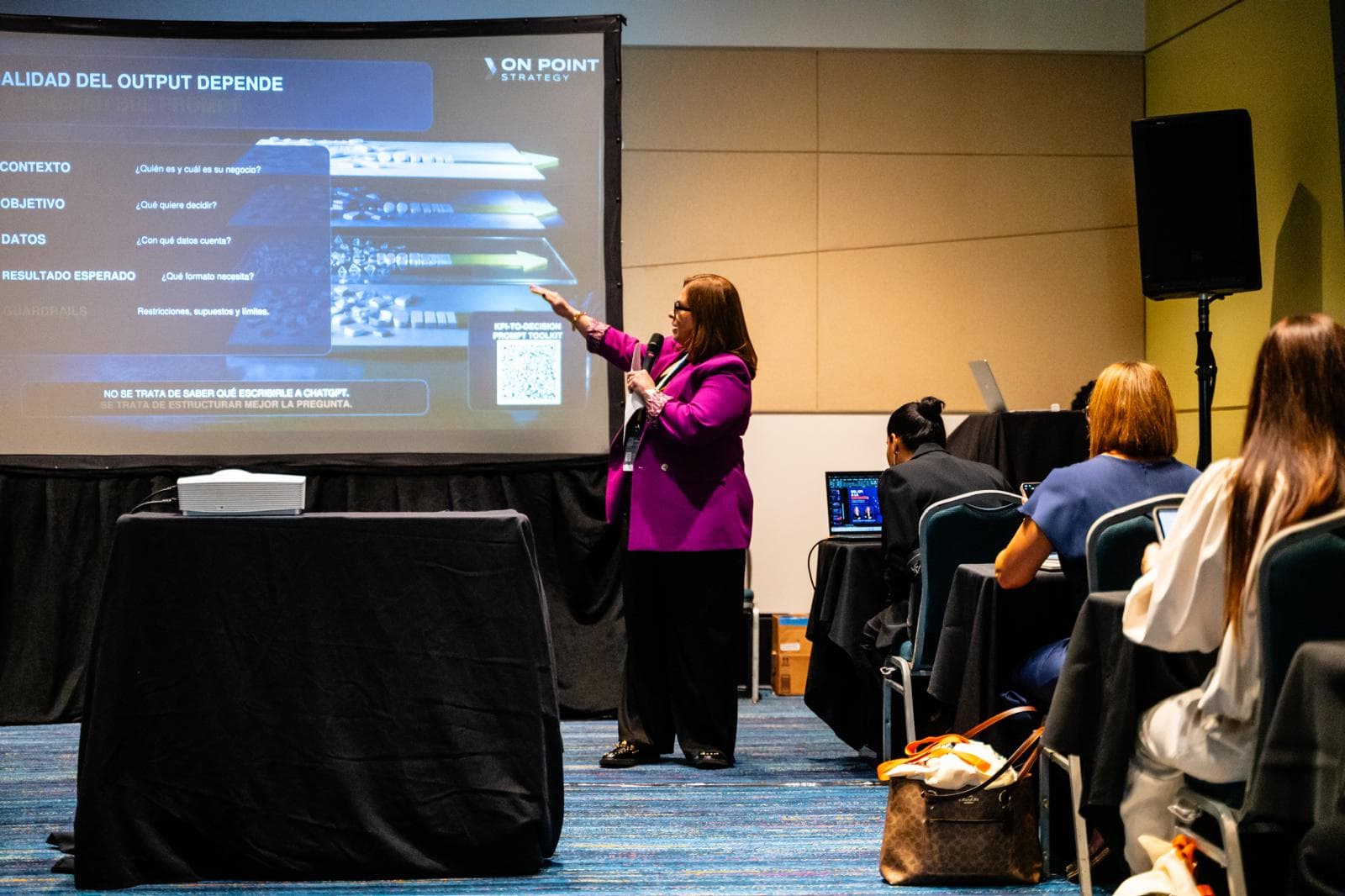
Manuel Calderón, director of the business consulting firm V2A, explained that companies interested in inserting AI into their workflows have to go on a journey that takes them from carrying out simple services that they can buy from other companies, to incorporating more autonomous agentic AI that requires minimal human supervision.
While generative AI can produce answers to questions and create content like text and pictures, agentic AI can be used to take on more complex actions that mimic human decision-making, as well as manage workflows.
Calderón said that many businesses in Puerto Rico have passed the minimal investment stage in AI and now want to have deeper AI integration in their workflows. Businesses looking into AI need to look at what regulations could affect them, what is the “right size” of AI integration for their companies, and what opportunities are available to provide services that are optimized with AI, he added.
For those who are being cautions, Calderón warned, “ this is a process and you have to start learning. Those who fall behind will have a problem… you can’t wait to see what’s going to happen. You have to start trying it out, playing with the technology to understand what you can do with it.”
In the case of Puerto Rico, Calderón explained that he is seeing more enthusiasm from the sales and marketing fields and more resistance from the risk management and human resources areas.
The survey also showed that education, healthcare and pharma, and manufacturing already have high levels of AI adoption. On the tail end of AI adoption are the retail side of the automotive industry and nonprofit sector.
Calderón argued that in the case of selling cars, low AI adoption is due to the type of work they perform, as it is primarily in-person, so there are fewer opportunities to automate. For nonprofits, he said that low AI adoption could be due to size, as many are small organizations.
While this attitude may seem counterintuitive—as AI can be used to simplify workflows or take on tasks that are often outsourced—Calderón explained that “for an organization, the bigger the better because you have more people that could adapt and their functions are more focused. The more sophisticated the personnel, the easier it is.”
Good Regulations May Enable More AI Integration
While AI continues to expand across the board, Calderón pointed out that some industries are concerned about the lack of AI regulations. He explained that the banking and investment sectors, healthcare professionals and attorneys need more regulatory clarity about how to handle sensitive information.
In the meantime, regulations on the use of AI in these industries is being enacted through enforcement in the courts. In February 2026, for example, the U.S. District Court of the Southern District of New York (SDNY) determined that queries or written exchanges using AI that is accessible to the general public—such as ChatGPT or Claude—are not protected under attorney-client privilege or doctrines pertaining to “work product.”
In other words, queries or writing exchanges using AI between a lawyer and his/her client are not considered a private conversation protected under privilege that cannot be subpoenaed. In the case of “work product” that a lawyer creates for litigation, such as a motion or opening statements, which are also usually protected, if AI is used in queries or written exchanges, that protection is gone.
“The SDNY highlighted that communications with AI platforms lack the ‘trusting human relationship’ (known as the “lawyer’s loop”) that privilege jurisprudence requires, and that users of such platforms consent to privacy policies allowing the provider to store, train on, and even disclose user inputs—including to government authorities,” according to a publication by the law firm McConnell Valdés.
Part of the debate around AI regulation is how much should states and territories regulate versus how much should be left to the federal government. While some state legislatures are considering bills to regulate AI software, U.S. President Trump signed the executive order, “Ensuring a National Policy Framework for Artificial Intelligence,” which aims at, among other things, preventing states from enacting particular legislation.
Even among the leaders spearheading the AI revolution— Demis Hassabis from Google DeepMinds, Sam Altman from OpenAI, and Dario Amodei from Anthropic— there is disagreement about what would be the right level of regulation that won’t stifle innovation but also recognizes the impact that AI could have on different sectors.
Rightsizing AI
Beyond the realm of regulations, most companies continue to look at ways to integrate AI into their workflows. Calderón explained that companies need to carefully analyze what is the right level of AI integration that they need.
“There’s a bit of anxiety regarding this topic. Like ‘I need to do something, but what do I have to do? How do I insert AI?’ I think that is not the correct approach. The right approach is to ask what do I have in my organization that I could improve or that I need to improve,” he said.
“It’s not a solution in search of a problem. It should be a problem in search of a solution,” Calderón added.
The V2A director explained that companies can first start with pre-packaged solutions within existing software, such as Oracle, which already prepares modules using AI to address the issues that commonly arise, such as timekeeping.
The next layer, Caldern explained, is bringing in an expert or consultant, like V2A or another consulting firm, that will create more tailored solutions. The third level of AI integration is for companies to have staff within their teams who can design and deploy needed solutions in- house.
“The larger the problem and the more it is entangled with legacy systems— like accounting or customer service, to your clients’ platforms— then you have to be more careful and you should probably look for someone who can help you build it and attach it [to your systems],” he said.
Preventing Negative Consequences Among Staff
It is important for companies to find the right level of AI integration that is within their budgets and to identity the specific AI tasks that will actually improve their employees’ workload rather than add stress, other studies indicate.
Recent Harvard Review research coined the term “brain fry” to describe when employees end up more exhausted by AI than they were from their previous routines. The two problems that can arise are feeling burned out with work, which is described as constant stress and negative emotions towards work, and mental fatigue.
Burnout can occur when AI is used to produce too much multi-tasking roles for employees. Mental fatigue can happen because the tasks that are left for employees to perform are too mentally taxing.
Several studies have pointed out that humans cannot do prolonged hours of work that implies a heavy cognitive load, day-in and day-out. Instead, our brains need to oscillate between tasks that vary in how taxing they are for our brains.
The other issue to understand when designing workflows with AI is cognitive offloading, which is when a person delegates too much of their thinking to AI and the person is not engaged enough with the task at hand.
Anthropic, the AI company with the second highest valuation, published a paper that showed too much reliance on AI can reduce a person’s ability to understand the task.
“We found that using AI assistance led to a statistically significant decrease in mastery. On a quiz that covered concepts they’d used just a few minutes before, participants in the AI group scored 17% lower than those who coded by hand,” said Anthropic when the findings of the research were announced.