Applied AI Software Has Become a Big Deal, and One Local Firm Is Diving In
On Point Strategy’s new IVH dashboard drops Puerto Rico into a $60 billion global business-intelligence market and contributes to the emerging model for the island
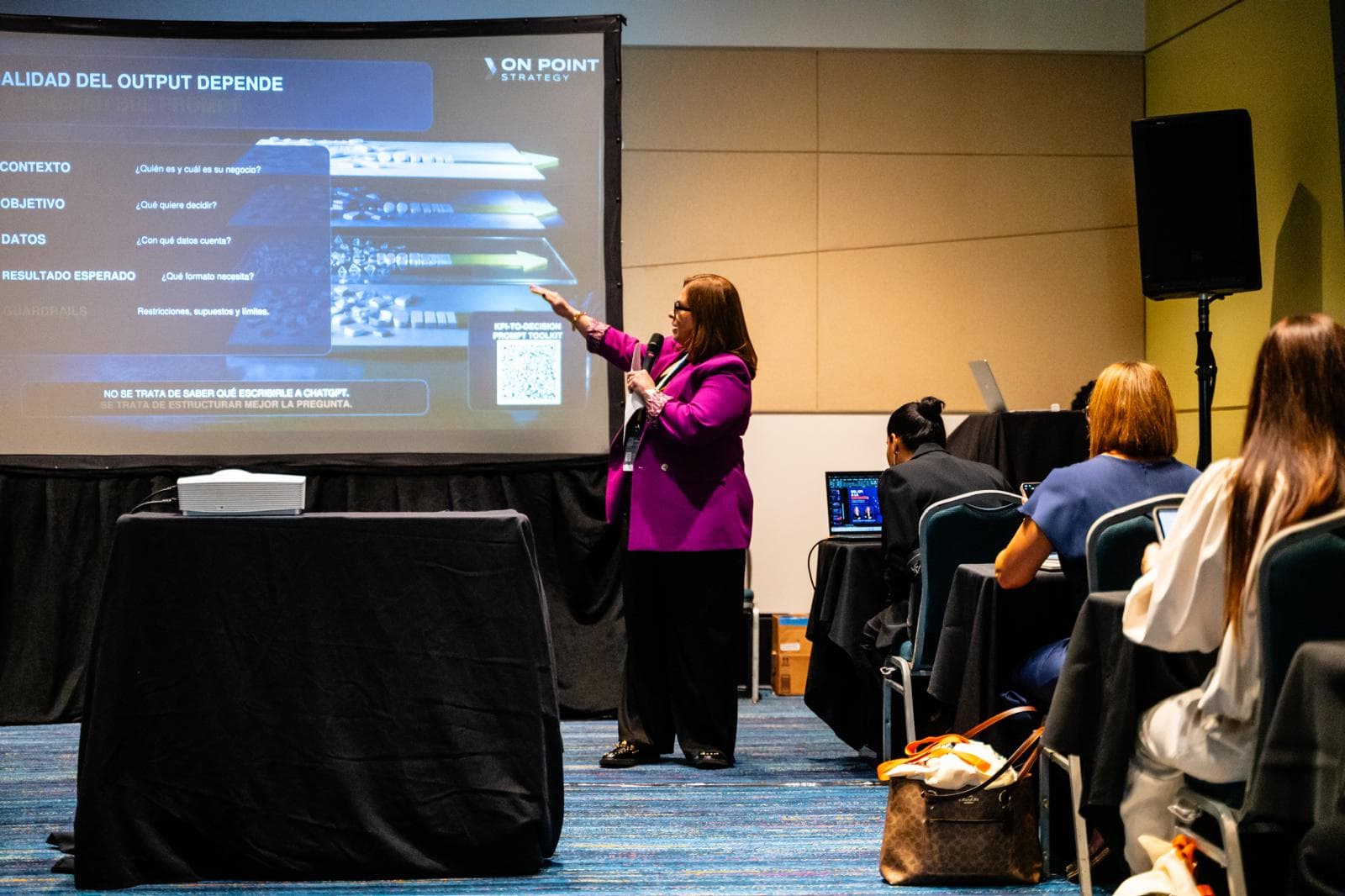
BE Fest 2026, held yesterday at the Puerto Rico Convention Center in Miramar, featured a lot of local startups, ventures and entrepreneurial dreams inspiring a vision of what the new local economy is quickly jolting into.
Not to take anything at all away from any of those newsworthy companies, but one in particular, On Point Strategy, caught our attention, given the rapid rise and increasingly central role of the new applied-AI software industry in the economy, globally and locally.
When the OPS founder took the stage to introduce the firm’s Impact Visibility Hub solution, it received a rousing welcome. When our research team dove in further, we came across a more nuanced, potentially game-changing perspective.
IVH, an AI-assisted dashboard that tracks an organization’s key performance indicators and flags which ones need attention, is built on a bet about where business value is migrating in the age of artificial intelligence: away from having data, which is now nearly free, and toward deciding what to do with it, which is not.
“Data on its own does not generate results,” said Carmen “Mely” Torres, who presented the tool during a workshop titled From KPI to Decision. “Its value is in helping us recognize what is happening, understand why, and decide what we should do.”
That sentence is, in miniature, the thesis of an entire and fast-growing category of software. Every organization now generates far more data than any human can read, including sales by hour, cash flow by account, website behavior, inventory turns, grant-compliance milestones, customer-service response times.
The traditional way to make sense of it was a business analyst building reports in a spreadsheet, a process slow enough that the answer often arrived after the moment to act on it had passed.
Business intelligence software, the umbrella term for tools that have emerged to automate that reporting into live visual dashboards. What AI adds, and what the newest wave of products like IVH is built around, is a further step the industry calls augmented analytics, where in addition to charting the numbers, the software interprets them, surfaces the anomaly a human might miss, and answers plain-language questions like why did margins fall in the west region last month.
Within that space, Impact Visibility Hub is less a novel invention than a locally built entry into a well-defined and rapidly expanding global category, configured, in OPS’s case, and at least initially, for the financial, operational and grant-compliance fields the company is in.
A market measured in the tens of billions
The category is large and growing at a healthy clip. Estimates vary by definition, but the global business intelligence market is generally put around $35 billion to $44 billion in 2025 and 2026, with forecasts running to roughly $62 billion by 2031 and higher by the mid-2030s, at compound annual growth rates in the 9% range.
The AI-native slice is growing far faster. The augmented analytics segment, where OPS competes, is expanding at a compound rate above 27% a year by several estimates, precisely because generative AI has made natural-language querying and automated insight cheap enough to put in front of non-technical managers.
The strategic reason for that growth is the historic drop in the cost of producing and storing data. Analysts now describe the frontier of the field as the move from dashboards that describe what happened to systems that recommend and increasingly execute what to do next. Value is accruing to firms like OPS that service that last mile between the number and the decision.
In that context, OPS is doing what most successful applied-AI companies do, which is integrate existing components into a configured solution for a defined customer and wrap it in the expertise required to make it deliver. And in a market this large and this fast-moving, the applied layer is where most of the accessible value is created.
The competition and the innovation
That also largely explains why a niche that has become such a crowded field can remain a huge opportunity for boutiques like OPS.
Our research did not find another locally owned company in Puerto Rico that offers the same configured decision dashboard product to the same clients, but it did surface global players able to sell, if not already selling, their software on the island, including Microsoft, Salesforce-owned Tableau, IBM Cognos, Qlik, ThoughtSpot and SAP, along with newer AI-analytics assistants from Amazon Web Services and Oracle.
A small local firm is unlikely to outspend those companies on core platform engineering at the headquarters or international level. But just like smaller ventures outfox larger rivals in local markets around the planet in nearly every industry, on the strength of strategic relationships, superior and direct service delivery, micro and local innovations, and underserved geographic or regional markets, so too does the perspective for OPS appear to be on solid ground.
In fact, speaking of geographic niches, the firm recently established a regional presence in Panama to expand in LatAm.
In Puerto Rico, OPS is the latest in a growing roster of technology firms that have shown Puerto Rico can compete with, and attract acquisition interest from, the category leaders.
Wovenware, the San Juan software and AI firm founded in 2003, acquired by geospatial-intelligence company Maxar in 2022 and fully absorbed as Maxar Puerto Rico in January 2025. In health data, Abartys Health has built clinical-analytics products from Puerto Rico for a global market and raised venture capital to do it. To name just two examples.
The takeaway for Puerto Rico
Founded in 2016, OPS has grown fast enough to make Inc.’s 2025 Regionals list for the U.S. Southeast, earned SBA 8(a) and Woman-Owned Small Business certifications, says it has managed billions in grants across Puerto Rico and the mainland, and has actively pursued national visibility.
The bigger lesson from companies like OPS expanding in applied AI fields is the trend beneath. The organizations that will pull ahead over the next several years are not the ones with the most data, which is now a commodity at near-zero cost, but the ones fastest at turning data into decisions.
That capability has become consultable and buyable, whether through the global platforms or through configured local tools like Impact Visibility Hub, and the cost of ignoring it is rising as competitors adopt it. Strategically for Puerto Rico, when a local firm from Morovis looks at a $60 billion global category, identifies a defensible niche within it, builds a product that competes, and ventures outside the island to grow, it becomes precisely the model that Puerto Rico’s economy will likely follow as we stumble our way to a new and more vibrant future.
In an exclusive CB interview, Vélez says employers are training rather than firing and schools have adapted, but national research and Thursday’s outage across AI labs complicate the picture
Aims to become the world’s first global data utility, pioneering an AI Corridor model that delivers AI to places the legacy carriers skip; Puerto Rico role strong on climate events