The coin, timed to the 250th anniversary of independence, revives a legal fight over putting a sitting president’s face on US currency.
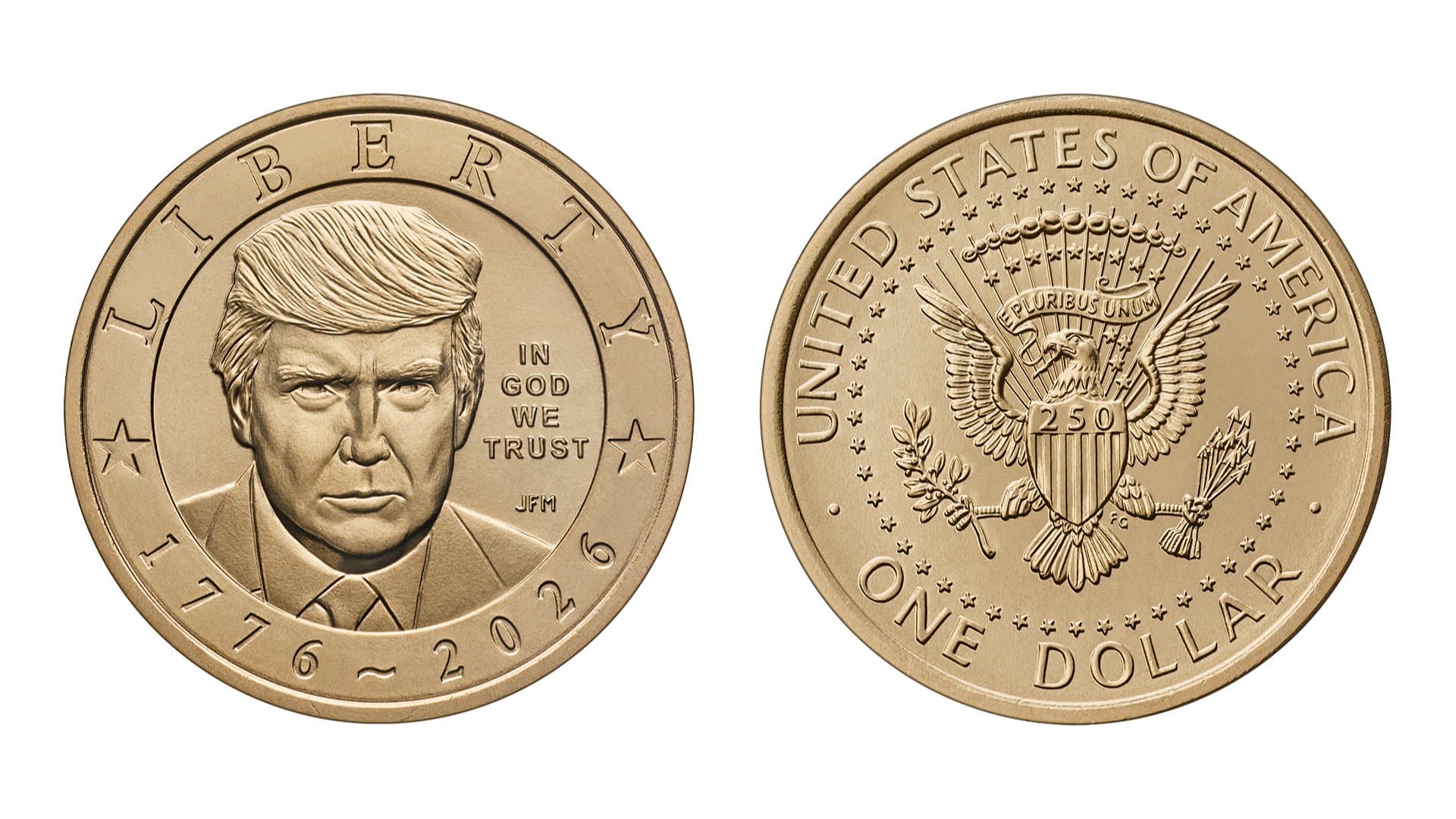
Treasury Secretary Scott Bessent announced Wednesday that the U.S. Mint will begin striking a new $1 coin featuring President Donald Trump’s image, timed to the 250th anniversary of the Declaration of Independence. The commemorative coin is the latest in a string of moves by the administration to put Trump’s likeness on official U.S. imagery during the run-up to the July 4, 2026 milestone.
The design
Bessent unveiled the coin in a post on X. “The @usmint will begin striking this new $1 gold coin to honor the enduring legacy of liberty and a lasting symbol of patriotism,” he wrote, adding that the coin, “with President Trump’s image, … celebrates the strength of American values, and the promise of a nation dedicated to preserving freedom for all.”
The front of the coin carries Trump’s portrait alongside the inscription “In God We Trust” and the dates “1776-2026”; the reverse features the American eagle emblem with “250” at its center. The coin has a gold-hued finish but is struck from a non-precious-metal alloy, not actual gold. It is being produced at the Philadelphia Mint and is expected to reach collectors in the fall. The Commission of Fine Arts, which reviews federal design projects in Washington, cleared the coin’s design in March.
A legal fight over a sitting president’s face
U.S. law has long held that only a deceased person’s portrait may appear on American currency and securities, a rule meant to keep circulating money out of day-to-day politics. The Treasury Department argues the $1 coin sidesteps that restriction because it draws its authority from a different statute: the Circulating Collectible Coin Redesign Act of 2020, which gives the Treasury Secretary broad discretion to issue special one-dollar coins with designs “emblematic” of the country’s 250th anniversary, or semiquincentennial.
Congressional Democrats have pushed back. Lawmakers have introduced a bill, dubbed the Change Corruption Act, that would explicitly bar the likeness of any living or sitting president from appearing on U.S. currency — a direct response to the Trump coin and to a separate, less advanced proposal in Congress for a $250 bill bearing Trump’s portrait, which faces the same legal hurdle and would need Democratic votes to pass.
Part of a broader makeover
The coin lands amid a series of anniversary-linked projects that have put Trump’s image and priorities at the center of the semiquincentennial celebrations. The State Department began issuing a limited-edition “Patriot Passport” on July 6 — the first U.S. passport to feature the portrait of a sitting president — available at the Washington Passport Agency while supplies, estimated at about 40,000, last. Separately, Trump has shared a mock-up of a redesigned $100 bill carrying his signature, distinct from the still-unresolved $250-bill proposal.
Beyond currency and travel documents, Trump has hosted a UFC mixed martial arts event on the White House grounds as part of the festivities and is pursuing a broader remake of the capital tied to the anniversary, including a new White House ballroom, a Reflecting Pool renovation, and a planned 250-foot triumphal arch modeled on Paris’s Arc de Triomphe, to be built near Arlington National Cemetery and the Lincoln Memorial. Officials have not finalized a cost estimate for the arch and expect to fund it through a mix of public and private money; most of the renovation projects are not expected to be finished until well after the July 4, 2026 anniversary itself.