EcoEléctrica has not yet reached an agreement with the Puerto Rico Electric Power Authority (PREPA) on a potential extension of its operating contract beyond 2032, but the private power producer has already begun technical studies to assess the remaining useful life of its key assets and identify future investment needs.
During a public hearing Wednesday before the House Government Committee, EcoEléctrica President Carlos Reyes Berríos said the company has launched evaluations to determine the condition of critical infrastructure and the upgrades that may be required to sustain efficient operations if the contract is extended.
Studies to gauge the plant’s remaining life
The company is also developing an economic and commercial model that incorporates capital investments, operating expenses, major maintenance projects, equipment modernization and fuel supply costs, Reyes Berríos told lawmakers.
“Beginning this work in 2026 is a prudent planning practice and does not presuppose the outcome of any future contractual process,” he said. “Our expectation is that, at the appropriate time, the government and the agencies with jurisdiction will evaluate the continuity option objectively and based on verifiable technical and economic evidence.”
“Based on what we know today, it seems to me that EcoEléctrica will be necessary for the system until 2045, or perhaps somewhat beyond.”
EcoEléctrica President Carlos Reyes Berríos
Reyes Berríos stressed that the studies are strictly preparatory due to the nature of the thermal generation facility and do not constitute a formal request to extend EcoEléctrica’s contract with PREPA or LUMA Energy. He also said the company has not held any meetings related to a potential contract renewal.
Lawmakers press for talks to begin
Rep. Víctor Parés Otero, who chairs the committee, expressed concern that discussions regarding the future of the agreement have yet to begin.
“We are concerned that, as of today, there have been no conversations or indications that such an important process is about to start,” Parés Otero said. “This is a fundamental issue for the people of Puerto Rico.”
The lawmaker also criticized the absence of PREPA Interim Executive Director Fernando Osorio from the hearing. PREPA representatives said Osorio was meeting with Energy Czar Josué Colón, but Parés Otero rejected the explanation and said Osorio would be required to attend a future hearing.
Appearing on Osorio’s behalf, PREPA legal adviser Fabiola Rosa said negotiations over a possible contract extension would also involve the Public-Private Partnerships Authority, the Puerto Rico Energy Bureau and the Financial Oversight and Management Board.
How long a new agreement could run
Asked about the potential duration of a new agreement, Reyes Berríos said the term would depend on the amount of new generation capacity added to Puerto Rico’s electric system.
EcoEléctrica currently contributes 561 megawatts of contracted capacity through its natural gas-fired power plant, according to the company.
Contracted capacity is the amount of power a plant commits to have ready for the grid, measured in megawatts. EcoEléctrica is a combined-cycle plant: its gas turbines generate electricity, and their hot exhaust is then used to make steam that drives a second turbine, which extracts more power from the same fuel.
The plant, in Peñuelas, began operating in 2000, according to the Global Energy Monitor database. Its agreement with PREPA dates to 1995 and was amended in 2020, when it was extended through 2032, according to filings before the Puerto Rico Energy Bureau and company announcements at the time.
“Based on what we know today, it seems to me that EcoEléctrica will be necessary for the system until 2045, or perhaps somewhat beyond,” Reyes Berríos said.
Who pays for maintenance and fuel
The EcoEléctrica executive also addressed questions regarding plant maintenance expenses. According to Reyes Berríos, the facility’s annual maintenance costs, estimated at between $20 million and $30 million, are paid directly by the private company. He rejected suggestions that those expenses are passed on to consumers through electricity bills.
“That has never happened, and it is not going to happen,” he said.
However, PREPA Operations Administrator Jorge Cotto noted that electricity customers do bear a different cost: monthly charges of approximately $16 million to $17 million associated with two vessels that transport natural gas to EcoEléctrica and the Costa Sur power plant.
“At the end of the day, it comes out of the bill that everyone pays,” Cotto said.
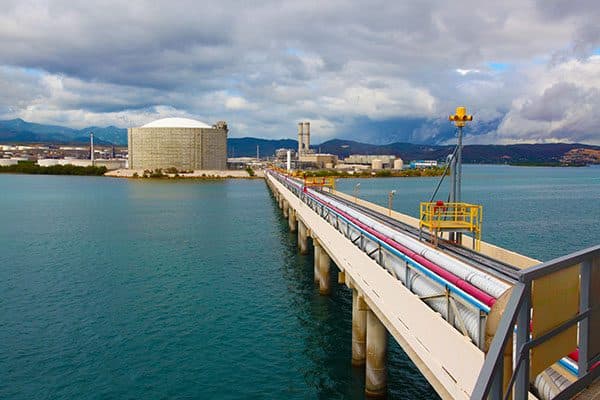
The gas reaches Puerto Rico as liquefied natural gas, or LNG, which is natural gas cooled into a liquid so it can be shipped. At EcoEléctrica’s terminal in Peñuelas, it is stored and turned back into gas, a process known as regasification. Naturgy has supplied the gas under a contract extended in 2020 through 2032, with prices tied to Henry Hub, the U.S. benchmark for natural gas.
A work schedule that starts in 2027
Regarding the timeline for a potential extension, Reyes Berríos said formal discussions should begin as early as 2027. EcoEléctrica has also developed a schedule for future plant work, with the most significant projects expected to take place between 2030 and 2032.
Major shutdowns are planned outages in which generating units are taken offline for inspection, repair and overhaul. Equipment for that work can take years to manufacture and deliver, which is the company’s reason for starting its studies now.
“Several critical plant systems require specialized inspections, detailed engineering, planning for major shutdowns and the acquisition of equipment with long manufacturing and delivery lead times,” Reyes Berríos said.
Ex-PREPA, LUMA and Genera executive Daniel Hernández says the island lacks options, not fuel; his six-point plan faces a costly gas contract, stalled financing, a frozen procurement and a deficit of up to 850 MW