Harbor District Acceleration Puts San Juan Back on Course to Build the Caribbean’s Premier Waterfront Attraction
The Convention District Authority’s push to link its parcels with Bahía Urbana, add hotel rooms and draw housing for professionals revives a vision first outlined more than two decades ago to position the island as a top-tier global destination
As part of the projects being advanced in the Convention Center District, its executive director, Verónica Ferraiuoli, said the Authority seeks to expand the area’s hotel, residential and tourism offering, with the goal of attracting new investment and strengthening the area’s development.
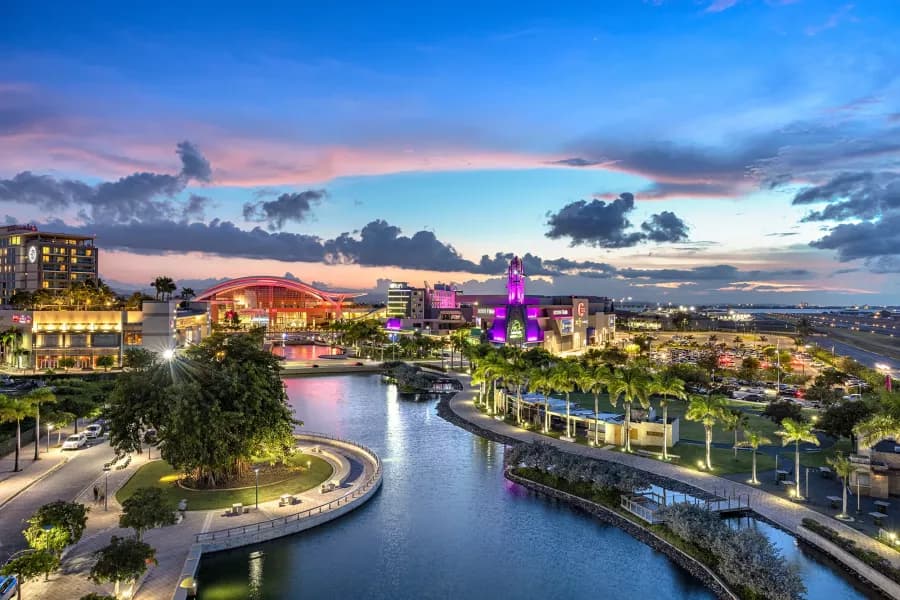
Through Harbor District, a new unified brand identity built on the concepts of Work, Play and Live, the Puerto Rico Convention Center District Authority connects business, entertainment and urban-living opportunities.
The rebrand and expansion mark a return to the ambition that gave birth to the district. When Caribbean Business reported on the project in September 2004, ahead of the convention center’s opening, the $415 million facility on a 113-acre site in Isla Grande was meant to anchor more than $1.3 billion in public and private investment, at the time envisioning two hotels, office and retail space, residences, a casino, a museum, a park and pedestrian walkways, with full build-out targeted for 2012.
Then-executive director Manuel Sánchez Biscombe called the center “the best meeting venue in the entire Caribbean and Latin America,” and the district’s planners measured it against Cancun, Fort Lauderdale and Dubai.
An original rendering by the firm CBT of what has now become the Harbor District.
More than two decades later, that build-out remains unfinished, although the district gained momentum after Distrito T-Mobile opened in 2021 and began drawing an estimated 3.4 million visitors a year, as Caribbean Business has reported.
Thursday’s announcement, which ties the Authority’s remaining parcels, PRISA Group’s projects and the Bahía Urbana redevelopment into a single destination brand, is the clearest step yet toward the original goal: an iconic waterfront district that projects Puerto Rico as the Caribbean’s top-tier tourism and business destination.
“The Authority has the responsibility to establish a development vision, to manage its assets responsibly and to ensure that investments serve the public interest. But to turn that vision into reality, we need developers who are willing to invest, to take risks and to bet on Puerto Rico,” Ferraiuoli said.
Joining other leading waterfront districts
The model Puerto Rico is pursuing has proven itself elsewhere. In Sydney, the New South Wales government’s A$3.4 billion transformation of Darling Harbour delivered the International Convention Centre Sydney in December 2016, along with new public space and a new city neighborhood, and is expected to generate about A$200 million a year in economic benefit for the state, according to the government’s project summary.
Cape Town’s V&A Waterfront, redeveloped from historic docklands beginning in 1988, combines a working harbor with hotels, upscale residences, offices, retail and the Zeitz Museum of Contemporary Art Africa, and draws about 24 million visitors a year, according to published figures.
In Singapore, Marina Bay Sands opened in 2010 within the planned Marina Bay district, combining about 2,500 hotel rooms, more than 110,000 square meters of convention and exhibition space, theaters, a museum and a rooftop park in a project of more than $5 billion, according to the Singapore Tourism Board.
“Many cities around the world are trying to achieve something similar, but they don’t have the idea or the concept.”
Dan Hoffend, executive vice president of convention centers at Legends Global
Those districts share the formula Harbor District is now branding: a convention anchor surrounded by hotels, homes, entertainment and public space, linked to the waterfront on foot. Each also took decades and successive waves of public and private capital to mature, a reminder that the measure of San Juan’s district is the build-out, not the announcement.
Destination and neighborhood
As part of the new offering, PRISA Group CEO Federico Stubbe highlighted his Homewood Suites by Hilton and Hampton by Hilton project. Together, the two hotels promise 257 “much-needed” new rooms.
“It would be the first dual-brand hotel in a single structure, and we hope to be able to open it before the end of the year,” Stubbe explained at a roundtable held in the District.
He also said that at One Distrito, the 38 residences “are completely sold,” with a waiting list of 1,400 interested buyers.
PRISA Group has invested close to $550 million in the Convention Center District, Stubbe said.
“We have to be part of the solution, of providing attainable housing for Puerto Rico’s professional class. We don’t want them to keep leaving, not only because the jobs are being created here, but because we have to create a quality of life so that these young people want to stay,” Stubbe explained.
In response to questions from the press, Stubbe said that “after studying the data,” home sale prices would range between $300,000 and $800,000.
“Typically that is a family in which both work, have relatively good salaries and both contribute to the household income needed for that type of housing,” Stubbe said.
He added that “certain things are being done” at a cost of around $200,000.
“It is not only about attracting large investments, although that is certainly important. It is about those investments producing spaces, experiences and opportunities for our people.”
Convention Center District, its executive director, Verónica Ferraiuoli
For her part, Vanessa Di Mari, executive vice president of Interlink, the company in charge of developing the Navy Frontier Pier parcel, explained that the housing components there will be aimed at the professional working class.
“I don’t have a sale price, but it would be close to a million,” Di Mari said.
The price points frame the district’s central housing proposition. Stubbe’s target market, two-income professional households, is precisely the group the island has been losing to the mainland, and the professionals the visitor economy increasingly employs.
In a companion story, Discover Puerto Rico CEO Jorge Pérez tells Caribbean Business that hotels now hire accountants, financiers and engineers who once looked to other industries. Whether Harbor District can house them at prices they can finance, rather than adding another tier of luxury product, will help decide whether it becomes a neighborhood or remains a destination.
A new public park
Following a competitive process under RFI 2026-01, DL, LLC, a PRISA Group affiliate, will advance its proposal called Distrito Park, which calls for the development of a new public park next to the Puerto Rico Convention Center.
With an investment of $4 million, Distrito Park would transform the Patria Yards space into a recreational and family destination that will include green areas, a central space with stages for activities, children’s play areas, a pet park and complementary commercial spaces.
“It is not only about attracting large investments, although that is certainly important. It is about those investments producing spaces, experiences and opportunities for our people,” Ferraiuoli said.
The proposal incorporates attractions such as a carousel, an ice cream shop and minigolf, as well as rest areas and community activities.
Stubbe, for his part, justified the project by saying that “there aren’t many places where multiple generations of the same family can go to share, have a good time and everyone is happy.”
PRISA expects to open the park in the first quarter of 2028, with most areas free to the public and fees limited to certain attractions.
Connecting the district to the bay
The District also includes projects such as Bahía Urbana, Bayfront Park and Bay Harbor Village, which are at different stages of development and planning.
To advance the Bahía Urbana initiative, developed by FUNCO, the governor created an interagency technical panel charged with coordinating its reconstruction, infrastructure and capital-improvement projects, and Ferraiuoli explained that piers six, seven and eight are in development.
Ferraiuoli said the District, located in Isla Grande and Miramar, has an allocation of federal Community Development Block Grant (CDBG) funds to build pedestrian walkways, connect the Convention Center with Bahía Urbana and improve Fernández Juncos Avenue, including its sidewalks, power lines and bicycle access. Published reports put that allocation, from the CDBG-DR Investment Portfolio for Growth program, at $130 million.
Pedestrian access is one of the Authority’s priorities, and construction will begin before the end of the year.
“For all of this to work, we have to connect both spaces, Bahía Urbana with what is now known as the Convention Center District. So connectivity and pedestrian access are very important things we are working on, and these will actually be the first projects you will begin to see under construction,” the District’s executive director explained.
Together, the projects seek to expand the area’s retail, entertainment and public-space offering to strengthen investment opportunities and economic activity in the zone.
A district sized for a bigger visitor economy
The lack of hotel rooms in the area has also been a recurring limitation. On this point, Ferraiuoli said that if the site consultation for the Bahía Urbana project is approved, about 500 new rooms would be added to the roughly 1,700 available today.
That room count matters because the visitor economy the district is built to serve is growing faster than its inventory. Foundation for Puerto Rico’s Visitor Economy Performance (VEP) model estimates the island draws about 6 million visitors a year, spending more than $8 billion, and projects 8 million visitors and about $12 billion in spending by 2030. VEP puts daily spend per visitor at $264 in 2024 and $280 in 2025, higher than other counts.
Discover Puerto Rico, which uses a broader count, projects about 13.7 million total visitors in 2026, including 8.9 million nonresident travelers generating roughly $9.5 billion in direct spending, as Caribbean Business reports in a companion story on the destination marketing organization’s strategy. National Geographic this week named Puerto Rico among its 25 Best of the World destinations for 2027.
The district is already testing that demand. PRISA Presents, PRISA Group’s new events unit, will bring a 30-show Cirque du Soleil residency to the District’s Music Hall venue from February to April 2027, a production of more than $10 million for which Cirque estimates a $63 million economic impact, as Caribbean Business has reported.
At the same time, the industry is pushing to spread growth beyond the San Juan metro area, which Foundation for Puerto Rico says cannot absorb it alone. A well-connected urban anchor like Harbor District and an island-wide product are positioned as complementary bets, as FPR founder Jon Borschow has said publicly.
“For all of this to work, we have to connect both spaces, Bahía Urbana with the Convention Center District. So connectivity and pedestrian access are very important and will actually be the first projects you will see under construction”
Verónica Ferraiuoli
Advances at Distrito Sports Hub
The presentation also highlighted progress on Distrito Sports Hub, a sports and recreation complex developed by PRISA Group, with an approximate investment of $20 million, which is expected to open to the public during the first half of 2027.
The project will include eight covered pickleball courts, four outdoor padel courts, spaces for beach tennis, soccer and basketball, as well as duckpin bowling, commercial areas and spaces for community activities and events.
Dan Hoffend, executive vice president of convention centers at Legends Global, said the projects represent an important idea that many countries are trying to replicate.
“This is an important moment in the relationship between our families, our businesses and our entertainment, all integrated in a single district. It is a fantastic idea, and many cities around the world are trying to achieve something similar, but they don’t have the idea or the concept,” Hoffend said.
“I congratulate the ideas and the concept; it is simply brilliant. I am very happy to be part of this,” he added.
Finally, the rear section of the District is in a request for proposals (RFP) process for future development.
CB Web Editor Alex Díaz contributed to this story.
In an exclusive interview with Caribbean Business, CEO Jorge Pérez explains how the organization is retooling its strategy for a sixth straight record year
Chairman Jon Borschow says the nonprofit will offer continuous guidance where existing resources fall short, a model it is already testing through a tourism-anchored plan in the Eastern Region
Reservations in five emerging municipalities grew more than 25% in 2025, giving traction to the push by the Foundation for Puerto Rico, Rebook and the Chamber to spread visitor spend across the island