Private Jets Are Outgrowing San Juan’s Airfield, and Local Investors Are Betting $54 Million on the Gap
With both existing operators at capacity, the Bluesky group is building hangars and an on-site customs post, a wager on demand that reaches beyond aviation into tourism, construction, finance
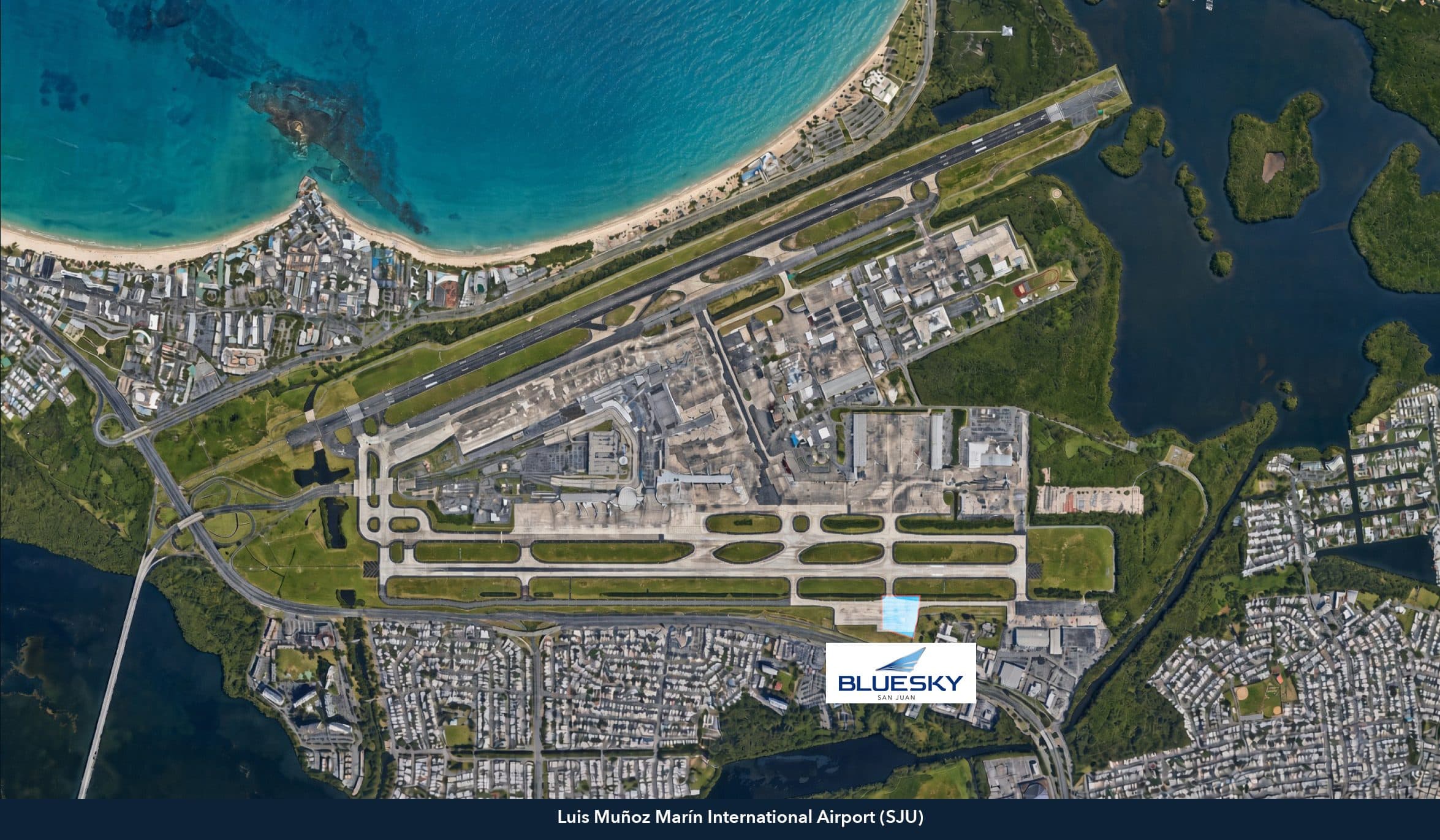
A group of Puerto Rican investors is committing at least $54 million in private capital to build BlueSky San Juan, a new executive aviation facility at Luis Muñoz Marín International Airport.
The project, expected to be completed in 2028, aims to strengthen Puerto Rico’s position as a Caribbean hub for private and corporate aviation while generating employment and attracting additional investment.
“BlueSky is a testament to what we can achieve when Puerto Ricans come together, combining experience, vision and capital to invest in our island,” said José Maldonado, a retired U.S. Army colonel and senior partner at BlueSky San Juan, at the project’s groundbreaking ceremony.
The facility will include an 8,000-square-foot terminal for a fixed-base operator (FBO), an apron of approximately 275,000 square feet and more than 60,000 square feet of hangar space in three units.
It will also provide aircraft fueling, with storage for 20,000 gallons of jet fuel, and U.S. Customs and Border Protection (CBP) facilities for processing international flights.
An FBO is the company authorized to serve private and corporate aircraft on an airport’s grounds, which the Federal Aviation Administration describes as a commercial entity providing aeronautical services.
A typical FBO sells fuel, rents hangar and parking space, services aircraft on the ramp and offers lounges for passengers and crews. The apron is the paved area where aircraft park, load and refuel.
The facility will be able to accommodate 60 to 70 aircraft at a time, provided they are dispatched quickly, Maldonado said.
The project is expected to create approximately 30 direct jobs during construction and 60 to 80 direct permanent jobs once operations begin in the fall of 2028. Another 110 indirect jobs are also projected.
The investors and thinking behind it
Also behind the investment is Francisco Díaz Massó, president of Bermúdez, Longo, Díaz-Massó LLC, who said that putting money into the project was a no-brainer for the construction company.
“The numbers talk, and they give you confidence. When we saw the market financial analysis, with its projections, and the growth happening in Dorado, for example, with all the private airplanes coming into the island, we were confident it was a smart decision,” he said.
The rise in private aircraft is also attributed to affluent individuals moving to the island, which makes this niche a gauge of how well Puerto Rico competes for high-net-worth residents and visitors.
RB Construction Group, Del Valle Group and Desarrollos Metropolitanos are also part of the investor group. Roberto Aybar of AIR Architects is the designer, and FirstBank is the financial institution behind the project.
For his part, Jorge Hernández, president of Aerostar Airport Holdings LLC, the private company that operates the airport, said the two FBOs already at Luis Muñoz Marín are working at full capacity, a strong sign that Puerto Rico’s private aviation industry is booming.
“We have looked at other markets around the world, and we have noticed the increase in demand for private aviation, which drives the whole economy around general aviation,” Hernández said. “A facility of this size, with the ability to offer full service to that part of the industry, makes a huge difference for Puerto Rico, particularly when the Caribbean is growing and there is a lot of demand for this type of service in the region.”
Business jets made 2,362 takeoffs and landings at San Juan between May 6 and Aug. 4, 2026, up 26.6% from 1,865 in the same period of 2025, according to flight data from AVI-GO SkyPulse. The busiest links were with St. Barthélemy (141 movements), Tortola (74) and Miami (63).
Space has been the constraint. In 2023, Modern Aviation announced a $17 million project to build two hangars of about 24,000 square feet each at Isla Grande Airport, the first able to hold heavy business jets, which until then had to stay on the ramp, Aviation International News reported.
BlueSky’s developers call their project the largest private investment in Puerto Rican business aviation infrastructure in more than a decade.
Permits, location and reach
Carolina Mayor José Carlos Aponte, whose municipality is home to the airport, also attended the ceremony.
“This project reaffirms Puerto Rican entrepreneurs’ confidence in our ability to develop world-class infrastructure,” he said. “BlueSky represents a strategic investment that expands economic opportunities in Carolina and strengthens Puerto Rico’s appeal as a business destination.”
Asked how Carolina earns the confidence of private investors, the mayor emphasized the importance of an expeditious permitting process, which allows developers to obtain construction permits and start their projects on time.
The project, strategically placed on the airport’s south side with direct access to the aircraft, also aims to strengthen Puerto Rico’s links to international markets by facilitating flights from South America, Europe and Africa, while offering greater convenience for flights from the United States.
The site covers about five acres, and the on-site CBP facility would let international arrivals clear customs at the FBO instead of the main terminal, according to trade reports.
Beyond the airfield
General aviation, which covers civilian flying other than scheduled airline service, is a larger economic engine than its profile suggests.
A PricewaterhouseCoopers study for the General Aviation Manufacturers Association put its 2023 contribution to the U.S. economy at $339.2 billion and 1.3 million jobs, with about 2.6 supporting jobs for every direct one.
The study measured the nation as a whole, so its figures are a benchmark rather than a forecast for the island.
Locally, the effects would run through channels the project already touches: construction and engineering firms, bank financing, fuel and ground services, and the wealthy travelers who fly into destinations such as Dorado.
Published reports have also tied the rise in private aircraft to affluent individuals moving to the island for its tax incentives, which makes this niche a gauge of how well Puerto Rico competes for high-net-worth residents and visitors.
Weekly container volumes now top 900, with greater scheduling discipline, more international traffic than generally assumed, and an energy-resilient microgrid now a year away
On top of the ones you know, products arrive on the island with mainland tariffs already baked in, plus the Jones Act cost, plus loss of investment from policy uncertainty