San Juan— When Sebastián Negrón Reichard resigned as Puerto Rico’s Secretary of Economic Development and Commerce on May 26, he did not go alone. More than ten senior officials walked out with him — the agency’s general counsel, chief financial officer, director of incentives, permit system transformation team, reshoring and semiconductor strategy lead, rum industry director, air cargo strategist and communications chief. In one afternoon, Puerto Rico’s primary economic development engine lost virtually its entire leadership structure.
The shockwaves did not stop at the island’s shores.
Within hours, Bloomberg published a news alert under the headline “Puerto Rico Economic Chief, Top Officials Resign Over Trust Issues With Governor,” characterizing the mass departure as a complication for “some of the government’s key initiatives that aim to attract manufacturing and wealthy mainlanders to the U.S. territory.” The Washington Post, the Washington Times and ABC News all picked up the story on the same day — an unusual level of mainland media attention for a cabinet resignation in San Juan. The international reach of the story signals something that local politics alone cannot fully explain: this departure has real implications for the investors and institutions that watch Puerto Rico from the outside.
What Was at Stake
To understand the weight of this moment, it helps to understand what Negrón’s team had built. Since taking office in January 2025, the DDEC under his leadership had positioned itself as the operational core of Puerto Rico’s economic revival strategy. The agency was the lead executor of Governor Jenniffer González Colón’s reshoring agenda — an executive order-backed initiative that by early 2026 had secured $176 million in investment commitments and 1,533 jobs, with an estimated $117 million payroll. The reshoring framework was built on four pillars: the Executive Concierge investment facilitation service, the Puerto Rico Workforce Reshoring Fund, the Incentives Master Grant, and the Puerto Rico Reshoring Roadshow — all of them now without the officials who designed and ran them.
The director of the Office of Incentives, who oversaw the administration of Act 60 — the island’s flagship tax incentive program for individual investors and export businesses — also resigned. Act 60, which has attracted thousands of high-net-worth individuals from the mainland and internationally, requires active administrative oversight: annual exempt reports, compliance audits, decree approvals, and enforcement actions. The DDEC had in recent months intensified audits of nearly 1,800 decrees and was rolling out automated compliance notifications for 2026. That entire enforcement and approval apparatus is now operating without its leadership.
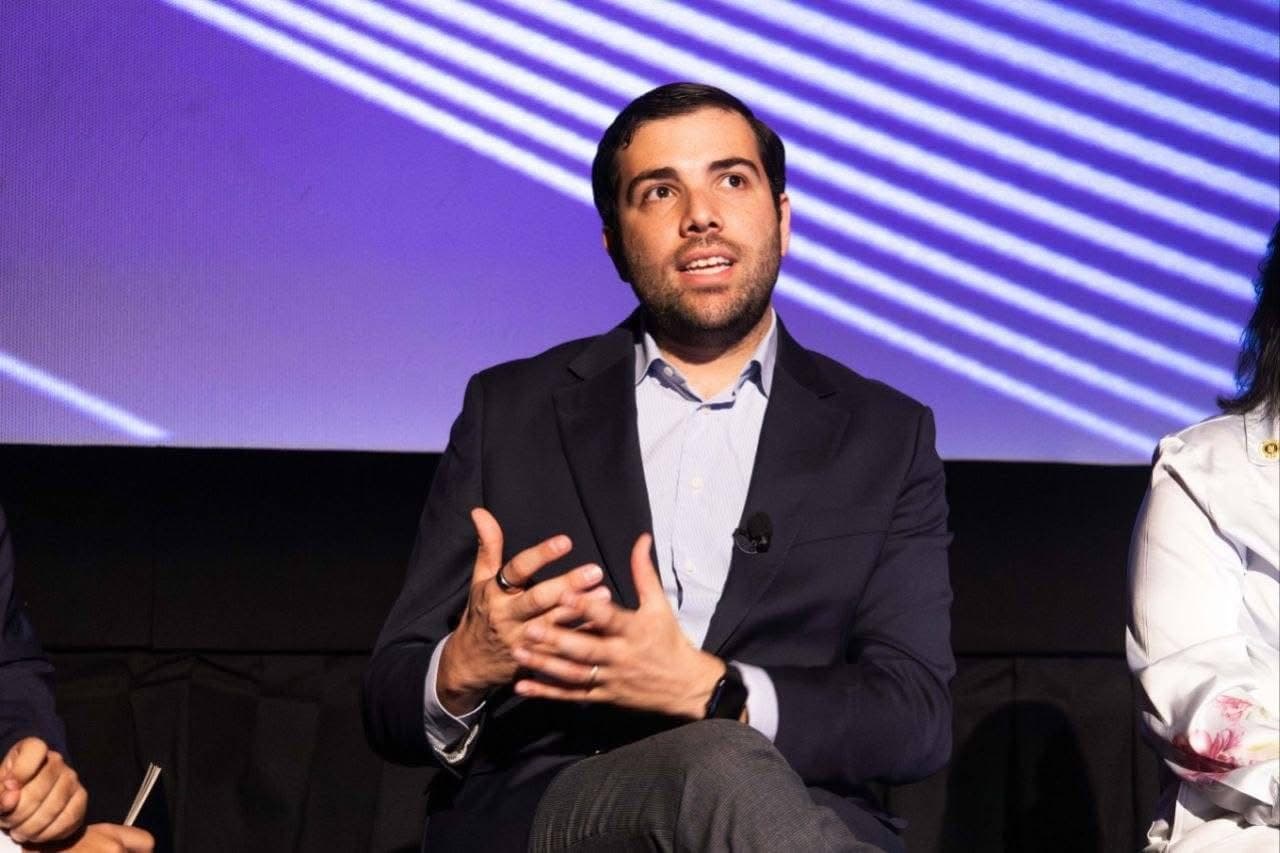
The former DDEC secretary, Sebastián Negrón Reichard, during an interview that took place inside the studio facility at the Caribbean Business Summit.
The permit reform initiative, arguably the most structurally significant economic modernization effort on the island, also lost its key personnel. Negrón had been the administration’s chief advocate for a sweeping overhaul that would consolidate permitting under a single Central Permitting Office, eliminate redundancies across agencies, and reduce the timeline that has historically deterred investment. The $780,000 initiative was funded and moving forward. Its chief architects are now gone.
The Federal Dimension
The crisis carries implications that extend beyond San Juan and into Washington, D.C.
At the center of the OGPe controversy that triggered Negrón’s resignation was a federal procurement process — a competitive contract financed with between $1 million and $2 million in federal funds. Negrón initiated referrals to the Puerto Rico Department of Justice, the Office of the Comptroller, and the Office of Government Ethics after an internal investigation found alleged irregularities including improper pressure on employees, retaliation against whistleblowers, and attempts to alter scoring in the federal contract process. Those referrals are now active, meaning federal fund management practices at a Puerto Rico government agency are under active institutional review — at a moment when the agency has no confirmed secretary.
A leadership vacuum at the agency responsible for economic development and, in part, federal fund coordination does not go unnoticed in those circles.
Puerto Rico’s resident commissioner in Washington, who represents the island’s interests in Congress without a voting seat, will likely face questions from federal partners and oversight staff. For an island still rebuilding its fiscal credibility after the PROMESA restructuring and years of oversight by the Financial Oversight and Management Board, optics of institutional instability at a major cabinet agency carry real weight.
Senate President Thomas Rivera Schatz — who has his own complicated political history with Governor González — described the departure as “sumamente lamentable” (deeply regrettable) and called Negrón “an excellent official, a very talented young person, an honorable person, very capable.” His measured but pointed language reflected the seriousness with which local political leadership received the news. Crucially, Rivera Schatz said he was “concerned about the allegations” Negrón made — an implicit signal that the Senate may not simply let the matter settle.
The Investment Signal Problem
For the business community, the concern is both immediate and structural. The Puerto Rico Manufacturers Association issued an urgent call for the governor to name a replacement swiftly, warning that the change “must not hinder, delay or halt the strategic efforts currently underway.” The framing was diplomatic, but the urgency was unmistakable.
The deeper problem is what economists and investment analysts call a signal. Puerto Rico has spent years — and considerable political capital — building the narrative that it is a stable, investor-friendly jurisdiction with a functional government committed to economic modernization. That narrative relies heavily on continuity, predictability and institutional credibility. A mass resignation at the cabinet agency responsible for investment attraction, triggered by a public accusation of executive interference from the departing secretary himself, sends the opposite signal.
Bloomberg’s framing — “complicates key initiatives” — is the language of cautious financial journalism. Behind it lies a harder reality: institutional instability is a risk variable in investment decisions, and Puerto Rico’s investment attraction pipeline depends on maintaining the confidence of corporate site selectors, pharmaceutical manufacturers, private equity funds, semiconductor companies and Act 60 applicants who are all evaluating the island on criteria that include governance quality and policy continuity.
The semiconductor and reshoring strategies deserve particular attention. Both sit at the intersection of Puerto Rico’s positioning and the broader federal industrial policy moment — the post-CHIPS Act environment in which the United States is actively redirecting manufacturing back to domestic or near-shore locations. Puerto Rico had a genuine opportunity to position itself as a beneficiary of that realignment. The team that was executing that strategy is no longer in place.
What Comes Next
Governor González will need to move quickly and credibly. A swift appointment of a qualified, private-sector-credentialed replacement could limit the reputational damage. A prolonged vacancy, an acting secretary without mandate, or a political appointment perceived as rewarding loyalty over competence will compound it.
The active referrals to the Department of Justice, the Comptroller and Ethics will continue to unfold regardless of the cabinet transition, and may eventually shed public light on the nature of the alleged interference Negrón described. That process will either validate his account — deepening the governance narrative problem — or produce findings that reframe the departure in different terms.
What the market and Washington cannot afford to see is the kind of institutional drift that Puerto Rico worked so hard to move past. The island’s economic trajectory since 2020 has been one of the more compelling comeback stories in the Americas — real GDP growth, record tourism, a manufacturing sector showing signs of revival, a bond market that has regained investor interest after years of default. All of that is durable, but none of it is immune to the perception that decisions at La Fortaleza are driven more by internal power dynamics than by economic strategy.
The next appointment to lead the DDEC will say more about the direction of Puerto Rico’s economic governance than any press release or investment roadshow. The business community, the bond market, and the oversight offices in Washington will all be watching.