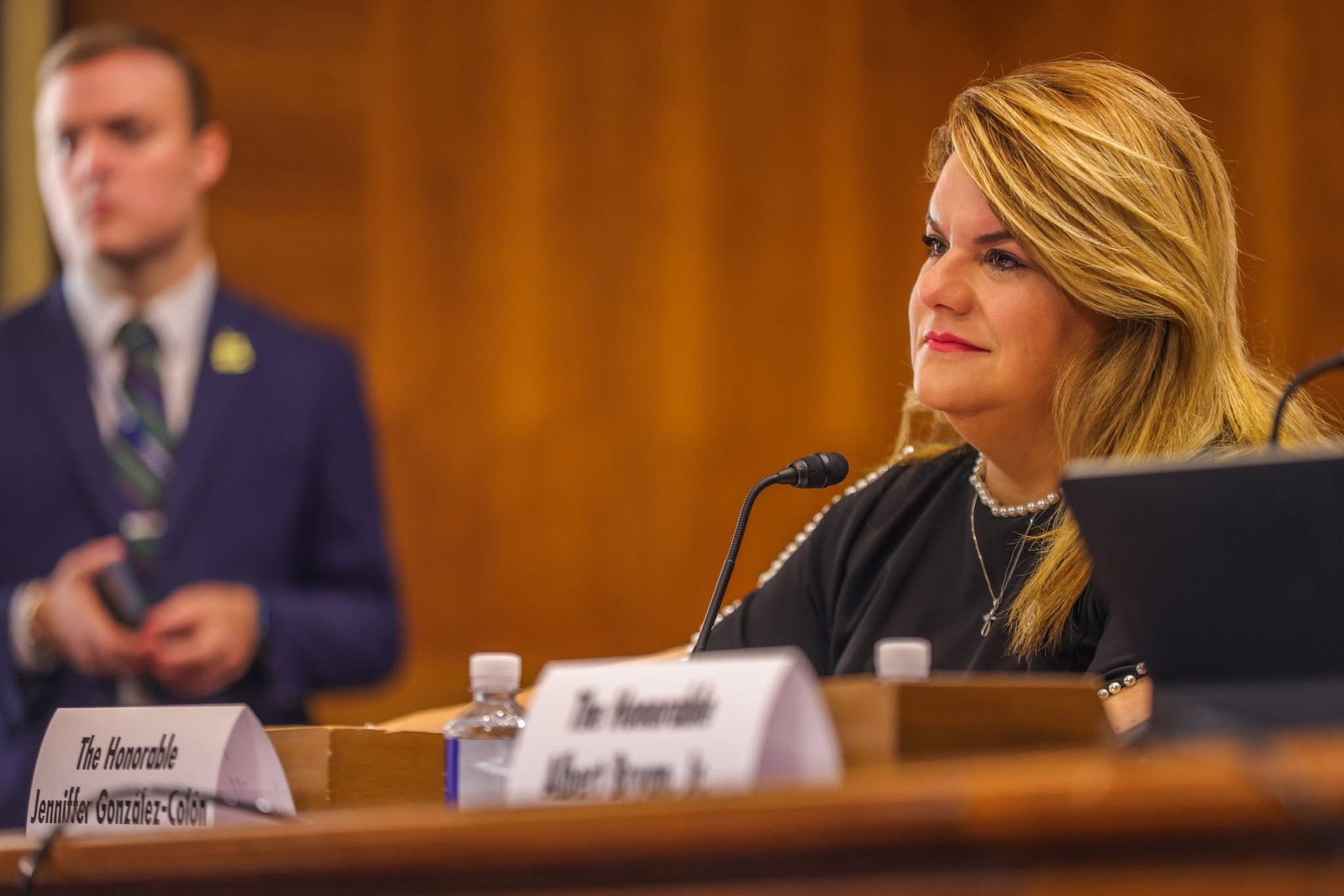
The Senate Energy and Natural Resources Committee hearing on Wednesday on the state of the U.S. territories opened with pointed questions about governance that set the tone for a session defined by fiscal strain, energy instability, and the limits of federal policy in island economies.
Committee Chairman Sen. Mike Lee pressed Puerto Rico Gov. Jenniffer González Colón on whether Congress could trust her administration to safeguard federal funds—an unusually direct challenge delivered moments after he asked about the recent scandal at Puerto Rico’s Department of Economic Development and Commerce (DDEC). Former DDEC Secretary Sebastián Negrón resigned after publicly alleging political interference in contracting decisions, prompting a wave of ten other resignations and an ongoing investigation by Puerto Rico’s Justice Department.
Negrón also filed a complaint on June 15 before the Office of the Special Independent Prosecutor Panel (OPFEI) alleging that senior officials in La Fortaleza, including La Fortaleza Chief of Staff Francisco Domenech, engaged in a pattern of interference and retaliation tied to a federally funded procurement process at the Office of Permits Management (OGPe).
“The allegation saying that my office, myself, or my chief of staff is involved is completely false,” the governor said. “There is no evidence of that.”
Lee pressed further, asking why a cabinet‑level official would make accusations he “would know could be figured out” if untrue. González‑Colón declined to speculate, saying only that she did not know what “political motivations” he may have had. She also clarified that the resignation of the COR3 disaster recovery director — cited as part of the alleged pattern — was unrelated and based on a family matter disclosed to her in April
The governor emphasized that her administration had expanded cooperation with federal inspectors general and law enforcement agencies to ensure accountability in the use of federal reconstruction and energy funds.
“No federal funding at this time during the last year has been misused,” she said, adding that her administration has enacted additional laws to strengthen oversight and anti‑corruption safeguards.
The tense exchange underscored the stakes of the hearing, which brought together the governors of Puerto Rico, Guam, the U.S. Virgin Islands, the Commonwealth of the Northern Mariana Islands (CNMI), and American Samoa at a moment when each territory is grappling with overlapping crises—energy instability, climate‑driven disasters, labor shortages, and the structural limits of small island economies.
What followed was a rare, unfiltered look at the fiscal and operational fragility of the United States’ far‑flung jurisdictions, and the degree to which their economic futures hinge on federal policy decisions made thousands of miles away.
CNMI: A Tourism Collapse, a Typhoon, and a Fiscal Cliff
CNMI Governor David Apatang delivered one of the starkest assessments of the day. His written testimony described a government “still recovering” from a convergence of shocks: a collapsed tourism industry, a global fuel crisis, and the devastation left by Super Typhoon Sinlaku just nine weeks earlier.
Visitor arrivals have plunged from 607,000 in 2018 to a projected 104,511 this fiscal year. Airline seat capacity has fallen 78 percent. Hotel occupancy tax revenues—the backbone of the Marianas Visitors Authority—have dropped from $14.2 million to $1.4 million. April revenues fell 32 percent below baseline, and the government has incurred more than $2.6 million in unbudgeted disaster costs.
“We are trying to rebuild tourism with a fraction of the air seats, visitors, and marketing resources that existed when the industry was healthy,” Apatang said.
He also defended the CNMI’s use of the EVS‑TAP travel authorization program, which allows certain foreign nationals—including Chinese visitors—to enter the territory without a visa. Under questioning from Sen. Lee, Apatang insisted the CNMI takes national security seriously but warned that eliminating the program without a replacement would “hurt our economy at a time when we are still recovering.”
Apatang urged Congress to support increased FEMA cost‑share for permanent infrastructure repairs, restore air service, consider cabotage relief, and impose a moratorium on deep‑sea mining in the waters surrounding the Marianas.
Puerto Rico: Grid Instability, Medicaid Cliff, and the Fight Over LUMA
González Colón used her testimony to highlight what she described as major progress in stabilizing Puerto Rico’s grid and restoring generation capacity—claiming more than 1,300 megawatts had been brought back online through conversions to natural gas, turbine overhauls, and new battery installations funded by FEMA and the Department of Energy.
But senators pressed her on the island’s chronic outages and her administration’s legal battle to cancel the contract with LUMA Energy, the private operator of Puerto Rico’s transmission and distribution system. Sen. Martin Heinrich asked who would run the grid if the contract were voided.
“We want a private operator,” González Colón said, explaining that the government is asking the courts for a one‑year transition period to solicit proposals from U.S.‑experienced companies. “We are not looking to go back to government operating the system.”
Senators also raised concerns about the island’s Medicaid funding cliff. González Colón warned that if Congress fails to renew enhanced federal support by 2027, Puerto Rico will face a “catastrophic” drop in funding that could destabilize care for 1.3 million beneficiaries.
The governor also reiterated her administration’s push for statehood, calling alternative status proposals “unconstitutional fantasies” and noting that Puerto Ricans have rejected the current territorial status in multiple plebiscites.
Guam: National Security at the Edge of the Pacific
Guam Governor Lou Leon Guerrero framed her testimony around the island’s central role in U.S. defense strategy. With major military realignments underway, she warned that Guam’s civilian infrastructure—power, healthcare, housing, and workforce—must be strengthened to support the mission.
“The tip of the spear is only as strong as the community standing behind it,” she said.
Guerrero called for reconvening the federal Economic Adjustment Committee, extending H‑2B workforce flexibilities beyond 2029, and securing federal investment in a new Guam Medical Complex. She also confirmed that Guam’s grid, which powers U.S. military bases, has recently been targeted by cyberattacks.
On tourism, she urged the federal government to approve the Philippines for the Guam‑CNMI Visa Waiver Program, arguing that the island’s economic resilience is inseparable from its strategic value.
She also joined CNMI in calling for a moratorium on deep‑sea mining, warning that federal decisions affecting Pacific waters must include territorial consultation.
American Samoa: Energy Dependence and Infrastructure Fragility
American Samoa Governor Pula’ali’i Nikolao Pula emphasized the territory’s extreme dependence on imported diesel—95 to 98 percent of electricity generation—and the resulting vulnerability to global fuel shocks. Electricity rates have climbed to $0.54 per kilowatt‑hour, nearly triple the U.S. average.
The territory is pursuing its first utility‑scale solar‑plus‑battery project, but Pula stressed that federal support is essential for grid modernization, a national control center, and expanded renewable integration.
He also requested $40 million for a U.S.‑operated air traffic control tower, noting that American Samoa currently relies on neighboring Samoa for aviation services—a national security concern.
Healthcare modernization remains a top priority, including major renovations to LBJ Tropical Medical Center and expanded Medicaid flexibility.
U.S. Virgin Islands: Medicaid Inequities, Refinery Uncertainty, and Maritime Tensions
USVI Governor Albert Bryan Jr. delivered a forceful critique of federal policies that treat territorial residents as “something less than what we are.” He focused heavily on Medicaid inequities, calling the Section 1108 funding cap a “moral failing” that forces the territory to ration care when federal funds run out mid‑year.
Bryan urged Congress to eliminate the cap, expand SSI to the territories, and direct CMS to rebase Medicare hospital payments that have not been updated in decades.
He also pressed for federal support to reopen the St. Croix refinery—once a major employer and revenue source—arguing that it is vital to U.S. energy security.
The governor raised alarms about the British Virgin Islands’ steep new charter‑vessel fees, which he described as discriminatory and harmful to the USVI’s marine tourism sector. He asked the State Department to intervene diplomatically.
Across the hearing, a common theme emerged: the territories are operating with shrinking fiscal space, aging infrastructure, and rising external pressures—from climate disasters to geopolitical competition.
Each governor emphasized that federal policy choices will determine whether their economies stabilize or slide into deeper crisis.