Bondholders Bankruptcy Claim Threatens to Derail PREPA Restructuring
First Circuit hears arguments that collateral-treatment dispute could become a “chokehold” on the utility’s path to emergence from Title III bankruptcy
During a hearing before the U.S. Court of Appeals for the First Circuit today, attorneys for the Puerto Rico Electric Power Authority’s major bondholders pressed judges to overturn a district court ruling. They argue that the utility has used their pledged revenues for years without compensation and that PREPA should now owe them priority payment as a cost of keeping the system operating during bankruptcy.
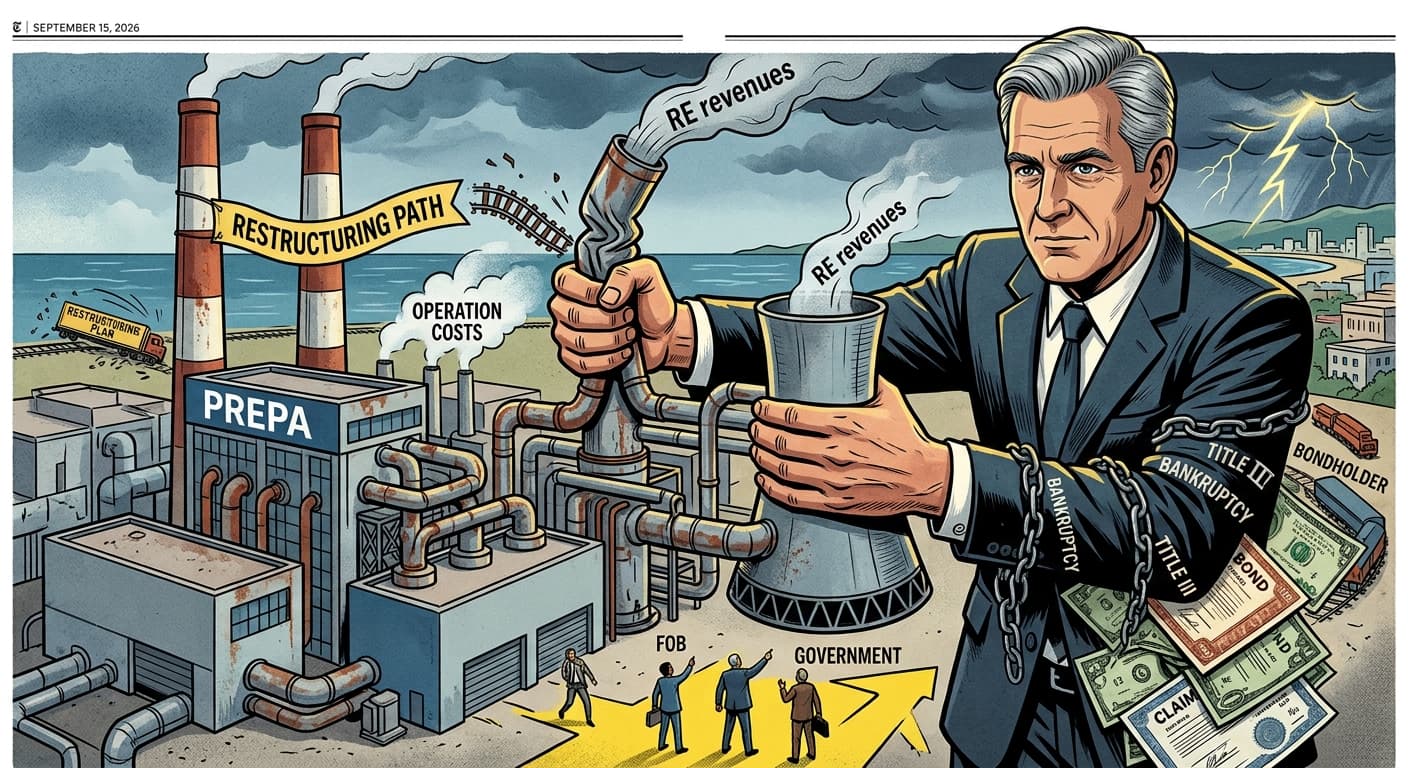
The case centers on a fundamental restructuring question: How should bankruptcy courts treat collateral (money pledged as security for a loan) when a debtor consumes it during bankruptcy? If bondholders win their appeal, the result could create what the Financial Oversight Board warned would be a “chokehold claim,” capable of destabilizing PREPA’s entire path to emerging from Puerto Rico’s Title III bankruptcy process.
At the core is a prior court ruling. The First Circuit previously held that the bondholders have a “valid, perfected and unavoidable lien” on PREPA’s net revenues, the money left over after the utility pays its operating costs. That lien was issued before PREPA filed for bankruptcy. But during the bankruptcy, and with court approval, PREPA used those pledged revenues to keep the electrical system running and to finance the restructuring case itself.
Bondholders now say PREPA should compensate them for that use. Under bankruptcy law, they argue, consuming collateral that belongs to a creditor is the same as incurring an “administrative expense,” a cost of running the business during bankruptcy that gets paid before other debts.
If that argument succeeds, bondholders could jump ahead of unsecured creditors in the repayment queue.
“PREPA’s spending of collateral constitutes actual, necessary and highly beneficial expenses,” GoldenTree Asset Management’s attorney Glenn Kurtz told the court, warning that the district court’s ruling “incentivizes theft” by allowing a debtor to consume cash collateral without negotiating compensation.
Assured Guaranty’s counsel, Miguel Estrada, added that bondholders have been forced into “involuntary credit” because bankruptcy law’s automatic stay (a freeze on all creditor collection efforts) prevents them from enforcing their lien rights while the case proceeds.
The PREPA Ad Hoc Group advanced a bolder legal theory. They assert that PREPA’s conduct amounts to a Fifth Amendment taking (seizing private property without “just compensation”) and a post-petition conversion tort (illegally using someone else’s property). Attorney Eric Brunstad told the panel that the destruction of lien rights “satisfies every possible element of a Fifth Amendment taking.”
Bondholders insisted they had repeatedly sought stay relief only to be blocked by the court and that PROMESA does not bar administrative expense treatment.
But the Financial Oversight Board, the Puerto Rico government, and PREPA’s unsecured creditors pushed back hard against the bondholders’ theory. They argue that Puerto Rico’s bankruptcy law, called PROMESA, has its own framework specifically for handling collateral in municipal bankruptcies. Under that framework, bondholders must pursue “adequate protection” through stay-relief proceedings, not administrative expense claims.
Unfair subordination?
What is “adequate protection”? In bankruptcy, when a debtor wants to use collateral, the creditor holding the lien can ask the court for replacement security, such as another lien on different assets or periodic cash payments to compensate for the collateral’s declining value.
The Oversight Board’s lawyer, Martin Bienenstock, told the court that PREPA continuously generates new net revenues, so the collateral hasn’t diminished in value and bondholders are adequately protected already.
Bienenstock warned that granting bondholders’ request would “swallow the rule” governing administrative priority. In other words, it would overturn the careful framework for prioritizing creditors in municipal bankruptcies.
Puerto Rico’s counsel, Peter Friedman, struck an even sharper note: the bondholders’ theory would create a “chokehold claim” capable of derailing PREPA’s restructuring entirely. The unsecured creditors’ committee added that bondholders failed to diligently pursue adequate protection and that elevating them to administrative expense status now would unfairly subordinate other creditors who played by the rules.
Bondholder attorneys rejected those assertions in rebuttal. They insisted they had repeatedly sought stay relief only to be blocked by the district court and that PROMESA does not bar administrative expense treatment.
The First Circuit took the matter under advisement. The court’s decision will turn on a narrow but high-stakes legal question: whether PROMESA’s special framework for municipal bankruptcy collateral treatment overrides the federal bankruptcy code’s general administrative expense rules.
For PREPA, the stakes are existential. The utility remains in Title III bankruptcy with more than $9 billion in debt, and any restructuring plan must account for how much creditors will recover. If bondholders can jump the payment queue through an administrative expense claim, the entire recovery calculus shifts.
A different recovery outcome could make a viable restructuring plan harder to achieve and delay PREPA’s emergence. That delay cascades in consequences: higher energy costs as regulatory costs rise, and continued uncertainty about the island’s power supply, which remains a fundamental constraint on Puerto Rico’s ability to attract investment and grow.
With procurements frozen, plants unbuilt, and solar hitting its limits, Project Hostos has become Puerto Rico’s least encumbered path to significant new capacity. A Paris impact award suggests the market has noticed.
The company argues federal court has jurisdiction over disputes tied to the utility’s Title III bankruptcy, citing recent precedent; PREPA counters in favor of transferring to Swain
New Fortress restructuring transfers control of the island’s power-generation assets to debt holders, raising questions about future PREPA negotiations and policy.