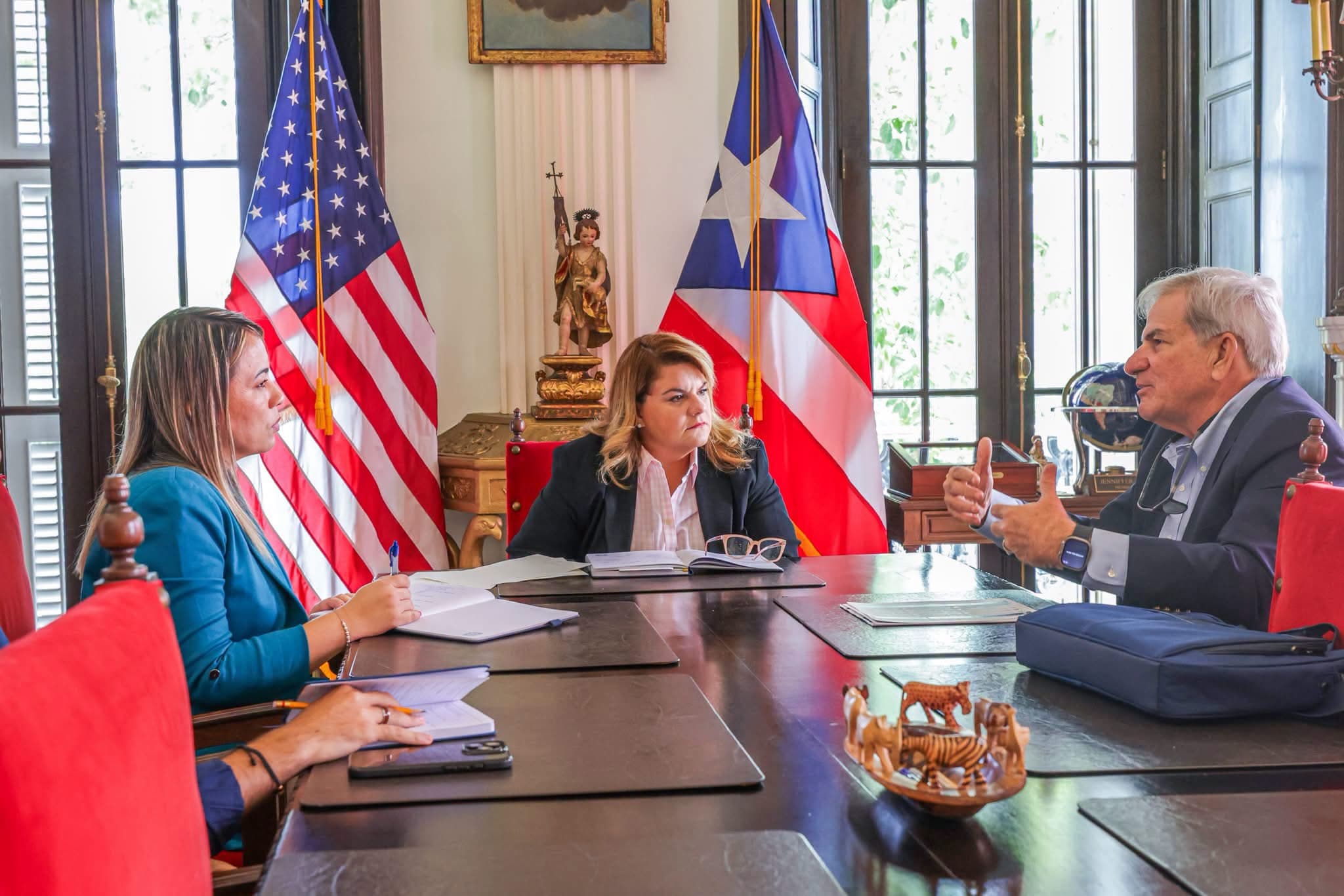
“I told the Governor that we need to use the Infrastructure Financing Authority to begin to understand the infrastructure challenges of the pipeline; we do not have a sound study to understand whether the recent faults are normal,” Pesquera stressed.
“The benefits of using AFI is that we can have the proper governance because right now, the Superaqueduct is managed by a private company. We don’t have knowledge of whether the faults are normal,” Pesquera said.
A private consortium that included Thames-Dick operated the Superaqueduct, but now the project is operated by Jacobs, a professional services company. The Puerto Rico Aqueduct & Sewer Authority (PRASA) is the owner.
Because of his vast experience with the water pipeline that helped then-Gov. Pedro Rosselló to establish a contingency plan to mitigate the devastating effects of a historic drought in 1994, Pesquera is well acquainted with the vast economic impacts of a water crisis. Thirty years later, he is warning that Puerto Rico needs to be active, rather than reactive.
Pesquera outlined to the government a comprehensive, long-term infrastructure plan aimed at resolving the persistent water shortages and service instability affecting Puerto Rico’s metropolitan region, where 1.5 million people live.
The proposal, which he provided to Caribbean Business, brings together three major components: the expansion of the Sergio Cuevas and Enrique “Richie” Ortega water treatment plants, and a long-term modernization strategy for the Island’s Superaqueduct.
Taken as a whole, the plan seeks to stabilize production capacity, strengthen system resilience, and shift Puerto Rico’s water management model from reactive crisis response to sustained, data-driven oversight.
Pesquera’s proposal calls for significant investment in the two treatment plants that anchor the San Juan metro system.
The Enrique “Richie” Ortega facility is scheduled for completion in 2028, while the Sergio Cuevas plant is projected to finish in 2030. Together, the projects represent $890 million in construction and modernization work.
The upgrades are designed to increase water production, improve treatment reliability, and ensure that the system can meet demand during peak usage and emergency conditions. Both plants are already under construction, and Pesquera argues that their phased expansion will deliver measurable improvements even before full completion.
The Superaqueduct Initiative
A central element of his plan is the Superaqueduct Initiative, which he frames as a long-term asset management strategy rather than a single construction project. The $585 million mega-pipeline spanning 42 miles that transports raw water from Arecibo to the San Juan metro and eastern regions went into operation in 2000.
However, aging water infrastructure and heavy water pressure have caused the massive 72-inch pipe to rupture in multiple locations.
The initiative would begin with the procurement of an international engineering team to conduct a full technical assessment of the system. That assessment would feed into a capital improvement master plan, followed by an eight-year implementation period focused on rehabilitation, modernization and resilience upgrades.
The final phase would establish continuous monitoring and predictive maintenance, replacing the Island’s traditional reliance on emergency repairs. Pesquera emphasizes that effective management requires accurate measurement and real-time system diagnostics.
He also recommended that AFI serve as the lead agency overseeing the initiative. Under the plan, AFI would not be a supporting actor, but rather the entity charged with imposing order, continuity and technical discipline on a system that has suffered from fragmentation, slow procurement and chronic operational blind spots.
AFI would serve as the primary integrator of all engineering, procurement and long-term asset-management functions.
Pesquera affirms that only AFI has the institutional structure, statutory authority and project-management capacity to oversee a multi-year, multi-phase modernization effort of this scale.
The agency would also be responsible for hiring and supervising an international engineering team, conducting a full technical assessment of the pipeline and developing the capital improvement master plan that will govern the next decade of investments.
In practical terms, AFI would become the command center, the entity that sets standards, enforces timelines and ensures that every contractor, consultant and PRASA division is working from the same technical blueprint.
The plan also assigns AFI the role of continuity guarantor, ensuring that the modernization effort does not stall or drift as administrations change. Pesquera stresses that the Superaqueduct cannot be managed through short political cycles; it requires a stable, technically competent authority capable of sustaining oversight through planning, con-struction, rehabilitation and the transition to predictive maintenance.
AFI’s governance structure would allow it to maintain long-term focus, shield critical infrastructure decisions from political turbulence, and enforce accountability across agencies.
AFI would be tasked with establishing the data-driven management model that will replace Puerto Rico’s reactive repair culture. The agency would oversee the deployment of monitoring systems, diagnostics and performance metries that allow the Superaqueduct to be managed proactively rather than through emergency responses.
Pesquera frames this as a foundational shift: AFI becomes the steward of the Island’s most important water asset, responsible for ensuring that decisions are based on measurement, not improvisation.
In Pesquera’s vision, AFI would not simply be coordinating projects-it would reassert control over a critical public utility, imposing technical rigor, and delivering the long-term water stability that Puerto Rico’s metropolitan region has lacked for years.
Pesquera’s proposal presents a unified vision: expanding treatment capacity, modernizing critical infrastructure, and adopting long-term asset management practices to secure reliable water service for the metropolitan region. The plan positions water security as a prerequisite for economic growth, housing development and climate resilience.
Pesquera estimates that capital expenditures could reach $400 million, but cost largely remains unknown until a viability study is conducted.
Warnings on the Importance of Maintenance
In a first white paper published in 2025, Pesquera forewarned of the importance of regular maintenance of the Superaqueduct.
“The Superaqueduet should be recognized as a critical state asset,” he stated. “A critical state asset is infrastructure whose failure or serious deterioration could affect public health, economic stability, essential services, and the normal functioning of so-ciety. The Superaqueduct meets that stan-dard. Its importance is not limited to the pipe itself. Its value lies in its role within a broader system of reservoirs, raw water sources, pumping stations, tanks, control systems, interconnections, and distribution networks.”
As this newspaper was going to press, the Governor was out of the Island and could not answer requests for comment.
Pesquera warned in his 2025 white paper that a major interruption could affect not only residential customers, but also hospi-tals, schools, government facilities, tour-ism, commerce, industry and major development initiatives.
“That is why the system should be managed proactively, not reactively. The wrong question is, how much longer will the Su-peraqueduct last? The right question is, what permanent management asset program is needed to keep the Superaqueduct reliable for decades? This distinction mat-ters,” he added.
A Full-Scale Crisis
Puerto Rico’s water system has been under mounting strain for more than a year, with recurring outages, low pressure and prolonged service interruptions affecting tens of thousands of residents across the metropolitan region. Aging infrastructure, deferred maintenance and slow-mov-ing capital projects have left key filtration plants and pump stations vulnerable to breakdowns.
As conditions worsened, frustration among residents and municipal leaders intensified, turning what began as isolated service failures into a full-scale governance crisis.
San Juan took the most aggressive step. After months of unstable service across neighborhoods from Condado and Ocean Park to Hato Rey, Cupey and Río Piedras, Mayor Miguel Romero filed a lawsuit against PRASA, arguing that the utility had failed in its ministerial duty to provide continuous and adequate potable water.
The city had already declared two municipal emergencies,
deployed water trucks, staffed oasis sites, and spent hundreds of thousands of dollars on response operations.
The lawsuit sought a court order compelling PRASA to stabilize services and improve transparency. A stipulation later created a ioint Stabilization and Restoration Committee, giving San Juan direct access to operational information and decision-making for the metropolitan system.
Other municipalities have voiced similar concerns. Bayamón has endured nearly a year of intermittent service following the failure of major pumps at the Finca Rosso I station. With only half the necessary pumping capacity available, Bayamón has relied on municipal water trucks, temporary tanks, and community cisterns to meet basic needs.
The city commissioned its own mul-timillion-dollar study to explore long-term redundancy options, arguing that PRASA’s delays forced municipalities to shoulder responsibilities that should fall to the utility.
The mayors of Guaynabo, Trujillo Alto, Carolina and Cataño have also raised alarms, reporting neighborhoods where water arrives only sporadically or not at all. Some have opened emergency distribution points; others have pressed PRASA for clearer timelines and more consistent communication.
Across the metro area, municipal leaders describe a pattern of reactive fixes, slow procurement and limited visibility into PRASA’s operational decisions.
Together, these actions reflect a growing consensus: Puerto Rico’s water woes are no longer isolated technical failures but a systemic challenge demanding structural reform, sustained investment, and a new model of accountability.”