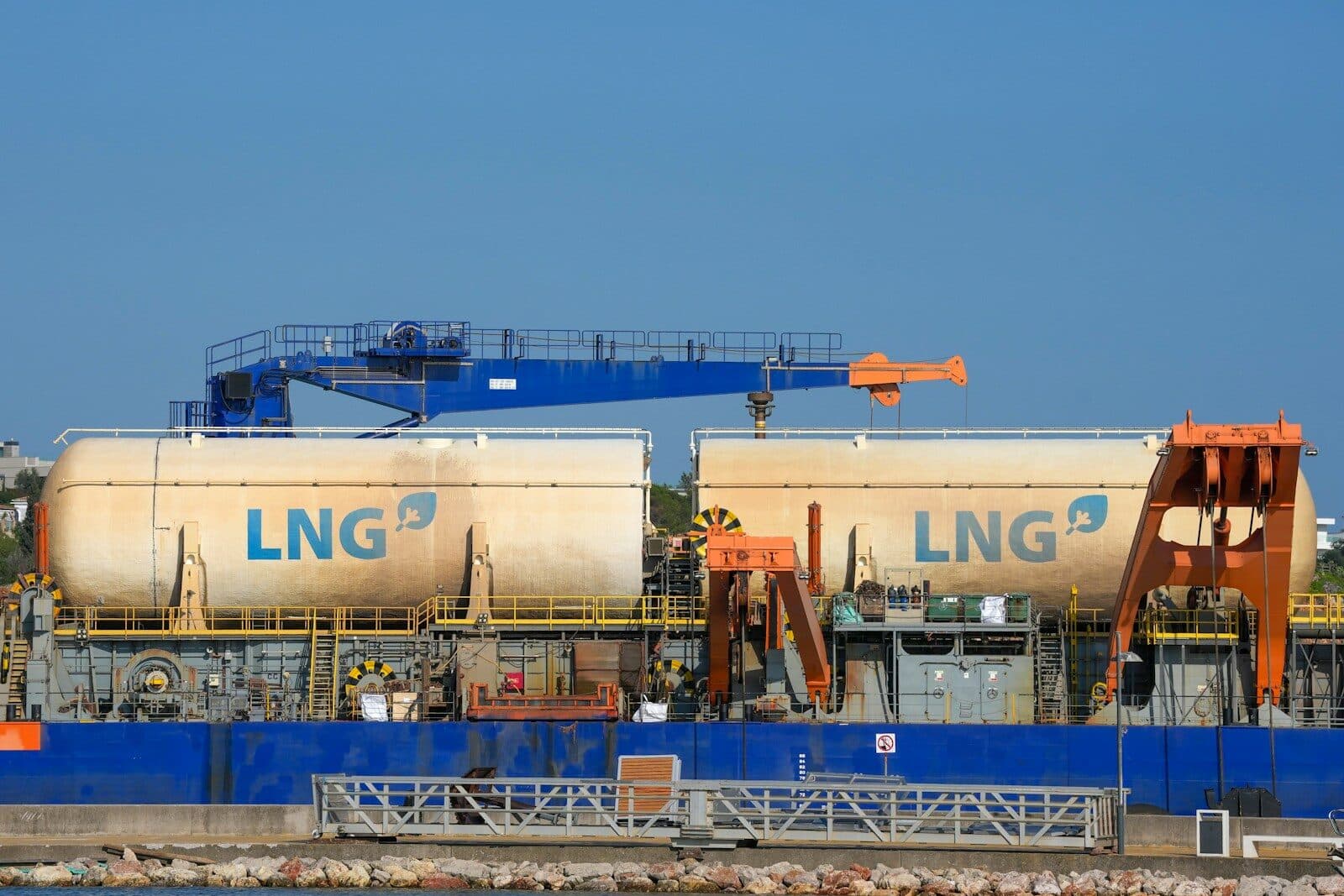
Maritime and logistics company Crowley said it is working with the Puerto Rico government to finalize a natural gas supply agreement and could begin deliveries once the contract is signed and approved and the required tolling arrangements are in place.
“Once the agreement has been signed and approved, and the corresponding tolling arrangements are in place, Crowley will be able to begin delivering liquefied natural gas in ISO tank containers to the temporary generation units at both power plants,” the company said.
Gov. Jenniffer González Colón announced Thursday that the government had reached a preliminary agreement with Crowley to serve as a potential natural gas supplier under a tolling arrangement designed to reduce the island’s reliance on costly diesel generation.
Speaking at a press conference in La Fortaleza, González said the agreement with Crowley represents the most advanced of several negotiations underway with companies interested in supplying natural gas to Puerto Rico amid the government’s ongoing dispute with New Fortress Energy.
The governor said the administration will notify the federal court overseeing the matter that Crowley has expressed its willingness to participate in a tolling arrangement, which would allow a third-party supplier to use New Fortress infrastructure to deliver natural gas when the current supplier is unable or unwilling to fulfill contractual obligations.
“We have finally been able to establish an agreement for tolling with Crowley,” González said. “The objective is to have more than one natural gas supplier so we do not find ourselves in this same situation again.”
The agreement has not yet been finalized and remains subject to court approval. González stressed that the government cannot formally execute any arrangement until the court authorizes the activation of the tolling provisions at the center of ongoing litigation involving New Fortress.
The governor said discussions involving the Financial Oversight and Management Board, the Puerto Rico Energy Bureau, government attorneys and energy officials have been taking place nearly every day as the administration seeks alternatives that could lower electricity costs.
According to González, securing alternative natural gas suppliers would allow power generators currently operating on diesel to switch back to natural gas, reducing fuel costs and ultimately moderating electricity bills throughout the metropolitan area.
Crowley is one of three companies engaged in discussions with the government. While negotiations continue with the other firms, González described Crowley as the company closest to reaching an agreement.
Following the Puerto Rico governor’s announcement that the Third-Party Procurement Office (3PPO) had reached an agreement with an alternative supplier of liquefied natural gas, NFEnergía LLC in a statement expressed its readiness to finalize, as soon as possible, the agreement that will allow it to receive, regasify and deliver the fuel to the San Juan and Palo Seco power plants.
The use of alternative natural gas suppliers is an option provided for in the existing contract between NFEnergía and the Puerto Rico Electric Power Authority (PREPA), through a mechanism known as tolling, which allows third parties to use the company’s facilities.
As of November 2, NFEnergía had certified to the federal court that its facilities were available for these purposes, submitted the operating procedures and technical requirements, and exchanged draft agreements with PREPA, in accordance with the schedule established by the court.
Legislative inaction
During the press conference, the governor delivered a broad critique of legislative inaction on a series of initiatives she argues are critical to Puerto Rico’s economic growth and fiscal stability.
Among the measures left unfinished were two proposals negotiated with the Financial Oversight and Management Board to establish a budget reserve fund and a capital improvements fund. González said both measures passed the House but were defeated in the Senate.
She characterized the proposals as fiscally prudent tools that would help reinforce long-term budget stability and prepare the government for future economic challenges.
The governor also highlighted a failed proposal that would have reduced taxes on capital gains for local investors. The administration had proposed extending to Puerto Rico residents a preferential tax treatment similar to incentives available to certain outside investors.
Under the proposal, the tax rate on qualifying capital gains could have fallen significantly from current levels. González argued the measure would have encouraged local investment while placing Puerto Rican investors on a more equal footing with newcomers benefiting from existing incentive programs.
Another measure that stalled involved a comprehensive assessment of the island’s Superaqueduct system. González said engineers had recommended a review of the aging infrastructure to identify vulnerabilities before major failures occur.
She also expressed disappointment that the Senate did not act on a nomination that would have placed former Transportation and Public Works Secretary Carlos Pesquera on the Puerto Rico Aqueduct and Sewer Authority board.
Energy-related legislation also failed to advance, including a measure modeled after Commercial Property Assessed Clean Energy, or C-PACE, programs operating in dozens of U.S. states.
According to González, the proposal would have enabled private businesses to finance solar panels and battery-storage systems without requiring substantial upfront capital investments. The governor said the initiative could have accelerated renewable-energy adoption while reducing electricity costs for commercial customers.
Another measure left pending would have implemented provisions related to federally promoted “Trump Accounts,” a savings incentive program designed to provide additional financial assistance to families with very young children.
The governor reserved some of her strongest comments for the administration’s sweeping permitting reform initiative, a cornerstone of her economic development agenda.
The legislation seeks to consolidate Puerto Rico’s permitting framework into a single code intended to reduce approval times, simplify processes and provide greater legal certainty for investors. González said the executive branch accepted approximately 76% of amendments proposed by the Senate, but major disagreements remain.
She argued that some Senate changes would create additional layers of bureaucracy rather than streamline development approvals.
“We need legal certainty through a permitting reform,” González said, comparing Puerto Rico’s current permitting process unfavorably to states such as Florida and Texas, which she cited as examples of more efficient systems.
The governor indicated she remains open to negotiations and suggested permitting reform could be revisited when lawmakers return in January, though she did not rule out the possibility of a special legislative session before then.
Such a session, she said, could be used to consider energy-relief measures tied to electricity costs, including legislation intended to reduce the impact of power bills on consumers and advance alternative-energy financing programs.
Beyond legislative matters, González announced that the Office of Management and Budget had formally submitted to the Fiscal Oversight Board a recommendation to approve payment of $66 million in audited teacher career incentive obligations accumulated between 2018 and 2026.
The payment would represent the majority of an estimated $90 million owed to educators for advanced academic credentials and professional development incentives that she said had gone unpaid for years.