When VRM Companies President & CEO Rafael Rojo was on his first climb to the pinnacle of the roller coaster ride called Real Estate, prior to the screaming drop in 2008, his mentor VRM Companies Founding Partner Joche Valdés gave him sage advice to keep an eye out for the coming cliffs.
“You have to plan always thinking there could be a cliff out there; you guys have never been through las vacas flacas — he always made us very mindful of that,” recalls Rojo during a recent interview that took place inside VRM Companies headquarters.
Like so many developers at the time, Rojo had a string of hits with developments — Palacios Reales in Bayamón, Paseo Los Corales in Dorado, Palacios del Monte in Toa Baja- over 41 developments and 7,973 units up to 2006— sold out across more than a decade while the myth of abundance was in full swing. He remembers heeding Valdés’ advice while his train was still atop Real Estate Mountain when the market suffered those first violent shudders in 2006.
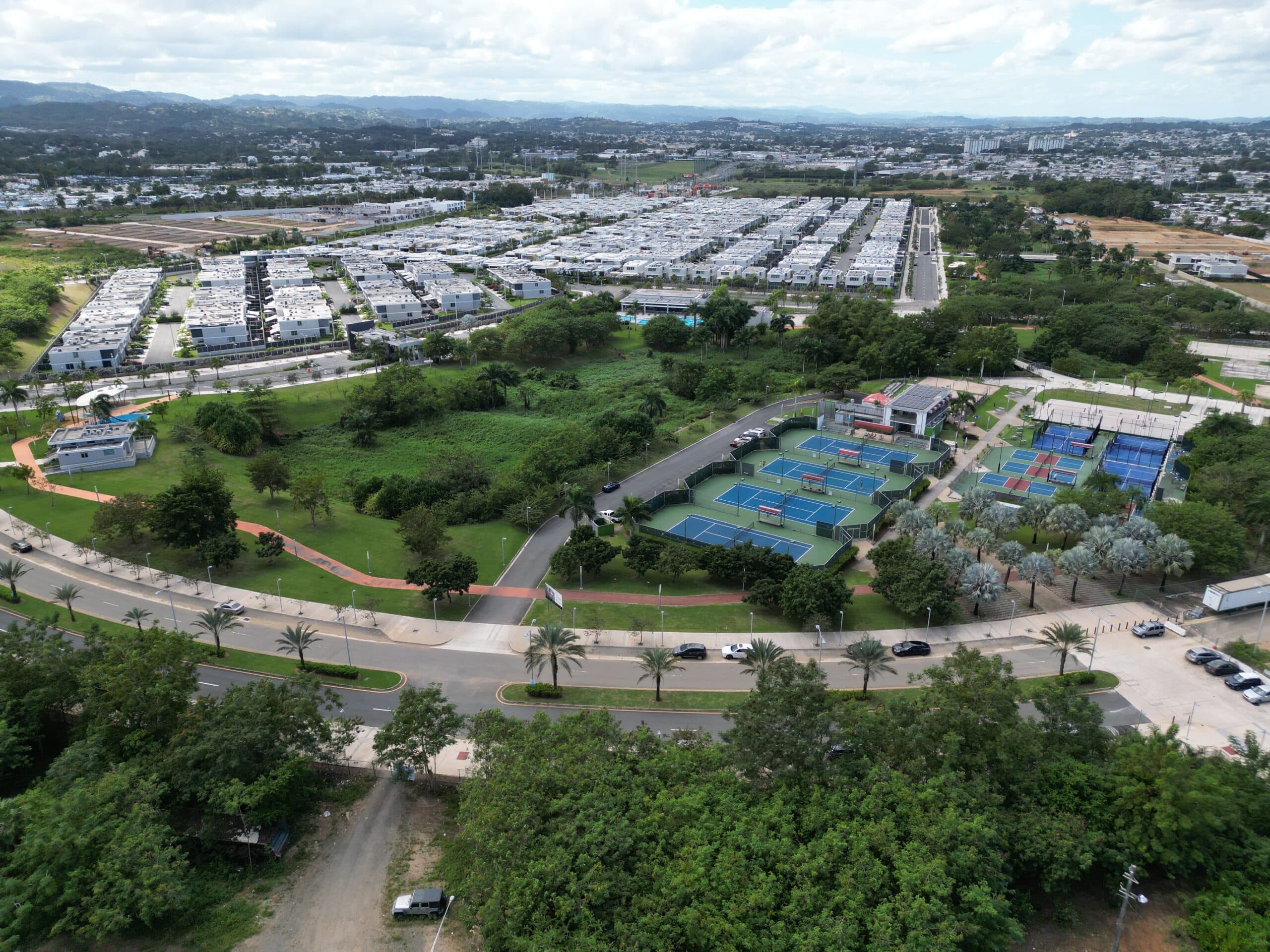
The photo on the left shows Rio Bayamón Norte plots of land in disrepair; the photo on the right is a view of the same area after VRM Companies developed Riviera.
To its credit, VRM Companies’ management weathered the tempest of 2008, while the housing market crashed across the U.S. mainland and in Puerto Rico, where people defaulted on mortgages in record numbers. The global economy’s near collapse — securitized subprime mortgages weighing heavily on an overexposed global insurance giant AIG — sent shockwaves throughout Europe. Puerto Rico expectedly fared far worse. VRM hunkered down while it kept eyes peeled for opportunities.
A Rising Tide Floats All Boats
Less than a decade later, the multiplier effect of VRM’s cautious penchant for growth is exemplified in Riviera, the master-planned community of roughly 1,000 residential units straddling the Bayamón-Guaynabo line on Avenida Los Filtros (PR-177).
This community encompasses five neighborhoods with homes that have helped amass wealth for homeowners while also raising the value of homes in the area.
“This shows that Puerto Rico needs a lot more Rivieras, as well as recreational and sports facilities available to the public”
Rafael Rojo, VRM Companies, President & CEO
During a recent wide-ranging conversation, Rojo let on that VRM Companies conducted an analysis of home sales and resales in Riviera using data from the Puerto Rico Property Registry. The study documented that 57 families who resold their properties earned a total of $21 million. Furthermore, the company estimates the value of the homes that their owners still retain at $126.2 million. Between 2019 and 2026, 428 homes were delivered, with a total sales value of $300.3 million.
Rojo recalled that VRM’s investment in the technology company Braintrust caught wind that the property would be put up for public auction after the wind beast named Maria devastated the Island in 2017. “It was publicized everywhere. That’s how we found out,” Rojo recalls with a furrow in his brow. “We thought this would attract a lot of attention. We thought there would be many Act 22s (now named the Act 60 Incentives Code). Which, if you think back in those days, there were some investors. But early on the program was in diapers.
“We thought it would attract many. To our surprise, after we submitted our bid and we were awarded the project, we found out we were the only bidders. Which is pretty crazy. And look at the community that’s there now. But then again, I have to remind myself that this happened in 2018, a year after Hurricane Maria. Puerto Rico was in distress,” Rojo adds.
Importantly, the VRM development brigades looked at a project that had been abandoned and shelved after the Government Development Bank went belly up in 2016 and they saw an opportunity to build a thriving community. Although the land in former Río Bayamón Norte was in disuse and strewn with a few abandoned cars and poor electric infrastructure, the residents in neighborhoods bordering the future hub of a thriving community benefitted from well-lit roads before the complex remediation of soil was commenced, requiring an eventual investment of nearly $5 million.
“The honest truth is that we just saw this as an important piece of land in a fantastic area; if the economic conditions weren’t there quickly, we would just sit on this property and develop it slowly as the conditions would require,” Rojo explains. “Never did we model, not even the price points, nor the timing that it has taken us to develop.”
Rojo noted that the project had very conservative price points tracing to what the market would bear. Colleagues in the industry believed the developer should have had his head examined for doubling down on the project during such uncertain times. Then COVID-19 happened and the housing market got a fever soon thereafter.
“It was incredible demand that pushed prices up. It pushed costs up as well. So luckily, both things came at once,” Rojo says with perspective coloring the sound of his voice. “That doesn’t happen too often. So, we were able to increase prices to cover our costs.”
Manos a la Obra
Plot-by-plot, foremen and engineers built intelligent homes with state-of-the-art infrastructure. The plot of land where tennis courts once sat empty with nets in tatters, is now a Tennis complex that has evolved over the years. When beach tennis was all the rage, Riviera Tennis Center featured eight tennis courts; VRM built six additional beach tennis courts.
“We adapted to market reality. Now we have 10 pickleball courts and three padel courts. We’ve grown the facilities,” he says, nodding in disbelief at the transformation. Today, the Tennis Center rivals top oceanside centers on the Island.
“We gated the community, but we left the Tennis Center open,” Rojo explains. “We thought that if we left the Tennis Center with access to the open community, adjacent communities, and our residents as well, it would create a much better vibrant sports facility. Which does mean that, yes, our customers sometimes will not find available courts, but when they go and play, every court is full. It is vibrant.”
The Riviera Tennis Center has hosted NCAA tournaments. Tennis stars Serena Williams, Carlos Alcaraz and William Tiafoe have offered tennis clinics free-of-charge. “By doing that, we not only improve the lives of our customers, but we also improve the lives of all the adjacent and surrounding communities. We have a great bar and grill. And it’s just a community hub. I think the value that we have derived for our residents just by keeping that accessible to the outside community has been immense,” Rojo says.
Up next is Riviera Sunset, which is under construction, and Riviera Marketplace.
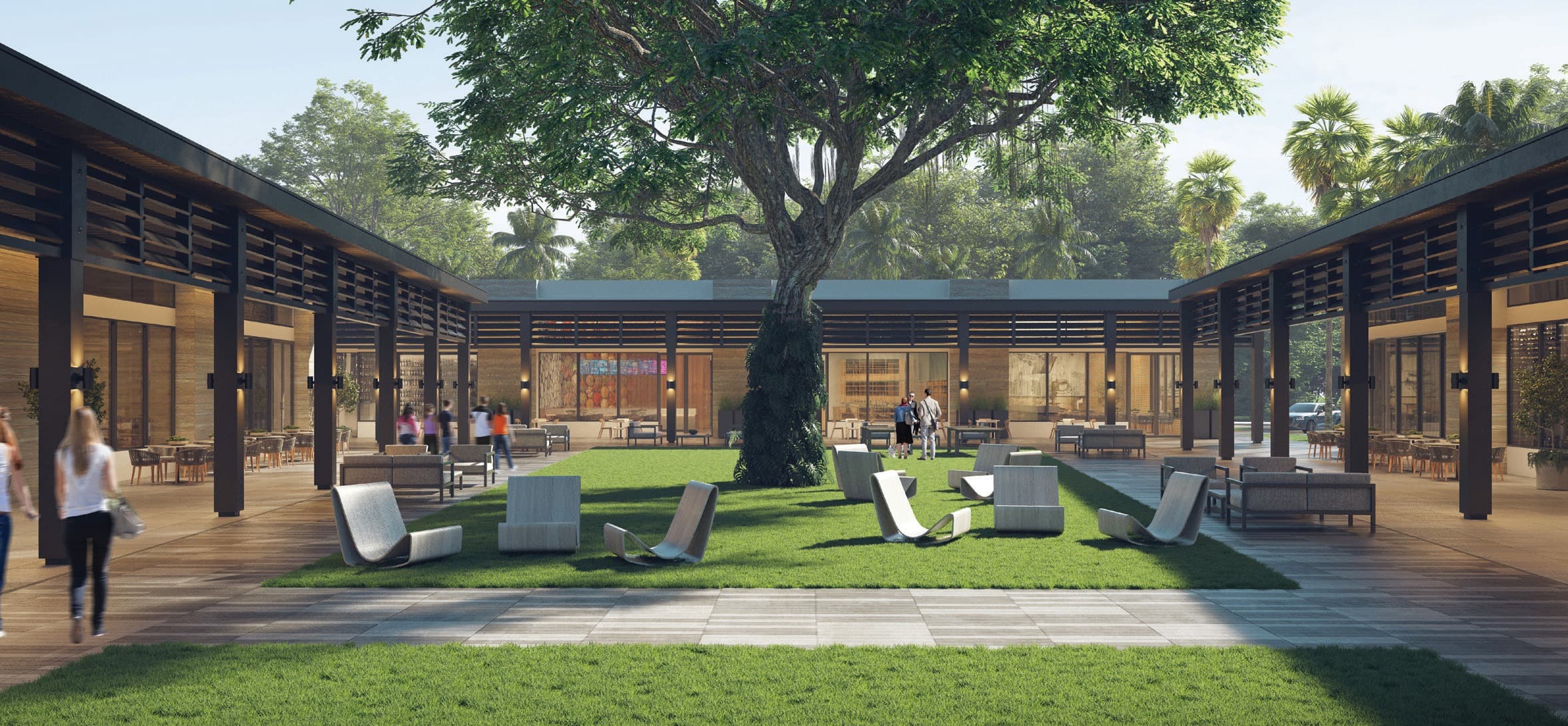
Riviera Marketplace is a place that looks more like the quad of a college campus for up-and-coming professionals who want to hang out with their children in an environment that is safe. “We wanted to create a place where you could go and sit with your kids, and they could run around freely while you dine or have a drink or a coffee, and they could run around and cross over to the Tennis Center and come back, and you feel safe. Right. And that’s what we wanted to create. That is the vision,” says Rojo, who initially thought this vision would become headwind for the drive to recruit the ideal tenant mix.
“Retailers are trained to think traffic and exposure. Right? And this is a destination. But they saw it because, again, also, restaurateurs, they not only sell food, they also sell an experience. We wanted to create a really nice one,” Rojo explains.
At this writing, the Marketplace is scheduled to open during the upcoming holidays. The tenant mix includes: Dr. Enrique Gorbea; Mexican restaurant 5 de Mayo; APEX chiropractors; GSKN; Casa Yoga; Entre Humos; La Santurcina and Santurcina Cocktails. “Others might be having pizza maybe… at La Santurcina. And then they will go out and just enjoy and have their kids running around in the big covered terraces that we provided.
“One of the things that really strikes me incredibly well is that when you go to the different activities with our customers, people walk up to me and say, ‘if Riviera had not existed, I would not be living in Puerto Rico. I wanted to come back, but I did not find the community that I was looking for. I was able to buy here, and now I’m living here. I’ve heard Houston, I’ve heard Florida. Thanks that this project exists. I’m very happy living here in Puerto Rico,’” Rojo recalls.
“This shows that Puerto Rico needs a lot more Rivieras, as well as recreational and sports facilities available to the public.”
In the cover photo above: the Tree of Life is a symbol of community in the Riviera Marketplace quad.
Tracing every resale in the Property Registry, VRM found its Bayamón homes rose 56% against a 10% island index and a neighboring complex doubled, a measure of how housing can fuel a recovery from the household up
The manufacturer has added capacity for solar projects and a new warehouse, even as a 50% U.S. steel tariff and a stalled economy test the market it is building for
The 65-year-old Carolina distributor joins others betting on building demand, even as a stalled economy and a 5,000-unit housing shortfall cloud the outlook