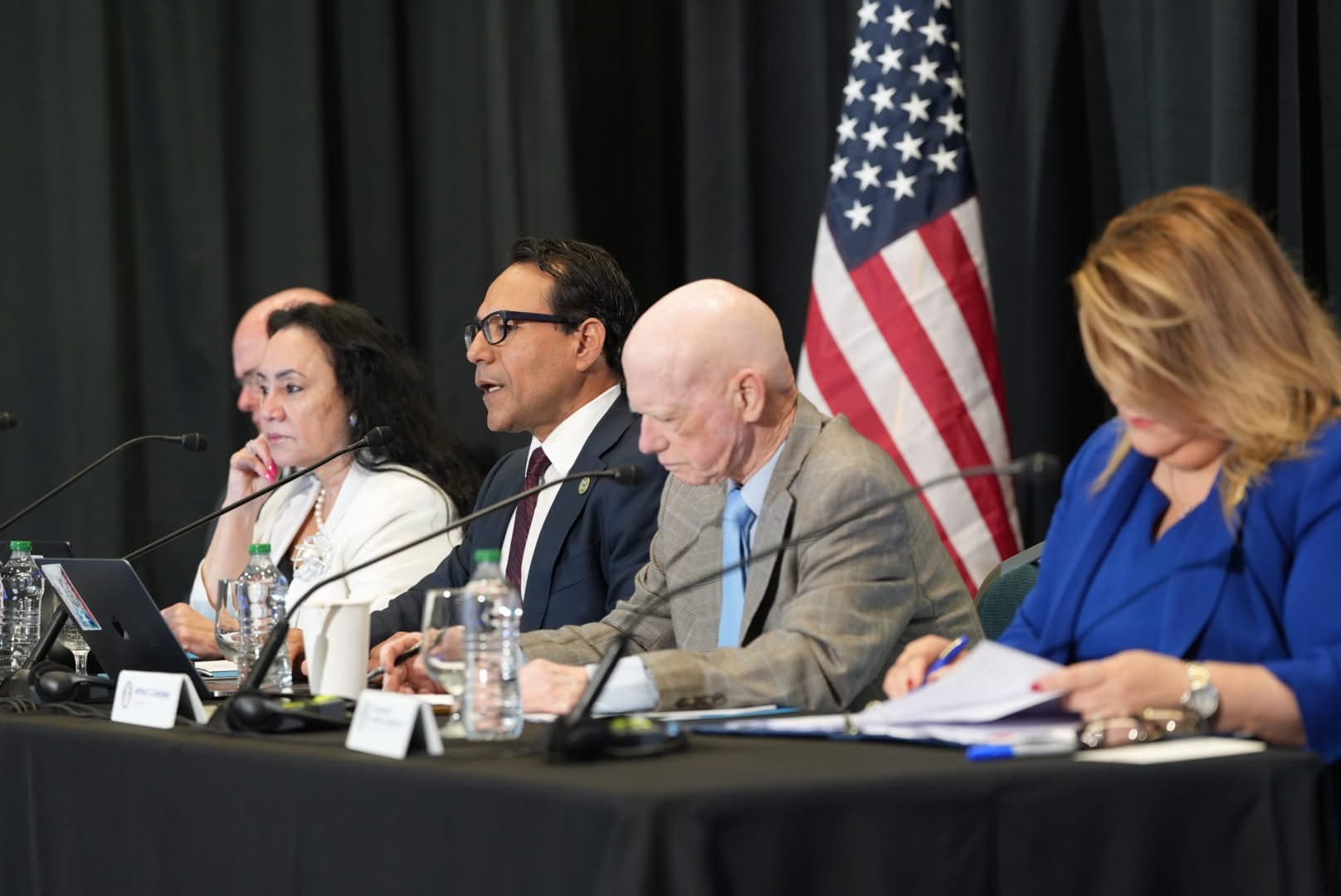
In a pair of key legislative updates, the Financial Oversight and Management Board (FOMB) has given its preliminary blessing to two controversial legislative proposals. In letters sent on Thursday, June 4, 2026, to House Speaker Carlos “Johnny” Méndez Núñez, FOMB Executive Director Robert F. Mujica Jr. confirmed that both a sweeping overhaul of Puerto Rico’s […]
In a pair of key legislative updates, the Financial Oversight and Management Board (FOMB) has given its preliminary blessing to two controversial legislative proposals.
In letters sent on Thursday, June 4, 2026, to House Speaker Carlos “Johnny” Méndez Núñez, FOMB Executive Director Robert F. Mujica Jr. confirmed that both a sweeping overhaul of Puerto Rico’s notorious permitting system (HB 1213) and a restructuring of the island’s minimum wage decision-making process (HB 1115) are “not inconsistent” with the Commonwealth’s Certified Fiscal Plan.
The most complex measure reviewed by the Oversight Board is House Bill 1213, which aims to dismantle decades of red tape by creating a unified Planning and Permitting Code.
The ambitious bill seeks to replace Puerto Rico’s heavily fragmented bureaucracy by completely repealing 15 existing permitting laws, amending 29 others, and aligning 29 special laws into a single, cohesive framework.
Executive Director Mujica noted that the island’s current permitting system has long been an obstacle to economic development, describing it as time-consuming, costly, and highly unpredictable. The FOMB believes HB 1213 directly aligns with Fiscal Plan goals to help Puerto Rico compete with the U.S. mainland.
The Board projects that a streamlined, digitally traceable system will yield massive macroeconomic benefits, including faster approvals for business construction, commercial openings, and affordable housing developments. The Board also said speeding up business launches means the government collects corporate income, municipal license, and sales and use taxes (IVU) much sooner.
The opposition to House Bill 1213 primarily centers on concerns regarding the centralization of power, the reduction of municipal autonomy, and severe threats to environmental protections.
While the Board gave a preliminary green light, it attached major strings. The FOMB stressed that the final bill must be budget-neutral. The government must efficiently redistribute existing personnel and systems without inflating the budget and maintain a robust cost-recovery model through user fees.
The second letter addressed House Bill 1115, a measure that aims to fundamentally change who decides minimum wage hikes in Puerto Rico.
Currently, under Act 47-2021, a specialized Minimum Wage Evaluation Commission handles rate adjustments. HB 1115 would eliminate that commission and return sole authority to set minimum wage changes to the Legislature.
According to the bill, the Legislature would convene every four years to determine if a wage hike is warranted, shifting accountability from an “unelected board” back to voters. Opponents of HB 1115 — authored by Rep. Roberto López Román — say this move would open the door to decisions driven by partisan interests rather than by economic data or the realities workers face.
The Oversight Board determined the bill is consistent with the Fiscal Plan for one simple reason: it doesn’t actually change the current minimum wage right now. Because the bill only alters the mechanism for future increases and doesn’t mandate immediate rate hikes, it has no immediate impact on government revenues or expenditures.
However, Mujica issued a clear warning for the future. The FOMB noted that any future minimum wage adjustments proposed by the Legislature will be intensely scrutinized for their ripple effects on the broader economy. “The Oversight Board will assess any proposed measure that adjusts the minimum wage by considering the effects on tax revenues, private-sector competitiveness, inflation, and labor force participation rates,” Mujica wrote.