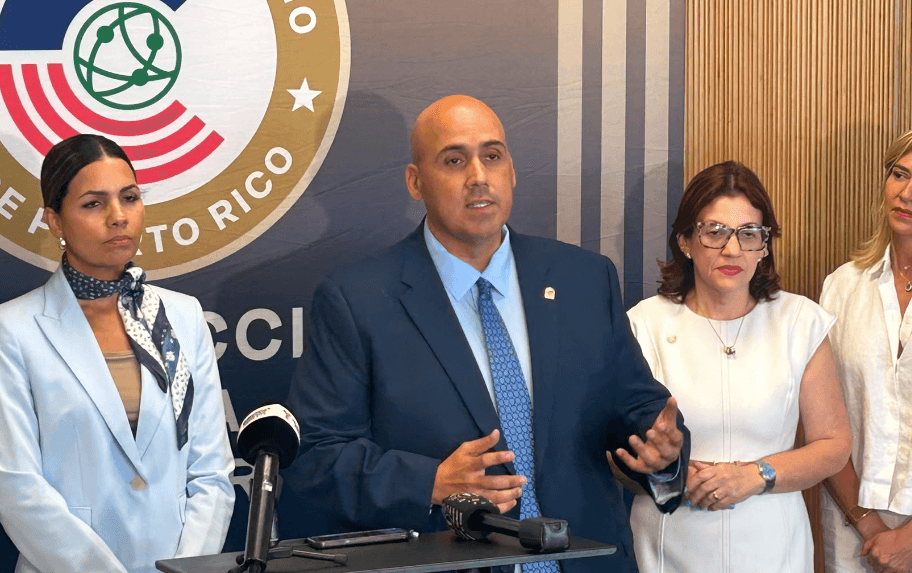
CCPR President Aparicio Laspina says daily agency contact has cut response times and won the Chamber a seat on the Business Operations Center.
The Puerto Rico Chamber of Commerce (CCPR) has been incorporated into the government’s coordination with businesses during the island’s ongoing water emergency, a move the organization says is already producing faster communication, more coordinated action, and clearer channels for businesses seeking assistance.
The Chamber’s inclusion in the Drought Committee and its direct communication with the Water Czar, the Puerto Rico Aqueduct and Sewer Authority (AAA), the Department of Economic Development and Commerce (DDEC), and the Puerto Rico Tourism Company mark a significant shift in how private-sector concerns are incorporated into emergency management.
CCPR President José “Che Julio” Aparicio Laspina said the new structure has enabled daily, fluid communication with agency heads, allowing immediate responses to urgent business needs.
“Since the Governor convened the multisectoral meeting last Friday, communication has been flowing every day through chat, calls, and texts,” Aparicio said in an interview with Caribbean Business.
“The secretary of Economic Development, the director of Tourism, and the Energy Czar contact me two or three times a day, and if there’s an urgent situation, we speak directly.”
One recent example involved a business facing severe water shortages. “They had a critical operational issue, and the agencies coordinated the delivery of a large volume of water to stabilize the situation,” Aparicio said. “That’s exactly the kind of rapid response this new structure is meant to ensure.”
To support this flow of information, the Chamber has established an internal protocol to gather and escalate business concerns. CCPR maintains a chat group with its members and a broad email database, through which it distributes government updates and receives reports of operational challenges. “All our members have direct access to me,” Aparicio said. “If they have a problem, I communicate it immediately to DDEC, Tourism, AAA, or the Energy Czar.”
While early complaints centered on a lack of information rather than a lack of water, Aparicio noted that the situation has stabilized. “I haven’t received a complaint in at least a week,” he said. “Most commercial operations are functioning with cisterns. Restaurants are using disposable plates, but the majority of businesses already had cisterns since Hurricane María.”
The Chamber’s agenda extends beyond immediate crisis management. Aparicio said the organization is satisfied with the current coordination but emphasized that long-term structural improvements are essential. One key development is the Chamber’s inclusion, at DDEC’s request, in the Business Operations Center (BOC), chaired by engineer Emilio Colón.
“We were not part of that committee before,” Aparicio said. “Now we will be at the table.” Additionally, the Energy Czar committed to revising the drought protocol to include private-sector input for the first time. “Right now, the private sector is not included in that approval process. We asked for that from the beginning, and he agreed.”
Energy Crisis
The Chamber continues to press for clarity and accountability in Puerto Rico’s energy reconstruction. In July, CCPR met with LUMA Energy’s executive leadership to review the status of grid reconstruction and federal fund deployment. While acknowledging an open communication channel, the Chamber expressed concern over discrepancies between LUMA’s reports and the persistent service interruptions affecting businesses.
CCPR also met with the Energy Czar to discuss generation challenges and the fragility of temporary generation assets. According to the Chamber, a broad presentation on Puerto Rico’s energy landscape, including major sector players, is scheduled for September 3 at San Juan Port Holdings.
Through its Federal Affairs Committee, FACES, the Chamber has taken its concerns to Washington, meeting with congressional energy committees and the U.S. Department of Energy. The Chamber is advocating for a coordinated federal approach, including the creation of a Presidential Task Force or a federal coordinator to oversee temporary generation and grid reconstruction.
“Puerto Rico cannot resign itself to the same energy fragility nine years after Hurricane María,” Aparicio said. “We need accelerated decisions, clear responsibilities, and results.”
Despite the dual crises, Aparicio rejected the notion that Puerto Rico is no longer viable for investment, a concern raised in public commentary and media coverage.
“People like to exaggerate crises,” he told Caribbean Business. “Companies operate in Cuba, Venezuela, and even North Korea. Puerto Rico has challenges like any jurisdiction, but we also have advantages no one else has: our climate, our talent, our engineers, and our unique tax incentives.”
Aparicio said the Chamber intends to continue strengthening communication between the government and businesses while ensuring that operational realities are represented in decision-making. “This crisis requires communication, coordination, and execution,” he said.
“The Chamber is prepared to contribute in all three. We are not here just to react; we are here to help manage the emergency and ensure businesses have the information and support they need to operate.”