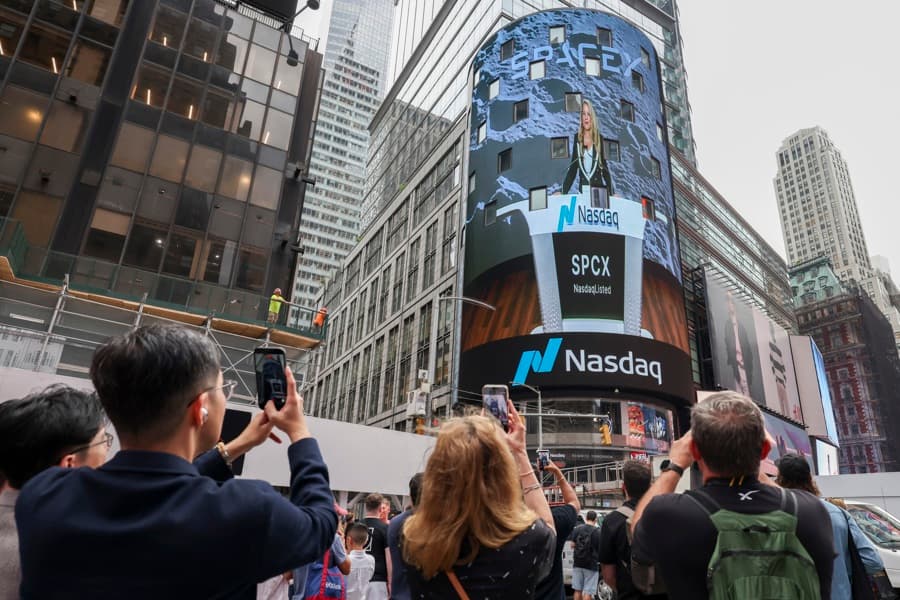
SpaceX shares stabilize near their IPO price as investors weigh strong growth prospects against rising AI spending and long-term profitability concerns.
The American aerospace company, SpaceX, marks two months since its historic stock market debut in New York, with shares trading virtually online with their initial public offering price (IPO), after a period of sharp volatility that has tested investor’s expectations for the future of Elon Musk’s company.
SpaceX shares opened at $135 on June 12th and four days later, midway through the trading session, they reached an intraday high of $225.64. However, the stock fell as low as $104.83 on August 3rd.
Two months after its IPO, SpaceX closed Tuesday’s trading at $133.36, 1.2% below its offering price.
Javier Santacruz, an economist and financial analyst, told EFE that SpaceX is following the typical pattern of many initial public offerings: an initial rise followed by a correction and subsequent stabilization around the offering price. For Santacruz $135 is now a “reasonable” benchmark for the stock.
SpaceX’s faced its first major test on August 4th, when it released its first financial results since going public. The company reported a revenue of $12,508 million, an increase of 53%. However, losses increased 257% to $5,488 million.
Santacruz believes that the company “has met earnings expectations” and that Starlink, its satellite constellation, is “the flagship product” and primary growth engine, while the artificial intelligence division also saw strong growth.
XTB analyst Manuel Pinto highlights the “poor reception” of the results, as SpaceX shares fell as much as 13% that day, although he believes that “the market’s reaction has been very harsh.” According to him, the main questions is the cost of the financial growth.
SpaceX allocated $15.828 billion to AI-related capital investments in the second quarter, more than double from the previous quarter. The spending has raised questions about when and how these investments will begin generating sufficient returns.
Pinto emphasizes that spending on AI is “the main flaw in the financials,” alongside the company’s funding requirements and “reliance on U.S. government contracts.” He also pointed to trends in Starlink’s revenue per customer and the “still uncertain” development of the Starship launch system.
Both analysts agree that SpaceX is not a company to invest in for the short term.
According to Santacruz, “the return should not be measured in months but in years.” The pattern observed in other technology businesses suggests, in his view, that positive cash flow could begin within “two or three years.”
“Anyone who buys the company is betting on the long-term growth of businesses that have yet to prove their ability to generate cash,” the economist says.
Pinto shares that view, arguing that the market is not valuing SpaceX “solely” based on its current business, but rather as “a company with the potential to break out.”
Santacruz expects the stock to trade around its IPO price for the remainder of the year, while Pinto says investors should closely monitor its upcoming earnings reports to gauge the trend.
Pinto believes that, starting in 2027, there will be growing pressure for “that massive capital expenditure” to generate returns. “If we start seeing the launch of new applications, AI tools, and new contracts, we’ll see SpaceX rebound. If not, we could even see it drop below $100,” he explains.