At Last! New Plant Will Triple Puerto Rico’s Recycling, Without Burning Trash
After decades missing the 35% mandate, Puerto Green’s $210 million, incineration-free complex in Humacao will lift the island to 20%, advance circular economy, include $100 million in federal funds
Puerto Rico has spent decades failing to meet its legally mandated recycling goals, led by a 35% rate that the law ordered reached by 2006. Of the waste the island generates every day, roughly nine of every ten tons still end up buried in landfills, many of them under closure orders, and only between 7% and 11% is recycled, depending on the estimate.
Now, after years of frustration, a group of Spanish recycling veterans believes it can finally change that trajectory, and fast.
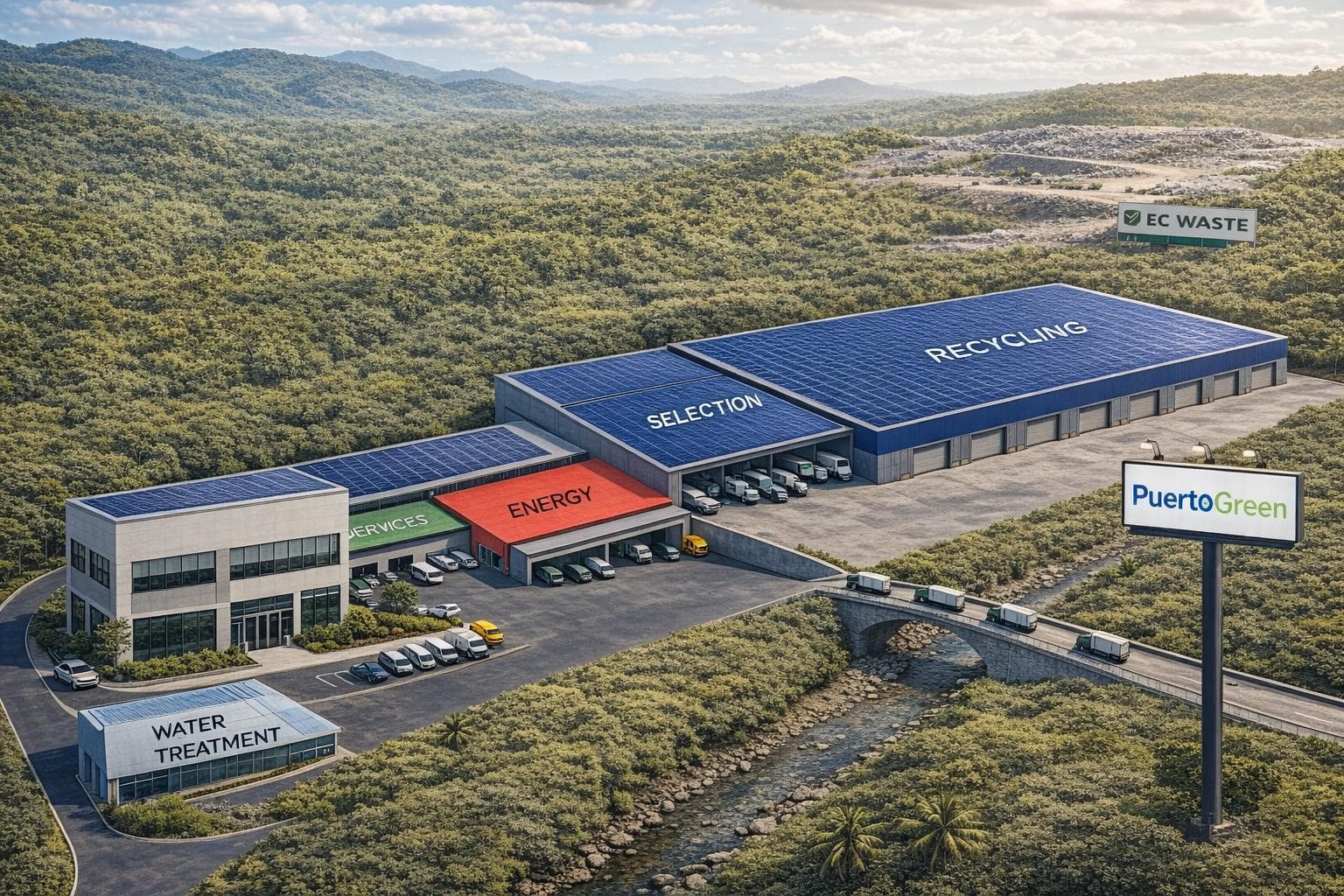
Their project, Puerto Green (pictured in the rendering above), promises to triple the island’s recycling rate and push Puerto Rico to the 20% threshold as soon as the plant is up and running in 2029, a milestone that would mark the territory’s most significant environmental turnaround in decades.
Puerto Green is a $210 million, vertically integrated recycling complex planned alongside the El Coquí landfill in Humacao. It will recover plastics, paper and metals from unsorted municipal trash through what the founders describe as a zero-emissions process that involves no incineration, a deliberate departure from the waste-to-energy proposals that have repeatedly collapsed on the island under public opposition.
The project is built as a circular economy, turning recovered plastics and other waste into such commercial supplies as food-grade resin for local manufacturers, bags for stores and boxes for multiple uses, with supply agreements already in place with major local buyers.
Puerto Green also plans to power itself. A plant already operating at the landfill collects gas from the waste site and produces energy, which Puerto Green will use together with solar power for all its energy, supplemented by a grid connection for safety. The goal is to operate “as an island within an island.”
The team brings the Zubieta model from Spain, where CEO Santiago Barba helped commission the complex, and government agencies in Puerto Rico have lined up behind it, motivated by the island’s solid-waste-crisis urgency and the long frustration.
A $22 million incentivized research and development program aims to open new recycling streams, from glass and textiles to electronics and solar panels.
The founders expect to close the CDBG-MIT portion in January, after completing the environmental underwriting process that has taken years. Construction permitting will follow. The plan calls for operations to start in 2028 and for the complex to be fully operational in 2029, as equipment arrives and operations ramp up in phases.
“We’ve been working on this for four years,” Quintanilla said. “The federal underwriting has been the slowest part, but we’re now at the end of that process.”
A strategic project with the government behind it
The Puerto Rico Planning Board has designated Puerto Green a strategic project, a status that helps with permitting, according to the principals. The project has also been designated an Act 60 company. It has worked closely with Vivienda, the Department of Natural and Environmental Resources, the Department of Economic Development and Commerce, the Economic Development Bank and Fortaleza.
Environmental permitting is nearly complete, and construction permitting is next. The founders say the agencies have been supportive because they understand the urgency of Puerto Rico’s waste crisis.
“Puerto Rico cannot afford not to do this project,” Barba said. “Half of it is funded by federal dollars, and the island desperately needs recycling infrastructure.”
Federal money, Act 60 equity and a bank syndicate
The financing structure behind Puerto Green is unusually large for a recycling project in the Caribbean. Barba and CFO Tomás Quintanilla explained that the investment totals approximately $210 million, supported by $100 million in federal CDBG-MIT funds, $40 million in equity from founders and institutional investors, and the remainder from local bank financing.
The project also receives $10.4 million in cash incentives from the Department of Economic Development and Commerce, along with a forthcoming package of tax credits tied partly to the project’s research and development program.
An Act 60 fund will be part of the financing structure. Puerto Green is also bringing in local investors, including high-net-worth individuals and Puerto Rican firms. Barba said the company wants Puerto Rican partners because the island’s recycling crisis requires local expertise and local commitment.
“This is a local problem, and local expertise is essential to solving it,” he said.
Juan Antonio Net, a Spanish banker who came to Puerto Rico to run Banco Bilbao Vizcaya and stayed on the island, is the project’s independent financial advisor and manages the financing. He said Act 60 funds must invest part of their proceeds in local projects, which makes Puerto Green a natural fit.
“Every ton we recycle is a ton that doesn’t go to the mountain. It extends the life of the landfill and makes the whole system safer.”
Puerto Green CEO Santiago Barba
“There is a very powerful niche of opportunity here because, in addition to profitability, Puerto Green offers major benefits for the development of the island,” Net said.
Negotiations are underway with Oriental, Banesco and FirstBank, the banks the founders describe as the most active in the market. Net said he expects them to act together rather than compete for the loan.
“This operation, as a strategic one for the country, merits that the main banks support it in a syndicated manner,” he said.
On the CDBG-MIT funds, Net said Puerto Green applied to the federal call while it was developing the project, and that Vivienda, the Housing Department that administers the funds, saw the project’s strategic interest from the first moment and bet on supporting it.
The earlier phases have been approved, he said, and the financial underwriting is being finalized, with completion expected in early January in preparation for the closing.
The research and development program is also expected to draw tax credits. “The R&D project is $22 million, with components of high interest, and it is usual for tax credits to amount to 50% of the investment,” Net said. That would equal about $11 million.
Barba said the financial model implies approximately $65 million in sales and a 40% EBITDA margin, which would be about $26 million in earnings before interest, taxes, depreciation and amortization. He described it as a cash-generating business because the entire value chain, from sorting to finished resin, sits in one place, and said the projection assumes high efficiency rates. The research and development program also supports those figures, he said.
Resin and sale prices are market prices that are normally tied to public indexes, Barba said, which means revenue would follow commodity markets.
The complex site will be adjacent to this El Coquí site, which is fully owned by EC Waste. El Coquí is the largest EPA-compliant landfill on the island, with more than 70 years of remaining useful life, and the site is already permitted for recycling.
Construction next to the island’s largest compliant landfill
“We’re going to convert a problem into a solution,” CEO Santiago Barba said during an interview in San Juan.
“Puerto Rico will become a global showcase of what modern recycling can look like.”
The complex would sit on an 18-acre campus at the El Coquí site, which is fully owned by EC Waste. According to the company’s presentation, El Coquí is the largest landfill on the island that complies with EPA requirements, with more than 70 years of remaining useful life, and the site is already permitted for recycling.
The decision to build there was strategic. Puerto Green needed a landfill that was EPA-compliant, had decades of remaining life, and offered flat land adjacent to active cells.
“Many landfills in Puerto Rico are not compliant,” Barba said. “We needed a site with space, flat land, and a company willing to support a project like this. El Coquí was the best option.”
Under a long-term agreement, EC Waste will divert a portion of its incoming municipal waste directly to the plant. That reduces the volume buried at the landfill, extends its useful life and lowers operational risk.
“Every ton we recycle is a ton that doesn’t go to the mountain,” Barba said. “It extends the life of the landfill and makes the whole system safer.”
According to the company’s daily plan, roughly 3,000 tons of waste arrive each day through EC Waste, and 1,650 tons of them would go through the plant. Puerto Green would recover 36% of those 1,650 tons, or 595 tons a day: 315 tons of plastics, 165 tons of paper and cardboard, and 115 tons of metal. That equals about 20% of the 3,000 tons arriving daily.
The remaining 1,055 tons, mostly organics, would go to the El Coquí landfill.
A key feature is that nothing needs to be changed in how waste is collected. The technology recovers materials from unsorted trash without relying on public participation or dedicated collection infrastructure, so households, businesses and municipalities would not have to change how they collect or separate their trash.
A circular economy
The company already has supply agreements with major local consumers of recycled polymers. Puerto Rico currently imports thousands of tons of recycled plastic each year, and Puerto Green intends to replace a significant portion of those imports.
The plant will produce FDA-grade PET for bottle-to-bottle manufacturing, FDA-grade HDPE for food packaging, LDPE resin for manufacturing garbage bags, paper and fiber products, and recycled metals.
One of the most immediate applications is municipal garbage bags. “We can make all the industrial garbage bags used across Puerto Rico,” Barba said.
The founders estimate that 80% of recovered plastic materials will reach near-virgin quality, with the remaining 20% going to lower-value markets.
The founders describe it as a flywheel: recycling enables manufacturing, manufacturing enables jobs, and jobs enable long-term economic growth.
Beyond recycling, Puerto Green aims to catalyze a new manufacturing ecosystem based on locally produced recycled polymers. Bottle makers, packaging companies, pipe manufacturers and other industrial users could shift from imported resin to the plant’s FDA-grade material.
The founders describe it as a flywheel: recycling enables manufacturing, manufacturing enables jobs, and jobs enable long-term economic growth.
“We’re building a circular economy,” Quintanilla said. “And Puerto Rico will be the center of it.”
The unmet 35% mandate
The Department of Natural and Environmental Resources (DRNA) puts the island’s recycling rate at about 11%, according to published reports, while Puerto Green’s own estimate is closer to 7%. Even among the 69 municipalities with active recycling programs, only a little more than 13 nearly comply with the law, Metro Puerto Rico reported in April.
Vega Baja, for example, recycled 1,015 tons in 2025 against 13,135 tons of garbage received, or about 8%, according to municipal figures reported by Metro. Cabo Rojo’s landfill has reached capacity, and Mayagüez’s has a little over a year of useful life left.
At least 29 landfills and dumps operate on the island, and 12 of them are under federal closure or compliance orders, according to the U.S. Environmental Protection Agency.
No incineration, by design
Puerto Green’s founders say the plant relies on proven mechanical processes, not combustion, and describe it as a zero-emissions operation. It is a deliberate choice on an island where incineration has been tried, and rejected, more than once.
Barba and Quintanilla said that today’s incineration technology can avoid harmful or toxic emissions but nonetheless stirs strong social opposition. They said the team went to great lengths to design Puerto Green so as to avoid the environmental elements that tend to trigger objections, not just in Puerto Rico but in Europe and elsewhere.
In 2001, then-Gov. Sila María Calderón discarded an earlier waste-to-energy proposal, as reported at the time by Caribbean Business. This newspaper also reported when Gov. Luis Fortuño later revived the idea, declared an energy emergency and fast-tracked permits for a waste incinerator in Arecibo.
The project, proposed by Energy Answers, would have cost $860 million, burned about 2,100 tons of waste a day and generated 77 megawatts, according to Northwestern University’s Social Justice News Nexus. Community groups, represented by Earthjustice, fought it for years over fears of air and water contamination from heavy metals, protesting in Arecibo and taking their case to Congress and the United Nations.
The company describes Puerto Green as the largest, most technologically advanced and most vertically integrated recycling project in the Americas.
In 2018, Gov. Ricardo Rosselló withdrew his support, and Energy Answers withdrew its request for “critical project” status from the federal Financial Oversight and Management Board, which would have allowed expedited approvals.
The unsorted trash model
Waste characterization studies conducted by Puerto Green in 2023 and compared with an independent Geosyntec analysis from January 2024 show that between 31% and 40% of Puerto Rico’s municipal waste is recyclable, commodity-grade material.
Plastics alone represent between 12.2% and 17.8% of the waste stream, paper between 10.9% and 17.2%, and metals between 4.9% and 8.1%, depending on the study. The company says it counted only commodity-grade materials with established markets and did not study glass or plastic films, a deliberately conservative approach.
Because Puerto Rico recycles so little, the founders say the island’s trash is unusually rich in recoverable materials. They describe the waste stream as an untapped “urban mine” that can fuel a new industrial sector.
“Everything comes packaged,” Quintanilla said. “There’s a lot of plastic, a lot of cardboard, a lot of metal. For us, that’s excellent.”
The plant will use a suite of proven technologies, including bag openers, optical sorters, ballistic separators, eddy current systems, magnets and AI-enhanced sorting modules. After separation, plastics such as PET, HDPE, LDPE and PP will be washed, shredded and processed into FDA-grade resin. The machinery itself comes with FDA certification.
“We’re not just making bales of bottles,” Barba said. “We’re making the resin, the granza, that manufacturers need.”
Model for the Americas
The company describes Puerto Green as the largest, most technologically advanced and most vertically integrated recycling project in the Americas.
Comparables include a Mexico City sorting plant operated by the Cemex subsidiary Pro Ambiente, which opened in 2021 and processes about 1,000 tons a day. In São Paulo, a mixed-waste treatment plant due to start up in August 2027 is designed for 550,000 tons a year. Puerto Green’s 1,650 tons a day would amount to roughly 600,000 tons a year.
In the United States, a 2016 industry survey by Government Advisory Associates counted just 29 mixed-waste processing facilities and found that the average materials recovery facility handled about 220 tons a day, according to Waste Dive.
The research and development program is focused on adapting sorting technology to Puerto Rico’s waste composition and developing new recycling streams such as glass, textiles, rubber, electronics and solar panels.
On the resin side, Republic Services’ Polymer Center in Las Vegas is designed to produce more than 50,000 tons a year of recycled-content resin, Recycling Today reported.
Puerto Green’s differentiator, the founders say, is combining all of those steps, from unsorted trash to food-grade resin, on a single campus.
240 jobs, local training, the R&D program
The project will create 240 direct jobs, including engineers, laboratory technicians, machine operators, sorting personnel and maintenance staff. The company says the jobs will have a high impact on the island’s low- and moderate-income population.
Training will be extensive, especially for engineering and laboratory roles. “We want people to stay with us long-term,” Barba said. “That means strong training and strong social benefits.” Some specialized roles may require recruitment from outside Puerto Rico, depending on availability.
The research and development program is focused on adapting sorting technology to Puerto Rico’s waste composition and developing new recycling streams such as glass, textiles, rubber, electronics and solar panels. The company is already in discussions with the University of Puerto Rico at Mayagüez and other institutions to develop specialized training programs.
“We’re starting with plastics, cardboard, and metals,” Quintanilla said. “But later we’ll expand to electronics, solar panels, glass, materials that today have nowhere to go.”
The team and the Zubieta model
Barba, who has more than 20 years of experience in plastics recycling and energy recovery in Europe, previously worked on the final commissioning of the Zubieta waste-to-energy and recycling complex in Gipuzkoa, Spain, a project that helped the region move from political conflict and landfill dependence to European leadership in the circular economy.
“That project turned a problem into a solution,” Barba said. “We want to do the same here.”
Quintanilla, who holds an MBA from IESE, has more than 35 years in metals and plastics recycling and founded Segometal and Sostenplas, which the company describes as two of the largest trading and processing companies in Spain.
Pablo León, the chief marketing officer, has more than 10 years in plastics recycling in Asia and Europe and co-founded the e-plastics recycler Sostenplas.
Ryan J. Carter, a Puerto Rico resident since 2017, has 15 years of experience in waste collection and recycling in Latin America, including establishing recycling at the Cancún landfill.
Landfills and the climate
If Puerto Green recovers 36% of the waste that enters the plant, the company’s presentation projects a reduction of more than 20% in landfill space use. That could allow the Department of Natural and Environmental Resources to execute long-delayed closure orders or redistribute waste to compliant sites.
“This is an island,” Barba said. “You can’t close a landfill unless you have an alternative. We’re providing that alternative.”
The presentation also projects that the plant would recycle 136,300 tons of waste a year and avoid 380,000 tons of CO2 emissions annually. Barba said the annual tonnage is consistent with a plant that operates 300 days a year. That works out to about 454 tons a day, or roughly 28% of the 1,650 tons entering the plant.
For a community that has watched the 35% goal slip further out of reach for two decades, the test now moves from promise to execution: the January closing of the federal funds, the construction permits and a phased ramp-up toward full operation in 2029.
If Puerto Green delivers, the island would gain not only its first large-scale recycling infrastructure but the start of a local resin industry that turns a disposal cost into a supply chain.
Airport operator weighing more projects; the master plan behind them understates how fast the climate is worsening, keeping LMM vulnerable to big risks