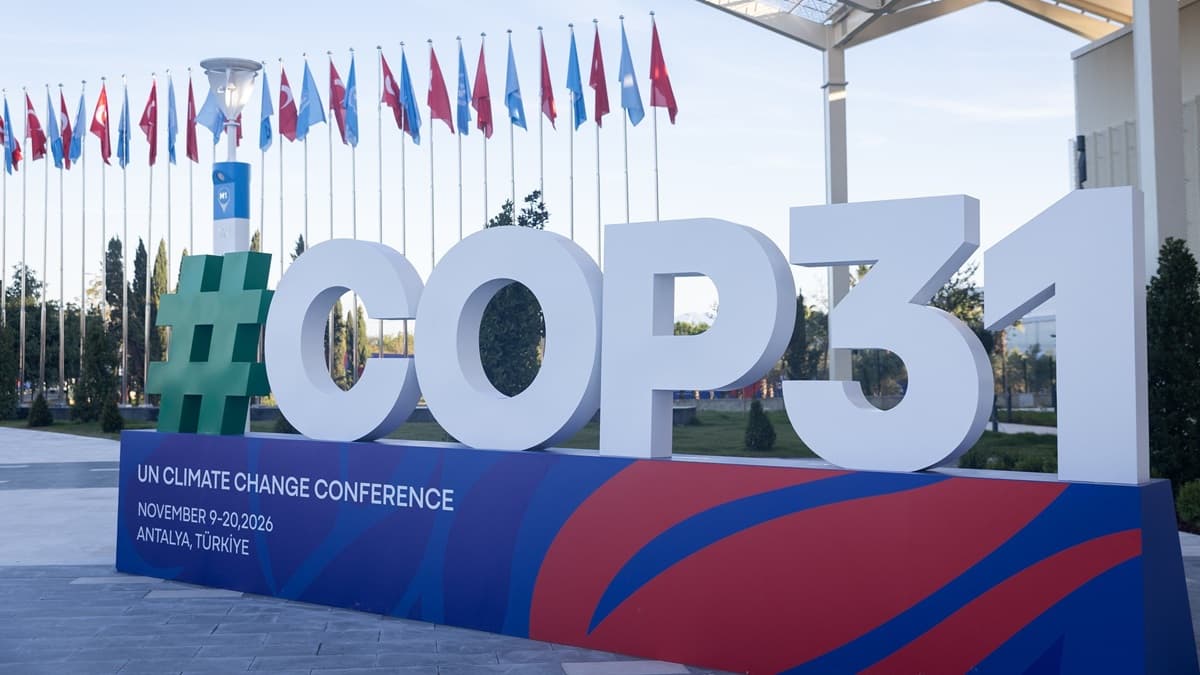
COP31 Collapse Settles It: Temperatures Headed Higher, Making Adaptation Puerto Rico’s Main Climate Agenda
Climate talks end in disarray, as the last five summits create a clear urgency and trend the island can capitalize on; a thriving global adaptation ecosystem awaits
The UN climate conference in Antalya, Türkiye, ended Sunday, two days late and without the political agreement its hosts had promised. The “Antalya Pact,” the cover decisions meant to frame the summit’s results, failed for lack of consensus after the European Union, the United Kingdom and a bloc of island and Latin American states rejected a text that did not mention fossil fuels.
“I understand there is no agreement on this text. For that reason, these decisions have not been adopted,” said COP31 President Murat Kurum famously said in closing.
For Puerto Rico, the more consequential interpretation is the one behind this exclusive two-part adaptation series by Caribbean Business. Taken together with the four summits before it, COP31 all but settles where global temperatures are headed and how unlikely it is that the world will cut emissions on time and at the scale needed to change course and avoid what is now an inevitable era of more frequent and extreme climate events.
That makes adaptation and resilience, centered on the national adaptation plans (NAPs) and ecosystem that organize it, more essential than ever for vulnerable places like Puerto Rico, and a larger market for those, also including Puerto Rico, that can see adaptation as a massive global opportunity to capitalize on by innovating and making the new class of goods and services the planet will need, starting right about now.
The science no longer leaves any room for doubt or debate. What remains uncertain is who prepares on time, who turns that preparation into an economic advantage, and whether Puerto Rico will be among the leaders for the coming Age of Adaptation.
What collapsed, and what survived
The failure of the cover text did not erase everything negotiated in Antalya. Parties adopted roughly 46 separate decisions under the conference, the Kyoto Protocol and the Paris Agreement, according to the UN climate secretariat’s list of outcomes.
They include decisions on the Global Goal on Adaptation, the Adaptation Fund, the Fund for responding to Loss and Damage, the Santiago Network for loss-and-damage technical assistance, guidance to the Green Climate Fund, carbon markets under Article 6 and a three-year extension of the Just Transition work program.
It amounts to an international infrastructure that Puerto Rico can dive into with the island’s incentives and U.S. legal and accounting system, plus the local manufacturing and services clusters and post-Maria reconstruction experience (the good and the not-so-good), to participate fully in the coming adaptation boom.
The main thing that did suffer from COP31’s collapse was available funding. The text would have reaffirmed the goal of at least tripling adaptation finance by 2035 and set out a pathway to deliver it under the climate finance work program.
An earlier draft had put the target at no less than $120 billion a year by 2035, with the Standing Committee on Finance to set a baseline for adoption at COP32, according to published reports; that figure was gone by the final draft, and the reaffirmation and pathway then failed with the rest.
The tripling goal “now stands almost exactly where it was at the end of COP30 in Belém,” India’s Centre for Science and Environment concluded.
Also lost were the cover text’s targets for universal early-warning coverage by 2027 and its language on health systems and oceans. Australia’s Chris Bowen, who led the negotiations, named fossil fuels and finance as the two obstacles that sank the package.
Parties agreed to hold dialogues in 2027 and 2028 on strengthening the consensus-based system, and the unresolved questions move to the Bonn talks in June 2027 and to COP32 in Addis Ababa.
Adaptation ecosystem advanced
On adaptation, the pattern from the first week, as CB reported Nov. 13, held to the end: plans multiplied and institutions matured.
The Global Goal on Adaptation decision continues work on the 59 Belém Adaptation Indicators adopted last year, the first shared yardstick for measuring adaptation, with voluntary testing by countries and further technical work in 2027, according to reporting on the decision.
The Adaptation Fund completed its long-debated transition to serve only the Paris Agreement. It will receive a mandatory 5% share of proceeds from the new Article 6.4 carbon market once that market is operating, and voluntary funding through Article 6.2, with a 17-member board that keeps a developing-country majority and reserves seats for small island and least developed states.
“Demand for the Adaptation Fund’s support has never been higher, and we are ready to scale up and deliver,” said Mikko Ollikainen, head of the fund, which has a $2.4 billion pipeline.
Pledges in Antalya came to about $50 million, nearly two-thirds below the $134.9 million pledged at Belém, against a 2026-2029 target of at least $1.2 billion. Small island states noted the fund missed its mobilization goal for a third straight year.
National adaptation plans, the backbone of the system, came out with no new decision. The item reached the conference on an unfinished draft from the technical bodies, and no NAP decision appears among those adopted.
A proposal by the least developed countries for a NAP implementation platform did not survive. Under UN practice, unfinished items generally return to the subsidiary bodies, which next meet in Bonn. The plans themselves keep coming: 81 developing countries had filed a NAP as of Oct. 20, up from 67 a year earlier.
Loss and damage, the money for harm that adaptation can no longer prevent, followed the same script. The decisions guiding the loss-and-damage fund and the Santiago Network were adopted, and the European Commission signed a $27.5 million contribution agreement on Nov. 18.
But the fund has received 176 requests from 119 developing countries totaling about $2.8 billion against $342 million allocated, roughly 12 cents for every dollar requested, and $485.8 million of its $822.7 million in pledges had been received by July 31.
Its board is due to approve its first funding decisions in December. No new pledges came out of the summit’s closing text.
Five summits, one direction
As it turned out, Antalya did not break with recent history. It extended it. Since 2022, the conferences have increasingly been hosted by, and negotiated around, producers of oil and gas, a pattern widely documented in coverage of each summit.
To be sure, even the Paris Agreement contemplates fossil-fuel production for the baseload energy most places, including Puerto Rico, require to keep the lights on as the world transitions to renewables. The clash has now become the reduced commitment for the transition to keep temperatures from overshooting the feared 1.5°C threshold above the multi-century historical record, and therefore the higher temperatures and more extreme climate the world can no longer escape and must now risk-manage.
Three other forces are pulling in the same direction as the negotiations. The first is the temperature record. The World Meteorological Organization put 2024 at about 1.55°C above pre-industrial levels, the first calendar year above 1.5°C, and 2025 at 1.44°C, with 2023 through 2025 averaging 1.48°C. January through September 2026 averaged 1.47°C.
Annual temperatures have settled in a range of about 1.4°C to 1.6°C, with a growing roster of scientists now advising companies and governments to plan for 2°C by 2040 and 3°C as soon as the 2050s.
The second is Washington. The U.S. withdrawal from the Paris Agreement took effect Jan. 27, 2026, and the country sent no federal delegation to Antalya. The world’s second-largest emitter, and historically its largest, is now outside the treaty, and with it Puerto Rico.
The third is the AI boom. Data centers are driving a return to fossil-fuel power, particularly natural gas. The International Energy Agency reports that U.S. gas-power investment roughly tripled in 2025 and expects U.S. investment in fossil-fuel power to overtake China’s this year, with data centers accounting for half of U.S. electricity demand growth through 2030. Global orders for new gas plants reached 130 gigawatts in 2025, a 25-year high.
Each of these forces would weaken a shared commitment on its own. Together with a negotiating process that can no longer reach an overall agreement, they have eroded the shared commitment, first seen after Paris, to hold warming well below 2°C and pursue 1.5°C.
Why adaptation becomes the main event
If prevention and mitigation are stalling and can no longer prevent an intensification of extreme events, adaptation stops being the secondary track and becomes the main one, for governments, for companies and for anyone who insures, finances or builds for them.
The Antalya record shows that the demand is real and growing: 81 national plans and counting, $2.8 billion in loss-and-damage requests, a $2.4 billion Adaptation Fund pipeline and UNEP’s estimate that developing countries will need about $305 billion a year for adaptation by 2035, against $28.2 billion to $31.7 billion in international public finance in 2024.
The delivery vehicles CB reported in the first part of this series also operate outside the negotiated text, so the collapse did not touch them. They include:
The Climate Investment Funds’ ARISE program, with about 40% of its funding earmarked for the private sector.
Development banks’ new adaptation investment partnership, after $35 billion in adaptation finance in 2025.
A UN disaster-risk financing platform aiming for more than $3 billion.
The insurance industry’s work on pricing and underwriting resilience.
With public grants falling short, those channels, along with private capital, are where adaptation will increasingly be paid for.
That is the opening for Puerto Rico. No public record shows island officials or companies taking part in Antalya, and the U.S. withdrawal leaves the island without a seat at the table. But development banks, climate funds and insurers buy from whoever can deliver, and Puerto Rico can use Act 60’s innovation and export-services incentives to become a hub for adaptation technology, exactly like its manufacturing base supplies medicines and medical devices to the world.
Water, cooling, resilient construction, climate-health systems, agriculture and risk-transfer finance, and more, are all markets the Antalya numbers lead to.
The island has a second reason to move. Like the 81 countries filing plans, Puerto Rico faces the same climate those plans prepare for, and it will have to protect its own economy first. A government and business community that builds adaptation capacity at home, and learns to sell it abroad, will be better positioned on both fronts.
The lesson of Antalya is not that the climate process has failed, but that it can no longer be counted on to deliver the outcome it was designed for.
The science no longer leaves any room for doubt or debate. What remains uncertain is who prepares on time, who turns that preparation into an economic advantage, and whether Puerto Rico will be among the leaders for the coming Age of Adaptation.
With 81 national adaptation plans now filed and new resilience vehicles launching in the Turkey UN Conference, the market Puerto Rico could supply is taking shape…fast