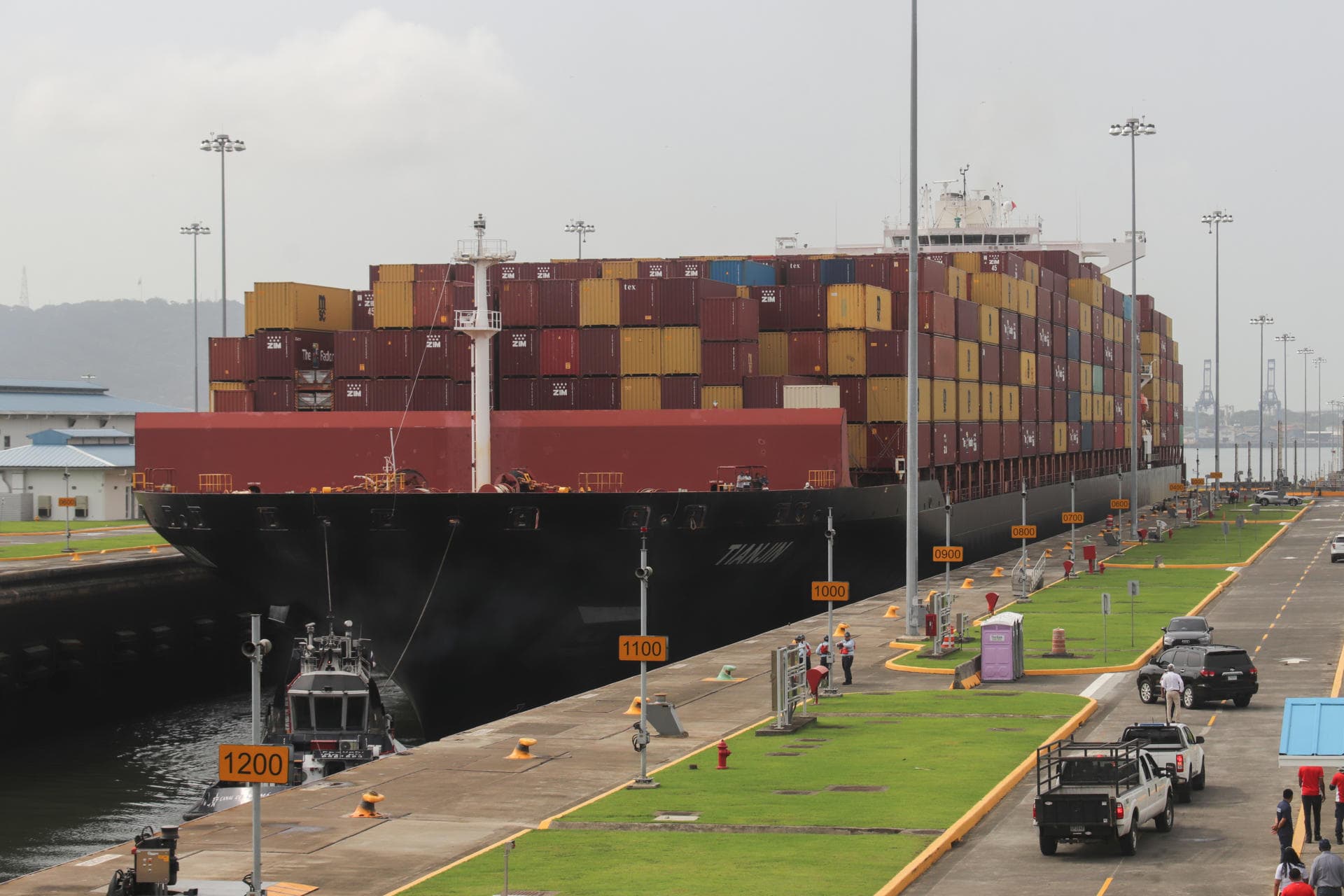
The $5.25 billion project transformed the waterway by accommodating larger vessels and helping drive record revenues.
Panama City— The Panama Canal on Friday marked the 10th anniversary of its expansion, a landmark engineering project that reshaped global shipping by allowing larger vessels to transit the interoceanic waterway and significantly boosting its revenue.
The expansion, inaugurated on June 26, 2016, added a third lane of traffic through the construction of the Agua Clara locks on the Atlantic side and the Cocolí locks on the Pacific. Built over nearly nine years at a cost of at least $5.25 billion, the project is widely regarded as one of the largest engineering achievements of the 21st century.
For Wilfredo Yao, a Panamanian civil engineer who has spent nearly three decades with the Panama Canal Authority (ACP), participating in the construction of the new locks remains one of the defining moments of his career.
“When a civil engineer has the opportunity to build a new lock, that’s priceless,” Yao told EFE. “I had the chance to be part of this project and leave my mark on the Canal’s history.”
Yao now serves as a rehabilitation engineer for the ACP’s Locks Division, overseeing major maintenance work on all five lock systems that operate along the canal.
The Panama Canal is the world’s only freshwater canal and relies on five sets of locks—three original lock complexes that opened with the canal in 1914 and two built as part of the expansion. Together, they use 12 lock chambers to raise and lower vessels between the Atlantic and Pacific oceans through Gatun Lake, an artificial reservoir located 26 meters (85 feet) above sea level.
The expansion dramatically increased the canal’s capacity by allowing the transit of Neopanamax vessels measuring up to 366 meters (1,201 feet) in length, 49 meters (161 feet) in beam and 15.2 meters (50 feet) in draft.
According to the Panama Canal Authority, construction required 4.4 million cubic meters of concrete, 220,000 metric tons of steel, and 16 rolling lock gates weighing more than 50,000 metric tons combined. The new locks also feature water-saving basins that recycle approximately 60% of the freshwater used during each transit.
The expansion has significantly strengthened the canal’s financial performance. Combined with revised pricing for several services, it helped generate $5.705 billion in revenue during fiscal year 2025, a 14.4% increase over the previous year.
The United States remains the canal’s largest customer, accounting for roughly 70% of the cargo moving either to or from the U.S. through the waterway. China and Japan rank as the second- and third-largest users.
The Agua Clara and Cocolí locks were built by Grupo Unidos por el Canal (GUPC), a consortium led by Spain’s Sacyr and including Italy’s Webuild (formerly Impregilo), Belgium’s Jan De Nul and Panama’s Constructora Urbana S.A. (CUSA).