Experts estimate rebuilding costs at more than $12 billion, with international financing expected to play a critical role.
Venezuela faces the complex challenge of reconstruction following the devastating earthquakes that struck a month ago, and while experts are still calculating the exact amount, initial estimates place rebuilding costs to above $12 billion, equivalent to 10.9% of gross domestic product (GDP).
The disaster adds a new, multibillion-dollar expense for a debt-ridden Venezuela that remains under international sanctions. Despite sectoral improvements over the past five years, Venezuela has yet to recover the losses accumulated during its seven-year recession that began in 2014, when the GDP contracted by 75%.
Economist Asdrúbal Oliveros told EFE that reconstruction will require between 12,000 and 15,000 million dollars, a “very significant” amount for a country with an economy valued at roughly 110,000 million.
The twin earthquakes have left nearly 5,400 dead, injured at least 16,740 and left about 18,000 people homeless. They also damaged thousands of structures including homes, businesses, hotels, hospitals, schools, shopping centers, churches, industrial facilities, roads, bridges, and the country’s main international airport.
The World Bank estimates that the June 24 earthquakes caused $19.6 billion in direct physical damage, underscoring the “importance of timely reconstruction for the country’s economic recovery.”
International Support
According to Oliveros, Venezuela “will likely be unable to undertake this effort on its own” because it has “very limited fiscal space (the government’s leeway to spend more without compromising its finances), virtually no access to international credit markets, and limited capacity for public investment.”
He said the country would require a combination of multilateral financing, international cooperation, the mobilization of foreign assets through transparent mechanisms, and “very active” participation by the private sector and civil society.
“Without that combination of resources, the reconstruction process will be much slower and more costly,” he said.
On Thursday, the World Bank warned that without increased investment, reconstruction would have to rely on funds redirected from other projects, and “would likely take more than 10 years,” with “lasting negative effects” on economic activity.
However, the institution noted that, if more resources were available, there would be greater investment to “accelerate” the process and even help affected families with transfers aimed at reducing “cushion consumption losses.”
The World Bank said it is working with the Venezuelan government and partners such as the Inter-American Development Bank (IDB) to identify the technical and financial assistance required.
Venezuela, which holds approximately $240 billion in accumulated debt, according to a recent report by the Financial Times, has secured $346 million from the International Monetary Fund (IMF). Acting President Delcy Rodríguez has promised to use those funds for reconstruction and has also called for the release of Venezuelan assets held abroad.
Housing: A Priority
The World Bank estimates that residential buildings, account for 47% of the Earthquake damage, roughly $9.3 billion, mainly in the devastated region La Guaira (a region north of Caracas).
A study by ANOVA, a public policy research consultancy, found that 4,958 of the 38,798 residential structures across seven of La Guaira’s eleven districts “exhibit some level of damage.”
Of those affected buildings, 2,654—home to 37,611 people—were “severely compromised or destroyed.”
ANOVA estimates that rebuilding housing infrastructure will cost 2,370.6 million dollars, which is equivalent to between 2 and 3% of Venezuela’s GDP. ANOVA’s chief economist, Omar Zambrano, told EFE that the amount does not include repairs to “public, road, commercial, industrial, or public utility infrastructure.”
The consultancy emphasized, that Venezuela will need international cooperation and multilateral financing, as it continues to “lack access to international capital markets, has an external debt in default, and has a virtually nonexistent catastrophic insurance market.”
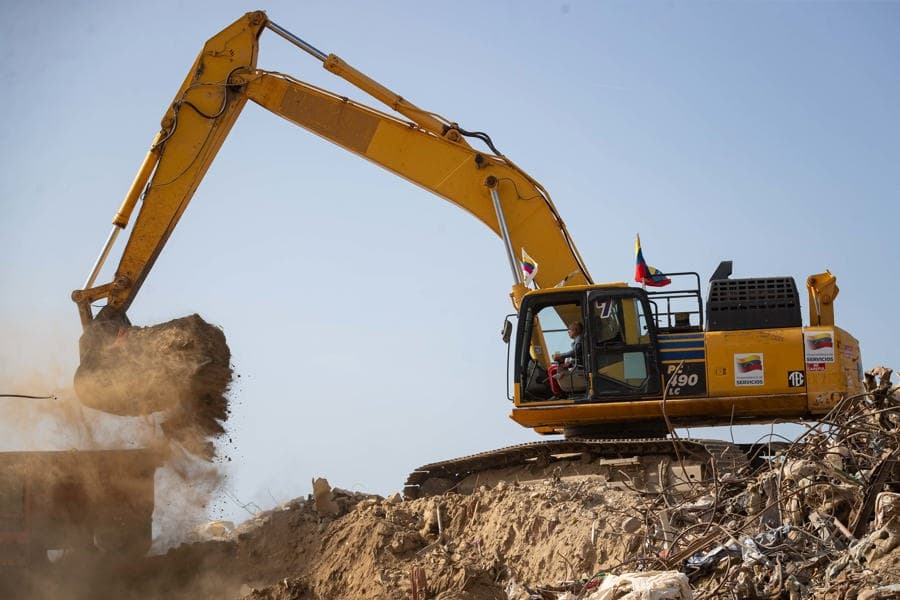
The government has launched a reconstruction plan that includes completing unfinished housing buildings, identifying land for new housing developments, and evaluating the livability of affected homes, and continuing debris removal efforts.