PRIDCO to Unleash Empty Buildings in Commercial Real Estate Move
Latest: a $9.7 million medical-tourism venture; vacant warehouse becomes template for reactivating island’s largest real estate portfolio; an initiative with multiple impacts
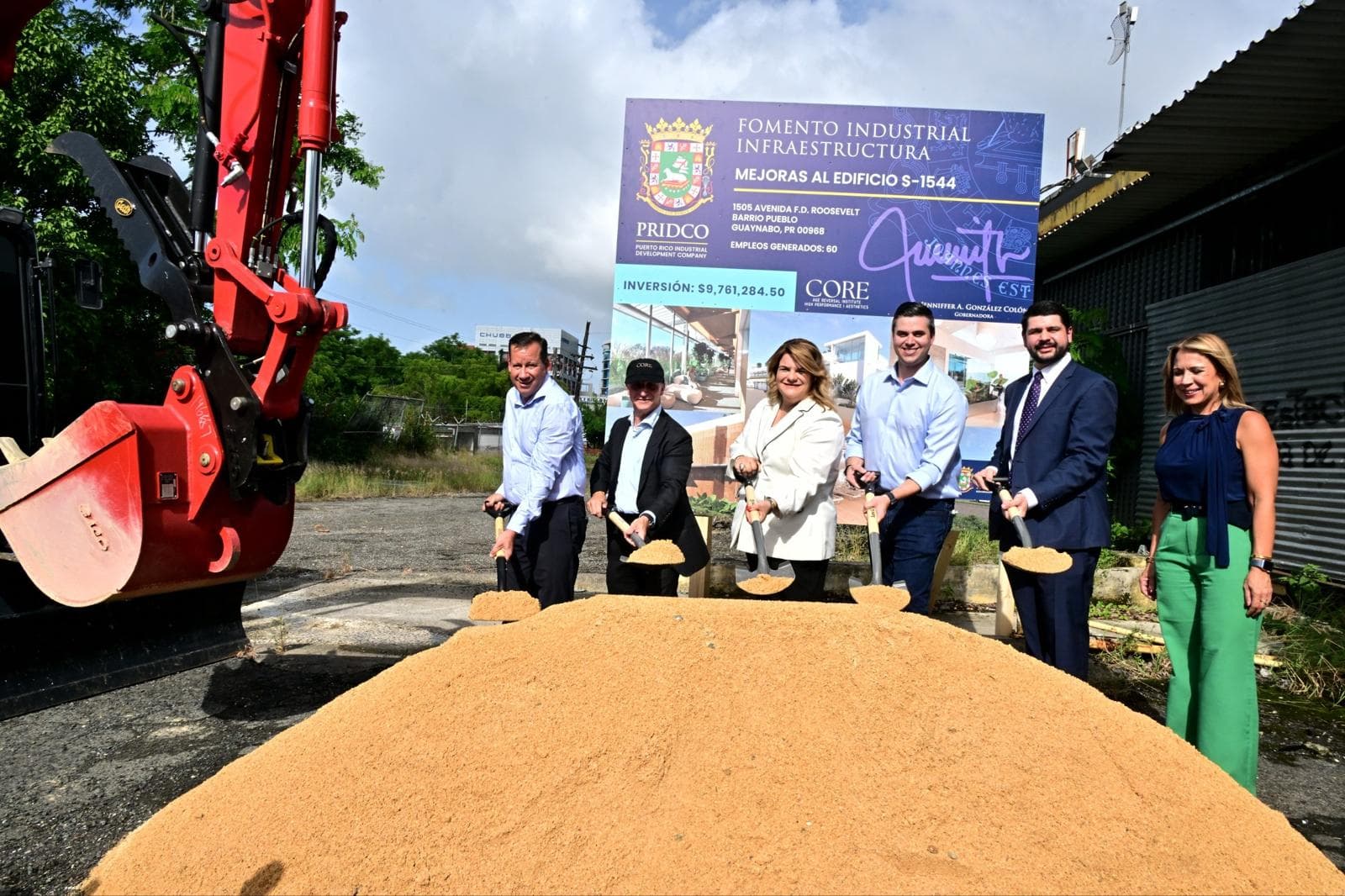
A Puerto Rico Industrial Development Company (PRIDCO) industrial building on Avenida Franklin Delano Roosevelt in Guaynabo, vacant for more than two years, will undergo a $9.7 million transformation into what its developers describe as one of Puerto Rico’s first integrated longevity and wellness centers that further positions the island as a medical-tourism destination.
It is the latest in a string of efforts to make Puerto Rico a player in that Visitor Economy niche, made more difficult of late by the flight of medical professionals. The local owners of this latest attempt hope the math and market dynamics behind the wellness niche, projected to become a $33 billion market in the U.S. by 2034, will make a difference.
DDEC Secretary Carlos J. Ríos Pierluisi, who served as PRIDCO’s deputy executive director from 2023 to 2025, praised the project as a bold investment by a Puerto Rican entrepreneur who saw opportunity where others saw decay. He said the department wants more local businesses to take similar risks, highlighting recent expansions by Chemical Solutions and Ocean Lab, and called regenerative medicine, wellness and medical tourism strategic sectors for the administration.
The longevity venture, developed by CORE and Age Reversal, was announced during an activity in which Gov. Jenniffer González, economic-development officials, and private investors placed the symbolic first stone.
Guaynabo Mayor Edward O’Neill tied the project to a wave of municipal investment including a $16.9 million renovation of the Mario Quijote Morales sports complex, and said the center will contribute to municipal revenue through construction permits and business activity.
The 17,704-square-foot structure will be rehabilitated entirely with private capital. Under a 40-year lease agreement, PRIDCO expects to generate roughly $12 million in rent revenue over the term.
González said the project exemplifies the administration’s push to reactivate Puerto Rico’s dormant industrial inventory, noting that many government-owned industrial buildings have sat unused for decades.
“Today we can say that in this urban area, the private sector will make an investment in a public facility to generate private activity,” she said.
The building is one of several hundred in PRIDCO’s vacant or underused portfolio, and the deal signed in Guaynabo appears to be a template the agency intends to run at scale against a policy backdrop the government has promised to activate at least three times before.
An inventory with real-estate impact
PRIDCO Executive Director Roberto Lefranc Fortuño revealed that PRIDCO manages 1,400 rentable units at 79% occupancy, meaning roughly 290 units sit empty.
Thirty-two properties are currently available for proposals, listed publicly on the agency’s website. The full portfolio spans more than 21 million square feet, making PRIDCO by a wide margin the largest industrial and commercial landlord in Puerto Rico.
Forty buildings have already been repaired, 70 are under construction, and 60 are in the bidding process. Earthquake-damaged buildings in Guánica are also slated for demolition.
Lefranc Fortuño said PRIDCO has identified 40 buildings for demolition and is leasing cleared land for logistics centers, AI hubs and transshipment facilities, in itself a sign of the economy’s growing diversification from industrial purposes to services, small business, tourism and other niches.
New construction is planned for Canóvanas, Bayamón and Guánica, including “white box” projects built to a finishable shell so tenants can move in faster.
For the commercial real estate market, the arithmetic behind PRIDCO’s unloading is a significant related story. Below-market public rents, 40-year terms and lease credits of the kind granted here, $911,000 plus no rent during 15 months of construction, lower the cost of entry for tenants who could not underwrite new construction at current build costs.
That is a subsidy the private market cannot match, and it cuts both ways. It activates dead square footage and seeds activity in neighborhoods that have gone quiet, which contributes to development, but also puts government-owned inventory into direct competition with private landlords in a market where industrial vacancy is already tight in the metro area and stubbornly high outside it, according to Caribbean Business research.
Medical tourism, for the fourth time
González framed the project as a flagship for her administration’s plan to revive medical tourism. She said the government will appoint a dedicated liaison to coordinate efforts across the Department of Economic Development and Commerce (DDEC) and the Puerto Rico Tourism Company, and intends to review the medical-tourism law, evaluate incentives and assess how many facilities currently qualify.
“We want to see if the incentives are enough and how we take medical tourism to another level,” González said, citing Puerto Rico’s climate, medical expertise and proximity to the U.S. mainland.
That legal architecture is 16 years old. Act 196 of 2010 created the medical-tourism framework; Act 171 of 2020 amended it and established a Medical Tourism Program Office under the DDEC secretary; and Act 60 of 2019 grants certified medical-tourism operations reduced corporate income tax rates, property-tax exemptions and municipal tax relief.
On the practitioner side, previous efforts at spurring medical tourism have run into the island’s loss of physicians in recent years, with the licensing board’s count falling from 11,397 to 9,950 over one five-year stretch, and the shortages concentrated in the specialties a medical-tourism market would sell.
Act 14 of 2017 offered returning and resident physicians a 4% income tax rate. By 2018 nearly 2,000 specialists had taken it, at a cost to the treasury of $237.5 million in 2021 alone, according to an independent analysis, and the shortage persisted.
Act 46 of 2026 amended the medical licensing board statute citing the limited capacity of local residency programs. In vascular surgery, one department chair estimated earlier this year that more board-certified Puerto Rican specialists practice on the mainland than on the island.
That gap explains why this iteration is arriving through wellness rather than through hospitals. Elective longevity and recovery services can be staffed without competing for the scarce surgical and subspecialty labor that traditional medical tourism requires, and they are paid out of pocket, sidestepping the insurance-reimbursement economics that drove physicians off the island in the first place.
Inside the longevity bet
Developers described the project as a holistic destination for health, sport, longevity and community. The center will include a full fitness facility, pickleball and padel courts, a café, a high-end restaurant, and a medical-grade longevity clinic offering biomarker testing, regenerative medicine, advanced recovery technologies, sauna and cold-plunge therapies, nutrition services and mental-health support. It will also house IV Talk, a hydration-therapy brand founded in New York.
Janet Díaz, speaking on behalf of investor Nelson Menda, said the goal is to create a place where people want to gather, train, recover and socialize, and emphasized that the project is funded entirely with Puerto Rican capital.
The category they are entering is real and crowded. Roughly 800 longevity clinics now operate in the United States, and the global longevity-clinic services market was valued at about $11 billion in 2025 with projections above $33 billion by 2034. Texas-based Lifespan Edge opened a longevity clinic in Dorado in February.
Premium memberships at flagship U.S. operators run past $20,000 a year, and almost none of it is covered by insurance, which is the model’s strength as an export product and its exposure if discretionary spending tightens.
A local bet on innovation
The project is expected to create 30 to 45 construction jobs and 60 permanent professional positions, with an opening targeted for late 2027. The construction plan includes demolition, structural reinforcement, new systems and full interior build-out. The second floor will be modified to raise ceiling height from nine to twelve feet; the third floor will house the sports courts.
Architect Jorge Ramírez Buxeda, who designed the center with Brenda García Sosa and Jonathan Rocafort Caro of Architectural Studio, said the building will incorporate emergency generators, potable-water tanks, water-collection systems and compliance with updated building codes. Solar panels are not planned initially because the rooftop will hold the sports courts.
“This is an example that the government and the private sector can work together to achieve good things for Puerto Rico,” Lefranc Fortuño said. The test of that proposition is not the building on Roosevelt Avenue. It is the roughly 290 others still waiting for tenants.