Puerto Rico’s healthcare system faces a $500 million funding cut starting in September 2027, when special pandemic-era Medicaid supplements expire, with broad implications for the entire economy.
A delegation of the Puerto Rico Chamber of Commerce warned Congress and federal health agencies of the threat during a recent visit to Washington, D.C., arguing that without legislative action, the island’s doctors, hospitals and insured residents face a “fiscal cliff” that could force service cuts and premium increases at a moment when the healthcare market is already fragile.
Chamber members also pressed members of Congress on post-Hurricane Maria reconstruction funding, energy transformation, creative industries, housing, tax treatment, and business climate matters.
Approximately 47% of Puerto Rico’s population, roughly 1.5 million people, relies on Medicaid, mainly via the government-issued health-plan card. A collapse in Medicaid coverage would likely force workers onto employer-sponsored plans or leave them uninsured, both scenarios that destabilize the labor market and increase operating costs for companies trying to attract and retain talent.
The Chamber presented its concerns during FACES, its annual Federal Affairs Chamber Educational Series, a multi-day lobbying push where the business group meets with lawmakers, agency officials and federal staff across multiple policy areas.
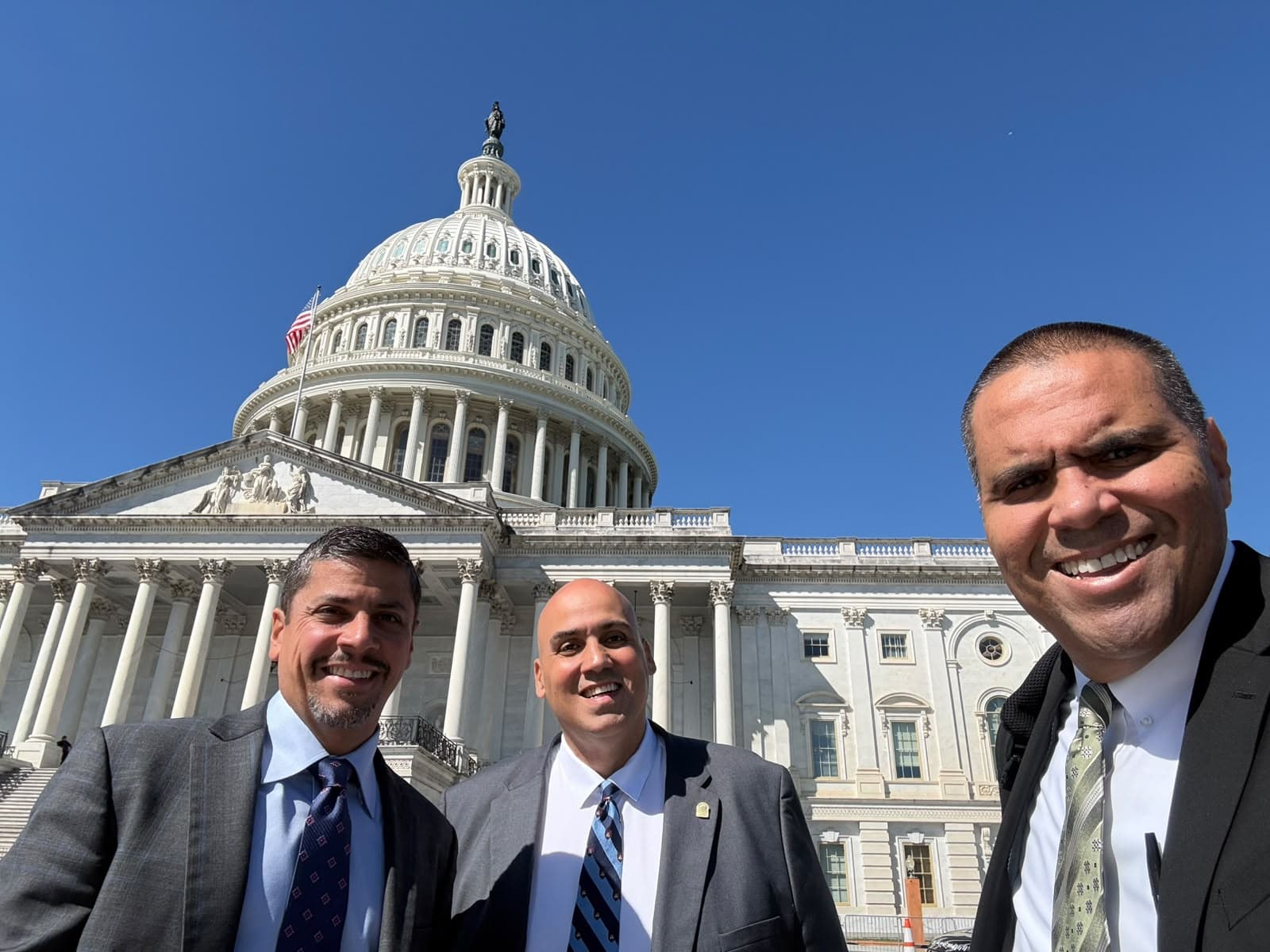
In the photo above (right to left), Chamber of Commerce leaders Luis Pizarro (chairman of the group’s Federal Affairs Committee), Kenneth Rivera (advisor, chair of the Ex-Presidents Council), and José “Ché” Julio Aparicio (Chamber president), met with Senator Rick Scott and Congressman Gus Bilirakis. Below, the group also met with Puerto Rico Resident Commissioner Pablo José Hernández (left).
The Medicaid Cliff
Puerto Rico has received enhanced federal Medicaid funding since the COVID-19 pandemic began in March 2020. That boost, which brought the Federal Medical Assistance Percentage (FMAP) to 76%, is set to terminate on September 30, 2027.
Without congressional action, the FMAP reverts to approximately 55%, creating a roughly $500 million annual gap between what the federal government reimburses for healthcare and what the system now receives.
At that reversion rate, the Chamber warned, Puerto Rico’s Medicaid system would face a fiscal collapse comparable in scale to previous crises that forced the government to cut provider payments and reduce beneficiary access.
Democratic and Republican leaders on Capitol Hill are already expressing doubt about whether legislation will pass before that September 2027 deadline.
“We need these proposals to translate into concrete actions that reduce operating costs and improve Puerto Rico’s ability to compete both inside and outside the United States.”
Chamber President José “Che” Julio Aparicio Laspina
In January 2026, U.S. Representative Frank Pallone, the senior Democrat on the House Energy and Commerce Committee, told journalists he saw little Republican appetite for addressing the issue this year. However, Republican Committee Chairman Brett Guthrie said he planned to tackle it later in 2026. Both timelines have since shifted.
On the island, health industry executives have said publicly they expect congressional action by year-end to resolve the issue, which would then need to be negotiated, refined, and voted on, likely pushing any vote into 2027, dangerously close to the September 2027 cliff date.
The Chamber’s Four-Part Legislative Ask
The Chamber requested congressional action, specifically seeking support from Senator Roger Wicker’s office, to establish:
Stable funding adjusted periodically for inflation. Puerto Rico’s current arrangement requires the federal government to reauthorize funding every few years, unlike other territories that have permanent Medicaid funding by law.
A Federal Medical Assistance Percentage (FMAP) of no less than 76%. This maintains the current rate and prevents the cliff.
Formal inclusion of Puerto Rico in the Medicare Savings Program (MSP). This would create additional protections for low-income Medicare beneficiaries.
A pilot program for home and community-based long-term care services. Puerto Rico’s system currently has limited capacity in this category, a concern that will grow more acute as the population ages.
Medicare Advantage Payment Disparity
Parallel to the Medicaid crisis, Puerto Rico’s insurers and employers have long complained that Medicare Advantage plans operating on the island receive federal capitation rates, the per-beneficiary monthly payments that fund the plans, that are 15% to 25% below comparable plans in mainland metropolitan markets. The disparity is codified in federal formula and has been in place for decades.
Federal dollars, that is, flow to the same Medicare Advantage insurer at lower rates here than in the states, creating pressure on plan design, provider payments, and ultimately premiums.
The Chamber met with representatives from the Department of Health and Human Services and the Centers for Medicare & Medicaid Services to push for a technical correction to the payment formula, with the adjustment to take effect in 2028. Congressman Greg Murphy, a North Carolina Republican, and 14 other House members have signed a letter backing the correction, according to the Chamber.
Other Congressional Advances
Beyond healthcare, the Chamber’s efforts at the federal level yielded specific advances and direct commitments from federal leaders and key lawmakers:
Energy Infrastructure
The Chamber held critical meetings with the Department of Energy and officials from the Senate Energy and Natural Resources Committee, as well as with Representative Steny Hoyer and Senator Cory Booker.
The delegation presented forcefully on the delays and operational failures in electrical grid repairs. It expressed firm opposition to the Autoridad de Energía Eléctrica (AEE/PREPA) retaking control of the grid, reiterating the private sector’s position to maintain operations under private management with strict oversight and accountability.
As a direct result of the Department of Energy meeting, federal representatives accepted the Chamber’s proposal for an on-site inspection visit in Puerto Rico alongside private-sector representatives. The goal is to evaluate the actual state of repair work and resolve implementation bottlenecks directly.
Housing and Reconstruction
During a meeting with the Department of Housing and Urban Development (HUD), the business delegation raised construction sector concerns about cost caps and financing limits on the federal R3 Program, which funds housing reconstruction for properties damaged by Hurricanes Irma and Maria and the 2020 earthquakes.
The delegation requested that the federal government update and relax cost ceilings for developers, allowing reconstruction housing to be delivered faster without compromising builder financial viability or work quality.
Strategic Alignment with PRAFAA
During a meeting with Puerto Rico’s Federal Affairs Administration (PRAFAA), the Chamber aligned its work plan to coordinate joint actions focused on:
Maximizing the deployment and impact of federal funds designated for electrical grid reconstruction.
Creating and protecting key incentives for the manufacturing sector.
Preventing the Medicaid fiscal cliff and ensuring fair treatment in Medicare Advantage rates.
Adjusting financing caps for reconstruction housing projects.
Integrating Puerto Rico into the federal film and audiovisual production initiative announced by President Donald Trump.
Tax, Investment Climate, and Creative Industries
During the lobbying push, the Chamber also addressed regulatory and tax initiatives aimed at improving the operational climate for employers in Puerto Rico:
Support for the adoption and local implementation of individual savings and investment accounts (called Trump Accounts).
Global Minimum Tax: Assistance and collaboration in negotiations related to the application of the global minimum tax on international companies operating in Puerto Rico.
Creative Industries and Film Production: Analysis of strategies to actively integrate Puerto Rico into the federal initiative announced by President Trump to advance and attract film and audiovisual production projects. The Chamber indicated it would pursue additional details and present them to stakeholders in coming months.
Protection of Reconstruction Funds
The Chamber also flagged a municipal tax issue: some municipalities are charging local construction taxes on federal infrastructure projects. The Chamber argues this practice inflates project costs and jeopardizes future federal funding allocations. The group coordinated with PRAFAA to address the practice.
Chamber President José “Che” Julio Aparicio Laspina said the group would continue tracking each commitment made in Washington.
“The business sector has to be present where decisions affecting competitiveness are made. We need these proposals to translate into concrete actions that reduce operating costs and improve Puerto Rico’s ability to compete both inside and outside the United States.”
During his seven-year presidency, the BSN grew from nine teams to 12, turned a pandemic-era scramble into a self-sustaining business, and landed its first U.S. broadcast deal with NBC Sports