Puerto Rico’s Talent Shortage Jumps to 75%, With Trade and Logistics Among the Hardest Hit
Crowley and Junior Achievement Americas respond by bringing 350 students to Isla Grande terminal Friday, part of a push to build the island’s maritime and logistics workforce pipeline
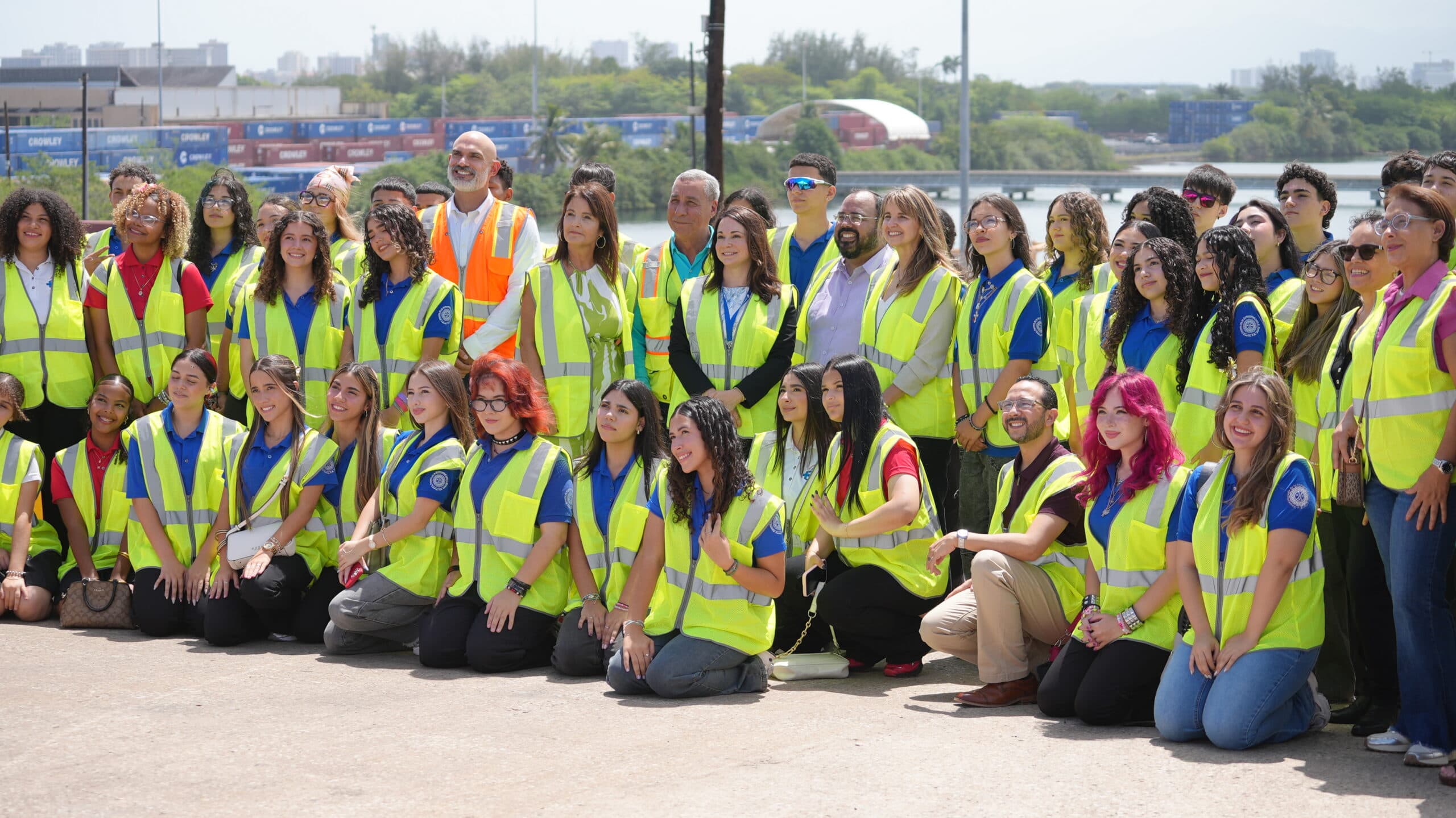
Hundreds of public-school students learned about operations at Crowley’s Isla Grande terminal on Friday and boarded one of its vessels as part of an initiative to introduce them to career opportunities in the maritime, logistics and supply-chain industries.
The program, developed through a partnership among Crowley, Junior Achievement Americas, and the Puerto Rico Department of Education, seeks to connect young people with sectors that are essential to the island’s economy and help them identify careers aligned with their interests, talents and skills.
The initiative responds to a deepening concern in the industry over the growing difficulty in recruitment. According to ManpowerGroup’s 2025 Global Talent Shortage Survey, trade and logistics ranked among the sectors reporting the most acute labor shortages, coming in at 80%.
Other sectors include manufacturing at 83%, professional, scientific and technical services at 81%, and information at 80%. Finance and insurance followed at 79%, with hospitality at 71%, energy at 68%, construction and real estate at 59%, and the public sector, health and social services at 55%. The island average sits at 75%.
Locally, employers identified logistics as one of the five hardest categories of positions to fill, alongside customer service, administrative support, manufacturing and production, and human resources. Medium-sized companies, those with 50 to 249 employees, reported the highest difficulty finding talent, a segment that includes many of the smaller operators along Puerto Rico’s supply chain.
That strain sits alongside a separate finding Caribbean Business reported earlier this month. A Sept. 9 analysis of ManpowerGroup’s Employment Outlook Survey, a different product that measures net hiring intentions rather than difficulty filling roles, found that commerce and logistics led every sector on the island in planned Q4 hiring, tied for the highest reading at 53%.
Read together, the two surveys describe the same sector pulling in opposite directions at once: trade and logistics wants to add staff more aggressively than almost any other industry in Puerto Rico, and it is struggling to find those workers more than nearly any other industry as well.
Experiencing a cargo ship: how many students will feel the calling and return?
The Mainland Faces a Parallel Strain
The shortage is not confined to Puerto Rico. In the continental United States, the transportation and logistics sector is contending with a structural gap between the workers companies need and the workers available in nearly every part of the industry.
The American Trucking Associations currently estimates a gap of approximately 60,000 drivers nationally, with projections showing that figure growing to 160,000 by 2028. Industry analysts tracking the trend put the potential shortfall as high as 174,000 drivers by the end of 2026 if current patterns hold.
Demand for supply chain talent broadly is growing an estimated 31% annually, even as hiring costs for logistics roles have risen 22% year over year.
“These are people who are joining in and who believe that the next generation can do better than we did.”
Education Secretary Eliezer Ramos Parés
Federal labor data captures the same paradox on a larger scale. As of December 2025, the most recent month with full industry detail, the Bureau of Labor Statistics’ JOLTS report showed 308,000 open positions in the transportation, warehousing and utilities sector, even as the sector has been shedding jobs in the aggregate.
Analysts attribute the gap less to a shortage of willing workers than to a mismatch between the digital and technical skills that modern logistics roles now require and the skills many candidates entering the workforce actually have.
Part of the strain traces to demographics. The average U.S. truck driver is 46 to 47 years old, and the workforce is aging out faster than younger drivers are entering it, according to industry researchers.
A Sector Built on a Narrower Pipeline
The maritime segment of the industry, the one at the center of Friday’s visit, faces its own version of the same problem, layered onto structural rules that make the labor pool even harder to expand quickly.
The Jones Act, the 1920 law that governs domestic maritime shipping between U.S. ports, requires that vessels serving routes like the one connecting Jacksonville and San Juan be U.S.-built, U.S.-owned and crewed primarily by U.S. citizens, with all officers required to hold U.S. credentials. That requirement means Crowley and other carriers serving Puerto Rico cannot look abroad to fill crew positions the way many international shippers can.
The U.S. Maritime Administration’s own workforce planning has flagged the mariner pipeline as shrinking, prompting Congress to direct the formation of a Maritime Workforce Working Group under the fiscal year 2024 National Defense Authorization Act to study recruitment and retention gaps that also bear on the country’s sealift readiness.
Globally, the Drewry Manning Report projects a 10% shortage of qualified ship’s officers by 2030.
For an industry that depends on a specific, credentialed and largely domestic labor pool, introducing students early is as much a goodwill gesture as a pipeline strategy.
Bringing the Industry to the Classroom
That’s where the Crowley and Junior Achievement Americas program enters the picture. “We believe in Puerto Rico’s talent,” said Noël Zemborain, president of Junior Achievement Americas, highlighting the organization’s commitment to education and community development.
According to Zemborain, the partnership is designed to open the door for students to learn about the many professions required to keep the maritime, logistics and supply chain industries running. She said Crowley plays an essential role in connecting Puerto Rico with the goods it needs, but noted that the continuity and growth of that operation also depend on investing in the people and communities who will shape the island’s economic future.
As part of the experience, students toured the terminal, took part in informational sessions, and received guidance on areas including business development, logistics, security, finance and supply chain management.
They also learned more about the operations of the Port of San Juan, which organizers said now runs more efficiently following Crowley’s investment in vessels serving the Puerto Rico trade.
The day began with a “safety moment,” a routine Crowley practice in which every meeting and operation opens with a roughly one-minute reminder about the importance of safety. Organizers explained that this culture of prevention is shared across the company’s workforce and forms a central part of its operations.
From a One-Day Visit to a Career Pipeline
Education Secretary Eliezer Ramos Parés said close to 300 young people are already actively working through the program’s educational modules.
Ramos Parés also highlighted teachers’ capacity to transform lives and the importance of adding organizations and companies that believe in the potential of a new generation.
“These are people who are joining in and who believe that the next generation can do better than we did,” the secretary said.
The program offers hands-on experiences in areas including STEM, finance and career exploration, designed to help students connect what they learn in the classroom with the operations and real needs of the labor market. During the tour, students observed firsthand how goods arriving in Puerto Rico are handled and learned about some of the roles required to keep the flow of supplies to the island moving.
Beyond jobs directly tied to navigation, the industry includes opportunities in engineering, technology, mechanics, maintenance, administration, finance, human resources, logistics and operations management. For Zemborain, this kind of exposure can broaden students’ professional aspirations by introducing them to jobs they may not have previously known existed.
Friday’s event also marked Junior Achievement’s return to Puerto Rico. The organization works with schools, businesses and volunteers to provide education in career readiness, entrepreneurship and financial management in more than 120 countries around the world.
Through the new partnership, Junior Achievement aims to strengthen its presence on the island and continue developing programs that help young people learn about, and better understand, the economy and supply chains that sustain commercial activity.
Organizers said the terminal visit is not meant to be a one-day field trip, but a starting point for students to explore future academic and professional opportunities.
By introducing them directly to the operations of a maritime and logistics company, the initiative aims to show that the industry responsible for securing much of Puerto Rico’s supply chain can also open the door to a world of career opportunities, at a moment when that industry, on the island and across the country, needs the pipeline more than ever.