Suddenly, Light at the End of the Tunnel in PREPA Bankruptcy
Creditors appear ready to let the courts decide, opening way for faster and cheaper resolution if courts validate the Board’s interpretation of bondholder rights
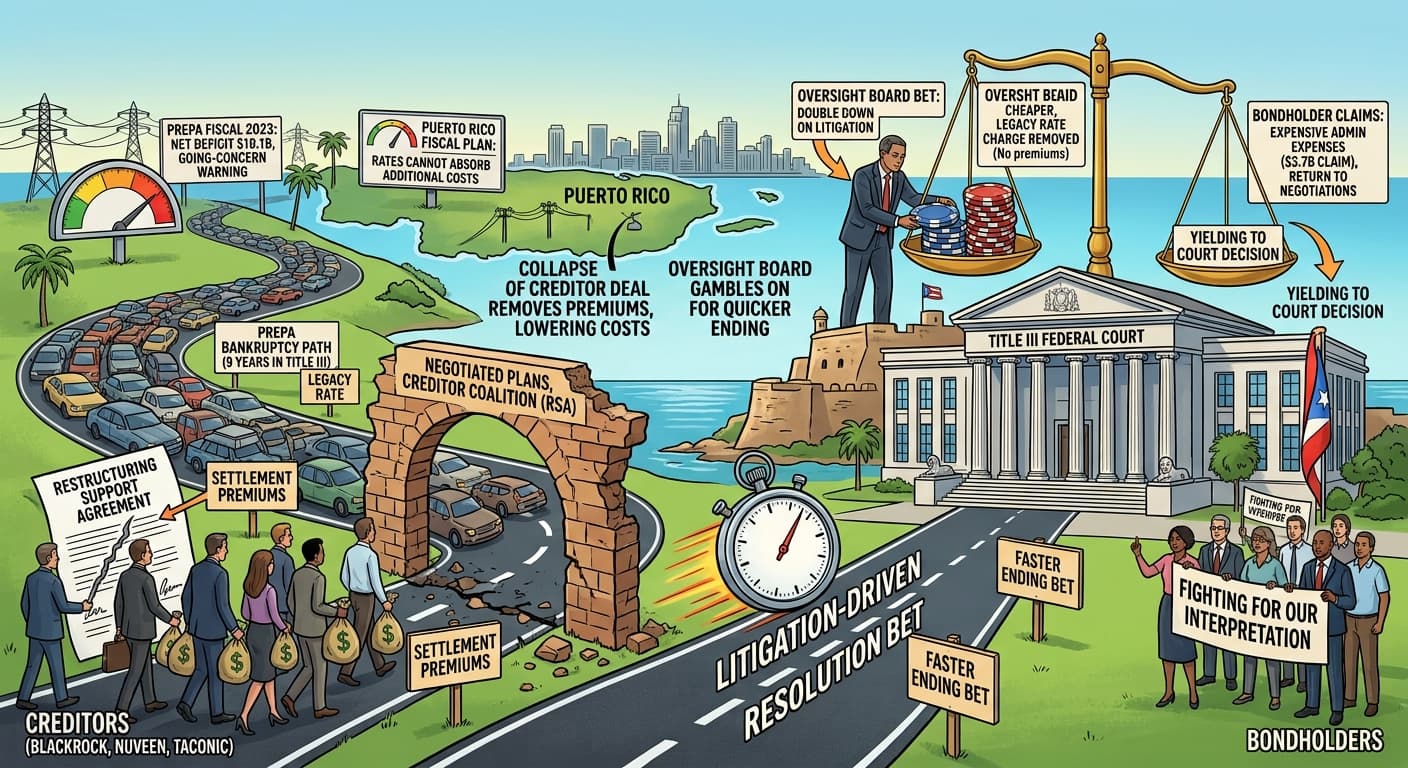
The Puerto Rico Financial Oversight and Management Board filed a court status report this week arguing that the collapse of its creditor coalition could actually help PREPA exit bankruptcy sooner and at lower cost.
In its filing ahead of Wednesday’s omnibus hearing, the Board said the Fifth Amended Plan of Adjustment, filed on March 28, 2025, remains confirmable even after the termination of the August 2023 Restructuring Support Agreement by the vast majority of participating creditors.
According to the filing, the plan becomes “materially less expensive to confirm” if the Board prevails in ongoing litigation over what bondholders are actually owed.
That reversal is the reason the Board told the court it is not preparing a sixth amended plan. After nine years in bankruptcy and five restructuring proposals, the Board is betting that resolution through court rulings will reach the finish line faster than continued negotiations.
What changes the math is that creditors in a settlement agreement are paid premiums for agreeing not to fight the plan. Strip away the deal, and those premiums disappear.
What gets cheaper and why
A plan of adjustment is the Title III equivalent of a corporate bankruptcy plan. Nothing becomes law until a judge confirms it, and confirmation requires that at least one class of creditors voting to accept it have taken a loss.
Creditors who support the plan in advance, through a restructuring support agreement, are paid for their cooperation. They recover more of their original investment than holdouts, and they become eligible for additional payments, called contingent value instruments, if the utility’s finances outperform expectations. Holdouts get neither.
The investors who signed the August 2023 agreement were funds affiliated with BlackRock, Nuveen and Taconic Capital. They committed not only to vote for the plan but also to purchase $1.6 billion in new PREPA bonds whose proceeds would fund cash recoveries for unsecured fuel-line creditors and other non-bondholder claimants. Their withdrawal from that agreement has left the Board without the financial mechanism to pay these other creditors.
If the supporting creditors walk away, the settlement premiums they were promised also disappear. The Board’s remaining obligation is to pay bondholders the value of their allowed secured claims as ultimately determined by the court, plus any additional amounts required if bondholders succeed in establishing other allowed claims.
In other words, a plan imposed through litigation could require less total payout than a negotiated plan, provided the courts side with the Board’s reading of bondholder rights.
One appellate decision
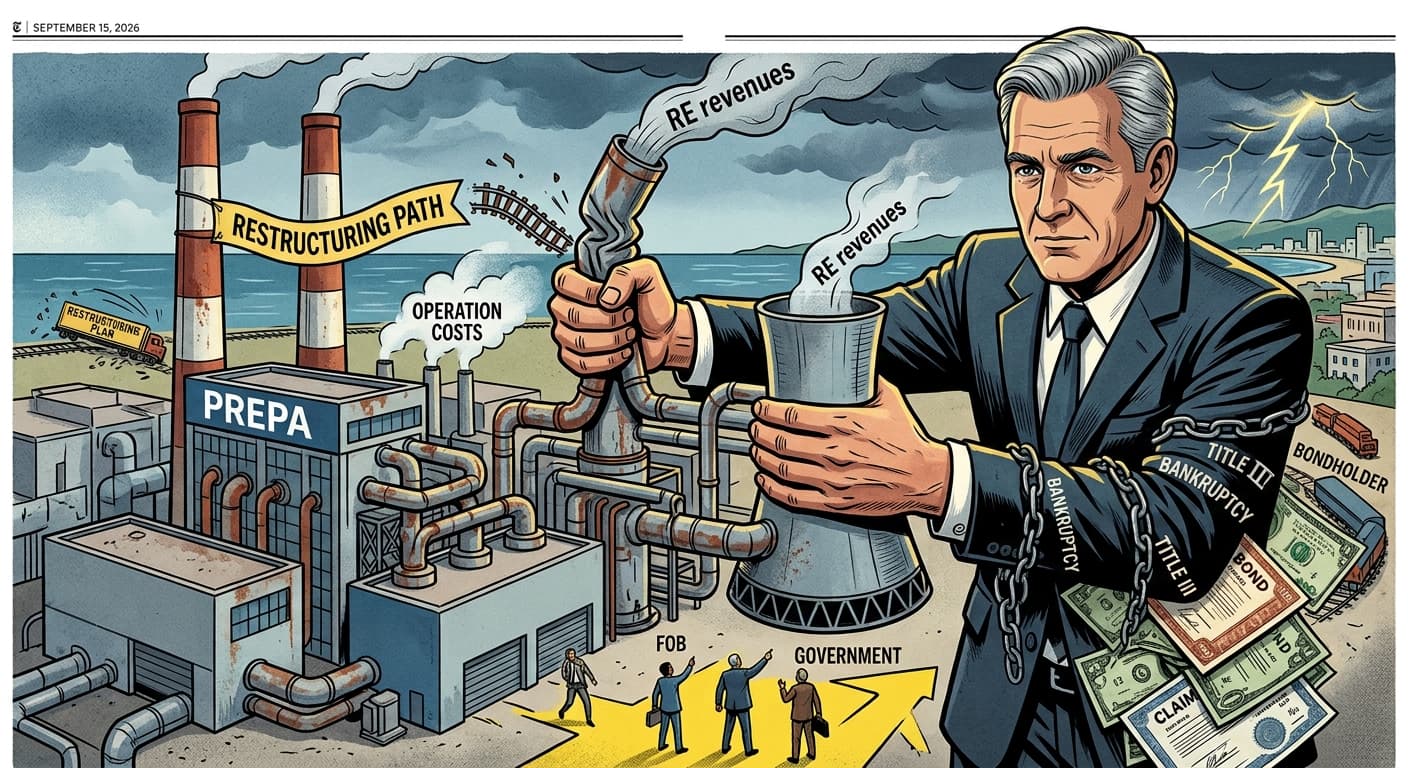
The Board’s interpretation rests on the First Circuit’s June 2024 ruling on PREPA bondholders’ collateral rights. The appellate court found that bondholders have a valid perfected security interest in PREPA’s net revenues, meaning the money left after the utility covers its operating costs. But the court rejected broader claims that bondholders possessed liens on all PREPA revenues or other utility assets.
The Board reads that as confirming that bondholder rights are real but bounded. Bondholders read it as leaving room for larger claims, and the gap between those readings is now being litigated.
The Board’s strategy assumes that courts will vindicate its reading of bondholder rights. If that assumption is wrong, PREPA remains in bankruptcy.
The focal point is administrative expenses, a legal term for costs incurred while a debtor is in bankruptcy. In a Chapter 9 case or Title III restructuring, administrative expenses get paid ahead of most other claims. Bondholders claimed at least $3.7 billion on that theory. Judge Laura Taylor Swain rejected that request in March 2026, and the First Circuit heard oral argument on the appeal this month.
If the appellate court agrees with the Board’s interpretation, the plan becomes confirmable at the lower cost the Board projected. If the court sides with the bondholders, the plan becomes substantially more expensive, and either more of the cost falls on ratepayers or the Board must return to the negotiating table.
What happens if the Board wins
The Fifth Amended Plan was introduced after the Board certified PREPA’s 2025 Fiscal Plan, which concluded that the utility could not sustain additional rate increases to support debt service without pricing out Puerto Rico consumers. The fiscal plan found that PREPA’s operational costs alone would require rates beyond what many households could reasonably afford.
That constraint eliminated a critical backstop in previous restructuring proposals. Earlier plans would have imposed a legacy charge on electricity consumers, a surcharge appearing on every customer’s monthly bill for decades to repay debt incurred before the restructuring. The Fifth Amended Plan removed it.
If courts ultimately determine that bondholders are owed substantially more than the Board projects, the money has to come from somewhere. The fiscal plan already concluded that rates cannot absorb it, leaving the Board without a clear funding source for a shortfall.
PREPA has been in Title III since 2017, restructuring roughly $9 billion in debt. The utility’s most recent audited financial statements, covering fiscal 2023, cited a net deficit of $10.1 billion, meaning liabilities exceed assets by that amount, and included a going-concern qualification, an auditor’s formal warning that the entity may not continue to operate over the coming year without outside support.
For investors, creditors, and ratepayers, the question is whether resolution through litigation gets faster than a sixth round of negotiations ever could. The Board’s strategy assumes it does, and that courts will vindicate its reading of bondholder rights. If that assumption is wrong, PREPA remains in bankruptcy and the utility’s financial condition continues to deteriorate.
What the Board is signaling
Two variables will determine whether what ultimately happens. The first is the First Circuit’s ruling on the administrative expense appeal. The second is the composition of the Oversight Board itself, which has been unsettled since the president dismissed five members in August 2025 and a sixth days later, leaving one member in place before a federal judge ordered several reinstated that October. Litigation over those removals continues.
For creditors deciding whether to settle now or hold out, the Board’s composition is an obvious reason to wait. Whoever sits on the Board when negotiations potentially resume could offer materially different terms than the current plan. The Board’s filing suggests it has concluded that creditors will wait regardless, and that a resolution faster and cheaper than settlement would offer is worth the risk of betting on courts.
That leaves PREPA’s nearly decade-long bankruptcy ultimately hinging on pending appellate decisions and upcoming rulings in the bondholder litigation, with the timeline and total cost both hanging on how those judges read PROMESA’s Title III framework and the First Circuit’s prior ruling on bondholder rights.
First Circuit hears arguments that collateral-treatment dispute could become a “chokehold” on the utility’s path to emergence from Title III bankruptcy
With procurements frozen, plants unbuilt, and solar hitting its limits, Project Hostos has become Puerto Rico’s least encumbered path to significant new capacity. A Paris impact award suggests the market has noticed.