Story by Luis Meléndez, CB and Metro sports correspondent
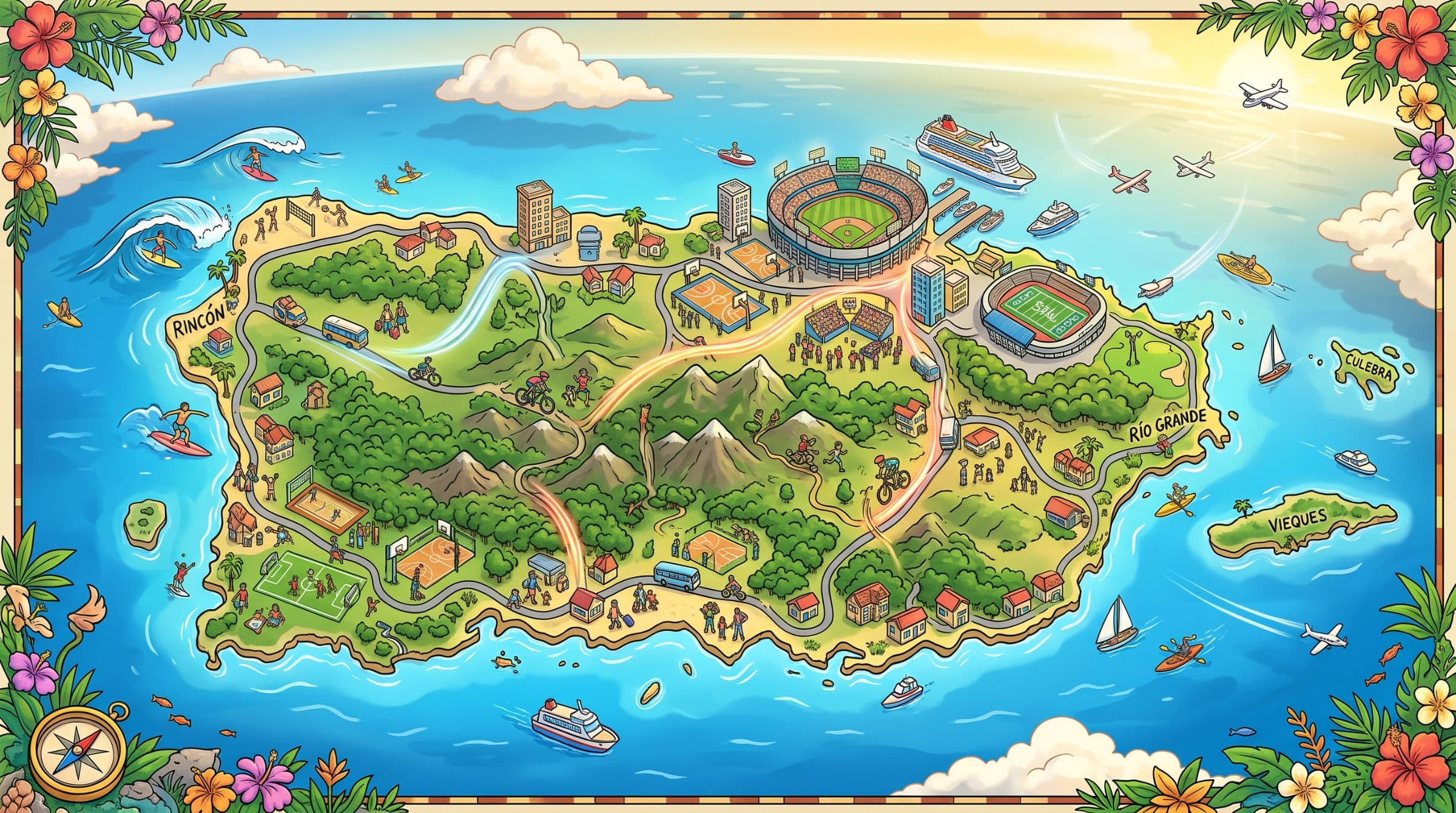
The Puerto Rico Chamber of Commerce (CCPR) is betting on sports tourism as a driving force of the island’s economic growth and is looking for ways to build a broader cultural and entertainment offering around sporting events.
In recent years, the sports economy has grown exponentially worldwide. Events such as the FIFA World Cup, the World Baseball Classic and the Super Bowl have become sociocultural and economic phenomena for their host cities.
Puerto Rico wants to get in the game by bringing in major sporting events. The island has already hosted NBA preseason games, the World Baseball Classic and several FIBA basketball events. But the vision of Chamber President José Julio “Che” Aparicio goes beyond what the island hosts today.
“I had the chance to see the data Discover Puerto Rico presented, and the Tourism Company, even though neither is an affiliate or member of the Chamber, sent us studies and shared with us the enormous potential there is. This is bigger than sports. This is sports, culture and entertainment,” the CCPR president said.
CB estimates that a realistic recurring sports calendar could generate roughly $85 million to $140 million a year in economic activity.
Part of a broader tourism push
The sports push adds another front to an industry on a record run. Discover Puerto Rico, the island’s destination marketing organization, projects about 8.9 million nonresident travelers in 2026, generating about $9.5 billion in direct visitor spending, as CB reported last week.
The Foundation for Puerto Rico (FPR) puts the visitor economy at about six million visitors a year spending more than $8 billion, and projects eight million visitors and about $12 billion by 2030. Leisure and hospitality employed 115,000 people in August, surpassing manufacturing’s 85,000.
The Chamber is organizing to capture more of that growth. In September, it launched a permanent Tourism Committee, chaired by CCPR President-elect Mickey Espada and co-chaired by Clarisa Jiménez Mayoral, president and CEO of the Puerto Rico Hotel & Tourism Association, with regional integration among its six work areas.
Aparicio then pointed to sports, culinary, cultural and entertainment entrepreneurs as part of the island’s pitch ahead of FITUR 2027 in Madrid. Today (Thursday, Oct. 29), the Chamber holds its Sports Business Summit 2026 at Bahía Beach in Río Grande, under the theme “Sports, entertainment and culture: a new economic development model for Puerto Rico.”
Spreading visitors beyond the usual corridors is a common thread. Airbnb data showed reservations in five emerging municipalities (San Germán, Coamo, Barranquitas, Jayuya and Maunabo) grew more than 25% from 2024 to 2025, led by San Germán at nearly 60%, as CB reported this month.
The Rebook Hospitality Conference has rallied independent operators to capture spending outside traditional tourist zones, and an FPR analysis from late 2025 identified decentralization as critical to the industry’s competitiveness.
The Chamber wants investment in these events to reach the entire island, not just the San Juan metro area. The main obstacle, Aparicio said, is a lack of infrastructure, including a shortage of rooms to house the number of people these mega-events could bring.
Several challenges
“To be realistic, we don’t have the rooms for these big events. If we want to hold a big surfing event on some coast that draws 5,000 or 6,000 people, we don’t have the lodging. That is something we have to address in the long and short term,” Aparicio said.
The numbers show how the island’s lodging has shifted. Through September, Puerto Rico logged about 6.4 million room nights, split almost evenly between hotels (3.3 million) and short-term rentals (3.1 million), according to Discover data cited by CB.
Short-term rentals make up about 47% of lodging inventory and are spread more widely across the island than hotels, which makes them the most likely near-term buffer for events outside the metro area, though not for a single coastal town hosting thousands at once.
Hotel capacity is a longer-term fix with its own obstacles. At the Chamber’s Tourism Committee launch, Raúl Bustamante, chairman of Discover Puerto Rico and the Hotel & Tourism Association, listed energy costs and reliability, water infrastructure, permitting and the expansion of hotel inventory among the industry’s main challenges.
Youth sports as a steadier stream
One area of focus has been youth sports. Puerto Rico already hosts countless highly competitive youth tournaments. These events draw teams from around the world, which means that besides the athletes, family members, coaches and other companions make the trip to the island.
“In the United States, private equity funds are buying youth clubs. Why? Because you reach mom, dad and the whole family directly, much more cheaply and directly than through traditional media,” Aparicio stressed.
The data back his focus. In the U.S., participatory sports (youth and amateur events) accounted for about 54% of total sports tourism impact and 227.6 million of 339 million sports travelers, according to the 2026 State of the Industry report by the Sports Events and Tourism Association (Sports ETA). Unlike one-off spectacles, these events recur on a calendar and can be held in municipal venues.
Puerto Rico has a base to build on. This year’s Caribbean World Series youth baseball tournament in July brought more than 230 teams and 3,000 players from Puerto Rico, the U.S. and the region to San Juan, Cataño, Dorado, Bayamón and Carolina, for more than 2,500 room nights and about $2.8 million in economic impact, according to Discover. The Perfect Game Puerto Rico Festival added international teams for the first time, with an estimated $400,000 in player and family spending.
The Chamber is aware of the large number of private investors willing to drive the sports economy on the island. That is why it seeks to promote projects that make Puerto Rico a more attractive host for major sporting events.
What Puerto Rico hosts, aspire to host
The 2026 calendar has been the island’s busiest in years. The World Baseball Classic’s first round in March drew more than 143,000 spectators over five days at Hiram Bithorn Stadium, with an estimated $46.8 million in economic activity, according to a study commissioned by the Municipality of San Juan, which has invested nearly $40 million in renovating the stadium.
The Tourism Company projected $18 million for Inter Miami’s February friendly in Bayamón, $12 million for the PGA Tour’s Puerto Rico Open in Río Grande and about $11.8 million combined for an NBA preseason game and FIBA qualifiers, according to published reports.
December adds a new category: college football. The inaugural TransPerfect San Juan Bowl, between the Atlantic Coast Conference and the Sun Belt Conference, is set for Dec. 16 at Hiram Bithorn, according to the conferences, and the inaugural Puerto Rico Bowl, to be broadcast by ESPN, is scheduled for Dec. 22 at Juan Ramón Loubriel Stadium in Bayamón. Discover is promoting bowl travel in hotel packages for key U.S. markets.
Sports are part of a wider events strategy. Discover counted more than 300 tourism and entertainment events in 2025, with an estimated economic impact of up to $393 million, according to published reports, and Discover CEO Jorge L. Pérez has said the goal is to promote Puerto Rico as an entertainment destination.
Short of hosting large multisport tournaments, the most accessible annual gains come from a recurring circuit that Discover, the Tourism Company’s sports tourism office, COPUR and the national federations can build together: annual youth and amateur tournaments in baseball, basketball, volleyball and soccer rotated among regional venues; FIBA qualifying windows and preseason basketball; surfing and endurance events on the west and south coasts; and sports conferences such as this year’s North American Society for Sport Management meeting, which Discover estimated at about $465,000 and 865 room nights.
Each partner holds a piece. The federations and COPUR control sanctioning and international relationships, Discover markets the destination, the Tourism Company manages incentives and the municipalities own most venues. The Chamber’s push could supply the missing private capital and coordination.
CB analysis: what a realistic calendar is worth
CB estimates that a realistic recurring sports calendar could generate roughly $85 million to $140 million a year in economic activity. The estimate assumes the Puerto Rico Open at its projected $12 million; the two December bowls at $5 million to $10 million each, a CB assumption since neither has published a projection; about $12 million from preseason basketball and FIBA windows; one or two marquee one-off events a year at $20 million to $50 million combined; 10 to 15 youth and amateur tournaments the size of the Caribbean World Series, or $28 million to $42 million; and $1 million to $2 million from sports conferences.
For comparison, the 2026 events cited above plus the youth tournaments, add up to about $92 million in official projections and studies, before the bowls. That makes the low end of the CB range achievable now and the high end dependent on growing the youth circuit and landing at least one major event each year.
The figures are gross economic activity as reported by organizers and agencies, not net new income, since such estimates typically do not subtract spending that would have happened anyway. Even at the high end, sports would represent less than 2% of the more than $8 billion visitors spend each year.
The niche’s value lies elsewhere, mainly indirect effects: it fills rooms, disperses visitors to municipalities beyond the metro area, and buys international exposure that marketing budgets cannot.
Luis A. Meléndez is a journalist with Metro Puerto Rico and is part of Report for America, an organization that supports journalists in local newsrooms
CB Web Editor Alex Díaz contributed to this story.
Bettina Garibaldi, who led marketing for the New York New Jersey World Cup host committee, shares key lessons to boost outcomes from events like Miss Universe
In an exclusive interview with Caribbean Business, CEO Jorge Pérez explains how the organization is retooling its strategy for a sixth straight record year
The Convention District Authority’s push to link its parcels with Bahía Urbana, add hotel rooms and draw housing for professionals revives a vision first outlined more than two decades ago to position the island as a top-tier global destination