Mexico’s $8 billion interoceanic corridor seeks to reshape global shipping routes and attract industrial investment
As supply chains shift and congestion strains global shipping, Mexico is developing the Isthmus of Tehuantepec, a multibillion-dollar project to create an interoceanic trade corridor to challenge the supremacy of the Panama Canal.
Building on this initiative, set for completion this summer, the Interoceanic Corridor of the Isthmus of Tehuantepec will link the Pacific and Atlantic oceans by transporting containers through upgraded ports, railway lines, and industrial zones. Supporting this corridor, the project is backed by the Development Program for the Isthmus of Tehuantepec, which seeks to address social and economic inequality across 79 cities in Oaxaca and Veracruz, according to government sources.
The corridor is the backbone of Mexico’s program to compete with global markets in the shipment of merchandise. The estimated $8 billion project comprises several smaller projects, such as railway routes, the modernization of important ports, like Coatzacoalcos in Veracruz and Salina Cruz, and highways and smaller road routes.
The Interoceanic Corridor of the Isthmus of Tehuantepec was formally approved by the Mexican government in 2019. The need to build the corridor became more pressing after a drought reduced the Panama Canal transit capacity, cutting daily vessel crossings by roughly 25%–35% and affecting a vital waterway that typically handles close to 5% of global maritime trade. The constraints prompted shipping lines and cargo owners to divert portions of the Asia–U.S. East Coast route and energy‑related flows toward longer trade routes or find alternative logistics solutions.
While the Panama Canal recovered to full capacity in mid-2025, long-term issues remain, such as the impact of climate change, high traffic volumes, and the need to conserve water for the local population.
In anticipation of the corridor’s operations beginning this summer, Mexican President Claudia Scheinbau has formalized an agreement with the European Union (EU) to strengthen the corridor’s position as an alternative to the Panama Canal. Under the agreement, the EU seeks to transport grains and salt to the United States, Latin American, and Asian markets via the corridor. According to Sheinbaum, as cargo volumes increase, mobility along the corridor will continue to expand, reinforcing its role as a key logistics hub.
“This is a Development Pole for the entire country, not just for the southeast,” Sheinbaum said during a recent press conference, known in Mexico as Las Mañaneras del Pueblo, as she also highlighted additional connectivity projects linked to the initiative.
For example, the Mexican president announced that the corridor is planned to reach Guatemala via the Line K railway, with ongoing talks to continue developing this cross-border link.
What are the components of the project?
The corridor consists of the utilization of the ports of Dos Bocas and Puerto Chiapas, the modernization of the ports of Coatzacoalcos and Salina Cruz, the rehabilitation of more than 1,200 kilometers of rail infrastructure across Lines Z, FA, and K, the expansion of the Salina Cruz–Coatzacoalcos highway, and the development of 10 industrial parks known as the Development Hubs for Well‑Being or Los Polos de Desarrollo para el Bienestar. The 1,200 kilometers of railway will connect to Mexico’s national railway system, the Mayan Train, and Central and North American railways. The corridor is currently in its final phase of construction and logistical consolidation.
According to the Mexican government, the system is expected to be fully operational by June 2026. By April 2026, key components of the project had made significant progress. Rail Line Z, connecting Coatzacoalcos to Salina Cruz, has operated passenger and freight service since December 2023. Line FA, linking Coatzacoalcos and Palenque, connects to the Maya Train and Dos Bocas refinery. Line K, from Ixtepec to Ciudad Hidalgo near Guatemala, is nearing completionand is expected to be operational in the second quarter of 2026.
The project also has numerous companies attached to it under a public-private partnership investment model managed by the Mexican Navy, according to the government. Key infrastructure work on railways and ports has been carried out by leading firms such as Mota‑Engil México, Grupo Carso, ICA, La Península Compañía Constructora, Grupo INDI, Construcciones Urales, and China Communications Construction Company. Industrial development within the corridor is being driven by private operators, including ProIstmo, Desarrolladora Multimodal del Istmo, Helax Istmo Holdco, and MARZAL, while Ursus Energy is planning a $450 million liquefied natural gas plant in Coatzacoalcos, underscoring the corridor’s strategic energy and logistics potential.
Cost Will be a Factor for Success
For the corridor to rival the Panama Canal, companies’ costs must be competitive. Cost estimates for using the Interoceanic route were not available for this article. Nonetheless, shipping cargo through the Panama Canal typically costs tens of thousands to more than $1 million per transit, depending on the size and type of vessel, cargo capacity, and congestion conditions. Container ships pay tolls based on their carrying capacity, with Panamax vessels generally costing about $100,000 to $400,000 per crossing and larger Neopanamax ships often exceeding $500,000, according to Panama Canal Authority tariffs and industry estimates.
Tankers and bulk carriers face similar six‑figure charges, while liquefied natural gas carriers can incur costs between roughly $300,000 and $1 million per transit, reflecting additional safety requirements and capacity‑based fees. During periods of drought or congestion, ships without advance reservations may bid for scarce transit slots at auction, driving total costs significantly higher; in recent congestion episodes, auction premiums alone reached $1 million to $4 million for a single passage.
Important Milestone Already Reached
Humberto Vargas, a railway consultant in Mexico, recently said that the Interoceanic Corridor of the Isthmus of Tehuantepec has already reached an important milestone with its first completed interoceanic transit, involving finished vehicles from a South Korean automaker that arrived by ship in Salina Cruz, crossed the Isthmus by rail in about eight hours, and continued on to Coatzacoalcos and the Gulf of Mexico. Details, such as cost and time to complete the transit, were not provided. That initial operation demonstrates that the corridor is no longer theoretical, but operational. “At the end of the day, this shows it is a reality,” Vargas said, adding that “what remains to be seen is whether it can truly reach its full potential.” He acknowledged that the project still faces significant challenges before it can compete with the Panama Canal. He emphasized that major investments are still required, particularly in port infrastructure at both Salina Cruz and Coatzacoalcos, to accommodate large container vessels similar to those that transit through the Panama Canal.
Vargas also noted that although current rail transit times across the Isthmus are efficient, the corridor is still operating shorter trains, and that running longer, heavier trains will be essential to improving efficiency and competitiveness. If fully developed, he said the interoceanic corridor could eventually serve not only as an alternative to the Panama Canal but also as an option for rerouting cargo currently moving through U.S. ports such as Los Angeles and Long Beach, a long-standing goal for Mexico. He also pointed to future opportunities tied to potential rail connectivity with Guatemala, though differences in rail gauge currently prevent cross-border operations.
In closing, he stressed that success will depend on realistic evaluations of infrastructure needs, investment levels, and expected returns. “Cargo moves like a river,” he said. “If it finds an obstacle, it will always seek another path. The opportunity is clear — the challenge is knowing how to take advantage of it.” Companies participating in the Interoceanic Corridor of the Isthmus of Tehuantepec (CIIT) are eligible for a package of federal tax incentives established under a presidential decree issued on June 5, 2023. The incentives apply to businesses operating within the designated Development Poles for Well‑Being (PODEBIs) and are intended to attract investment in priority industrial sectors aligned with the corridor’s long‑term economic strategy.
Among the most significant benefits is an income tax incentive that grants companies a 100% income tax credit during their first three fiscal years of operation after receiving a compliance certificate. For the next three years, the credit ranges from 50% to 90%, with the higher rate available to companies that exceed the government-set minimum employment thresholds. In addition, companies are entitled to an immediate 100% deduction of the original value of new fixed‑asset investments used within the development poles, a benefit that remains in effect for the first six years of operation.
The decree also provides a value‑added tax incentive that effectively functions as an exemption. Companies operating within the development poles receive a 100% VAT credit for four years on taxes generated from the sale of goods, the provision of services, or the leasing of property within the poles. This applies to transactions conducted both within the same development hub and between different hubs along the corridor. To qualify for these incentives, companies must engage in productive economic activities aligned with the government’s list of strategic sectors. These include electronics and semiconductor manufacturing, automotive and transportation industries with a focus on electromobility and auto parts, healthcare manufacturing, such as medical devices and pharmaceuticals, clean energy equipment and infrastructure, and heavy industry activities, including agribusiness, metals, and petrochemicals.
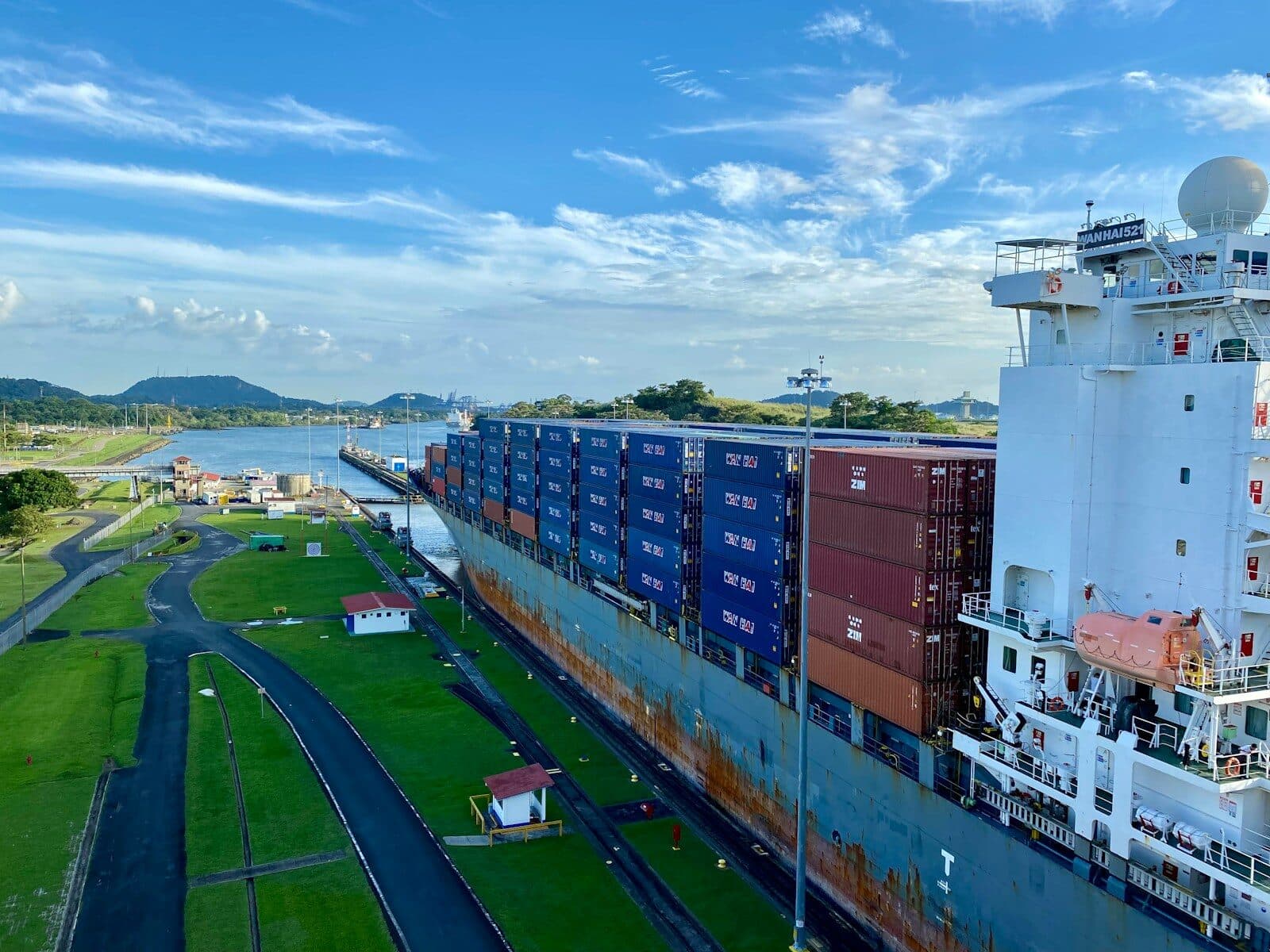
Freight moves through the Panama Canal, as Mexico advances a rail-and-port corridor to offer an alternative route between oceans.
Mexico is not Alone
Mexico is not the only country attempting to create an alternative to the Panama Canal.
Colombia is advancing plans for a so‑called “dry canal” railway that would link the Pacific and Atlantic oceans through a 220‑kilometer interoceanic rail corridor connecting Cupica Bay on the Pacific coast with the port of Turbo on the Caribbean. Pre‑feasibility studies are already underway, with Colombian authorities aiming to advance to full feasibility assessments during 2026.
In Nicaragua, renewed attention has been given to the long‑discussed Grand Canal project, a proposed 278‑kilometer waterway running from the Caribbean coast, through Lake Nicaragua, to the Pacific Ocean. Envisioned as a direct, “wet canal” alternative to Panama, the project was designed to accommodate ultra‑large cargo vessels that cannot pass through the expanded Panama Canal. Although the canal has been proposed and abandoned multiple times over the past decade, the Nicaraguan government has continued to revive the initiative. In 2024 and 2025, officials promoted a revised, smaller‑scale route aimed at attracting new international investors, though many analysts remain skeptical about the project’s financial and technical viability.
Alongside the waterway concept, Nicaragua has also floated proposals for a parallel “dry canal” rail corridor connecting large ports on both the Pacific and Caribbean coasts. Members of Congress were unaware that Puerto Rico received only 43 percent of the national average in Medicare funding, despite paying fully into the program.
The Financial Oversight and Management Board for Puerto Rico (FOMB) has issued an “approved with observations” determination for two contracts between the Puerto Rico Housing Finance Authority (PRHFA) and the municipalities of San Juan and Bayamón, clearing the way for the acquisition and rehabilitation of more than 100 residential properties under the federal HOME‑ARP program. […]
The head of the Puerto Rico Aqueduct and Sewer Authority (PRASA), Luis González Delgado, said Tuesday that the agency expects to have four filtration units at the Sergio Cuevas water treatment plant back in operation by October, a move he described as the key to stabilizing water service across the San Juan metropolitan area. The […]
La Rosa Realty, a national real estate brokerage, is expanding its footprint into Puerto Rico with a new corporate office in San Juan and a new tool. Leading the charge is the company’s newly appointed national president, Jose Couvertie, a Puerto Rico native who took the helm three months ago and is spearheading a strategic […]