Puerto Rico’s Fiscal Board Nears a Turning Point Amid Political and Economic Questions
Nearly a decade after Congress imposed the Financial Oversight and Management Board through Promesa, Puerto Rico stands at a critical crossroads. While the Island has restructured most of its debt and restored fiscal stability in some areas, unresolved challenges—including Prepa’s bankruptcy, stalled fiscal reforms, and questions about long-term economic sustainability—continue to fuel debate over the Board’s legacy and Puerto Rico’s future after Promesa.
After years of economic depression in Puerto Rico, by the summer of 2015, many voices, particularly those on the left of center, were arguing that the Island’s debt was unpayable. Pundits and politicians who were more status quo categorized those voices as unserious.
By the summer of 2016, the Island had defaulted on its debt service, Congress had approved the bipartisan Puerto Rico Oversight, Management and Economic Stability Act (Promesa), and then-President Barack Obama had appointed the seven members of the Financial Oversight and Management Board (FOMB).
Promesa created a special bankruptcy process for Puerto Rico. This started the process of the United States’ largest municipal bond bankruptcy, dethroning Detroit’s $18 billion bankruptcy, with Puerto Rico holding more than $70 billion in bond debt across at least eight government entities, including the Commonwealth of Puerto Rico.
“The crisis happened for two reasons: there was an economic downturn, and there was not the will to deal with the budget reality that resulted from the economic crisis,” the FOMB executive director, Robert Mujica, said during the recent Puerto Rico Real Estate Summit.
Mujica celebrated the success of the fiscal board and presented a picture of the FOMB righting the ship in Puerto Rico’s finances, which, by the time the Board was enacted, had run 16 central government budgets with deficits. Now that 12 entities have completed their restructuring, with the Puerto Rico Electric Power Authority (Prepa) bankruptcy the only one remaining unresolved, Mujica’s and the Board’s main focus now seems to be establishing the processes within the Island’s government to achieve balanced budgets.
As for the FOMB’s accomplishments, Mujica touted the 60% haircut that the Puerto Rican debt received on average, meaning that the government went from spending 30 cents of every dollar for debt service to six cents of every dollar. Mujica has also celebrated that the Puerto Rico government went from not putting money into its reserves to now holding $1.3 billion in reserves for emergencies.
Whither the ERP?
However, the discussion largely left out the Enterprise Resource Planning (ERP), a key project for the FOMB. Originally proposed by the fiscal board in 2018, the ERP is supposed to centralize the government’s fiscal and accounting systems. This will include the government agencies’ general budgets and payroll, as well as track procurements and external contracts. The ERP will also be used to record financial data, which will then be used to prepare the Puerto Rico government’s budget resolutions and audited financial statements.
According to news reports from Centro de Periodismo Investigativo, the FOMB has spent between $80 million and $100 million to implement the ERP, with very little progress to show for it over the past six years.
Answering press questions during the “A Better Plan” symposium, Mujica recognized that the ERP is not a reality, but the fiscal board expects to finalize the system this summer. As for structural reforms in general, Mujica said that the fiscal board is already in talks with the Legislature about possible bills that would enshrine in law certain budgetary processes that will outlive the fiscal board, but many changes remain to be made. It is necessary to complete the fiscal reforms in general, and the ERP in particular, before the Board’s departure, according to Mujica.
Both at the symposium and at legislative hearings, the heads of Puerto Rico’s financial and budgetary agencies have touted the processes they are implementing. When asked about this, rather than confirm the changes, Mujica tried to strike a diplomatic tone, arguing that the Puerto Rico government now sees the importance of making changes but it has a long way to go.
“In smaller states and big states, it takes years to implement these reforms. It takes years of practice and building up institutions, and building up the people in these agencies to recognize that these things are important. So I would say the desire is there, but we are far from actually having the practical results that you need,” Mujica stated.
The FOMB executive director’s arguments for concrete measures about budget processes fall in line with statements from other members of the fiscal board, including John Nixon, who argued that the implementation of the fiscal reforms requires “a strong Executive.”
Still, change has happened. Mujica argued at the summit. “The restructurings are mostly completed, and the results are real. So, what does it mean? We stopped the bleeding that occurred in 2017, and now we’re building a sustainable model for the future,” he said.
While there is consensus that Puerto Rico needed to restructure its debt and that previous administrations lacked the fiscal discipline to manage the Island’s long-standing economic depression, the fiscal board remains a controversial entity.
Deepak Lamba Nieves, the Infrastructure and Transportation Justice Director at the think tank Policy Link, indicated that at the beginning of the FOMB’s tenure, several opinion polls indicated that many people were welcoming of the Board, not because they necessarily knew of the FOMB’s plans, but because people were tired of the status quo.
However, the austerity policies enacted by the Board and the FOMB’s decision to never define what are “essential services” resulted in the waning of support for the fiscal board, argued Lamba Nieves. Political economist Rashid Marcano Rivera argued that balancing the budget through those austerity measures is not sustainable.
He added that the FOMB’s policies have resulted in deteriorated infrastructure and fewer services to the people. Lamba and economist José Caraballo Cueto note that Puerto Rico’s economy, while in better condition today, remains weak. Caraballo Cueto also highlighted the recovery funds the island has continued to receive after Hurricane Maria and the COVID-19 pandemic, which mask the actual state of the economy.
Changing the Political Discussion
On May 3, 2017, the FOMB officially entered Puerto Rico in restructuring proceedings, with two entities following the non-contentious process under Title VI of Promesa. The remaining five used the Title III bankruptcy process, which established a special court presided over by Judge Laura Taylor Swain.
The aforementioned experts argued that the dynamics between the government and the Board, and between the Board and the bondholders, created a greater distance between the people and the rooms where decisions were being made. Marcano Rivera wondered whether one reason for the decline in economic participation is that, with the FOMB in place, people feel their vote is less useful.
Lamba argued that the impression that power lies solely with the fiscal board has also provided cover for local administrations. “What better scapegoat could the government have than to say, ‘I tried, but the board won’t let me’? … They would say, ‘It’s the fiscal control board that won’t let me,’ in this cat-and-mouse game played by the Puerto Rico government and the fiscal control board; the Board turns out to be a convenient entity,” he said.
This political landscape doesn’t mean that meaningful activism hasn’t happened. Former Service Employees International Union lawyer and past chair of the Unsecured Creditors Committee, Alvin Velázquez pointed out that government retirees were willing to keep the fight going, which ultimately forced changes to the FOMB’s plans for public pensions.
“It sheds new light on what can be done in municipal bankruptcy and what can’t be done in municipal bankruptcy. That was very surprising for me to see the people realize that Judge Swain’s court was not the only place to engage in resistance,” said Velázquez, who is now a law professor at the Maurer School of Law at the University of Indiana.
One Last Hurdle
Puerto Rico’s bankruptcy has now completed all but one of the entities that needed debt restructuring: Prepa. In a case of “so close yet so far,” Prepa’s debt restructuring, which has lasted years, is proving very difficult. “I just don’t have a good sense that there has been genuine engagement in mediated negotiations by any constituency. At least nothing seems to have come out of them after multiple years. And there has been, there continues to be a lot of litigation,” said Judge Swain with a concerned tone to both the FOMB and the Prepa creditors’ lawyers at the March 18 Omnibus hearing.
The principal for Prepa’s debt is $8.5 billion, a figure that jumps to closer to $12 billion when accrued interest is added. Some bondholders are insisting on receiving payment in full of both principal and interest; the fiscal board is proposing that the debt be reduced to $2.6 billion. These figures don’t include Prepa’s $4 billion in pension liabilities, of which $3.6 billion are unfunded. Velázquez is watching the Prepa negotiations from afar with concern, because an insufficient recovery for Prepa could drag the island’s economic recovery down with it.
The law professor has questioned whether the haircut of the debt has been sufficient to reflect the island’s actual ability to pay. To get the actual full picture of what the Island’s repayment ability is, he argued that Prepa should have been seen as part of the Commonwealth writ large because it is the same people paying the taxes that go to debt repayment who will also have to pay the increased fees in their energy bills to repay Prepa’s bond debt.
“Public sector bankruptcies are a bit of an exercise in political economy and having to engage in large vision planning,” Velázquez argued. “If the charges are too high, you’re not only just choking out Prepa as a debtor, you’re also choking out the economy and the ability of Puerto Rico’s economy to sustain the debt repayment plan that the Board has already put into place.”
Getting Angsty About the Board
Today, nearly a decade under Promesa and with most bankruptcy cases completed, questions about how long the FOMB’s tenure will last have become more common—even from sectors that have welcomed the Board’s management.
The chair of the House of Representatives Treasury commission, Rep. Eddy Charbonier, argued at a public event that a positive side of the FOMB’s presence is that it has brought transparency and fiscal discipline to Puerto Rico.
At the convention of the Certified Public Accountants Association (CPAA), Charbonier went on to describe the dynamic with the Board as “being in a courtroom” where government officials have to justify every penny. Ultimately, he sees the Board as helping the government not kick the can down the road for future generations to pay, and instead ensuring that everything has funding sources.
Despite the praise Charbonier said to the CPAA: “We need to start visualizing a Puerto Rico that is post Promesa, and if we want to get rid of the Board, the Board is not leaving because we play bomba and plena; they are not leaving because their walls get graffitied. You know the requirements in the law.”
Section 209 of Promesa, to which Charbonier alluded, establishes two key requirements for terminating the FOMB. The first requirement is that Puerto Rico has “adequate” access to the credit markets at “reasonable” rates, and the second requirement is that the FOMB certifies four consecutive government budgets as balanced.
A key complaint among politicians, professors, activists, and even the president of the CPAA is the lack of clear definitions, especially on what constitutes a balanced budget. The press coverage over the past five years includes plenty of articles celebrating legislators who approved a balanced budget. But their hopes that the countdown to the four consecutive balanced budgets has started are eventually dashed by the fiscal board.
The current fiscal year has remained the first and only certified budget, and as we go to print, Governor Jenniffer González, the Board, and the Legislature are preparing the budget resolution for fiscal year 2027.
The FOMB’s executive director has explained at several public events that Puerto Rico’s budgets are indeed cash-balanced, but the fiscal board is using modified accrual accounting standards to evaluate them. “Cash basis allows for gimmicks. You deferred payments; time payments so you don’t have to pay them [in the fiscal year]; use one-time revenues to balance the budgets. It doesn’t really capture the full picture. Modified accrual closes those gaps. It requires real numbers, real discipline, and you get the full picture,” Mujica said at the Puerto Rico Real Estate Summit.
As for the requirement of access to the markets, one major hurdle is that Puerto Rico remains unrated by the credit agencies, whose downgrades on Puerto Rico’s ratings 20 years ago triggered punitive clauses in some of Puerto Rico’s bond emissions, such as increased debt service. The other major problem for a return to the credit markets under favorable conditions is that Puerto Rico defaulted on its debt service and then received a considerable haircut on the debt.
Today, Mujica believes that Puerto Rico needs to rebuild trust with the different components of the credit market. In an aside with the press during their symposium on best practices for preparing budgets, “A Better Plan: Symposium on Puerto Rico’s Fiscal Future,” Mujica argued that now Puerto Rico needs to send the message to the credit markets that Puerto Rico has moved on from the practices that led to the bankruptcy.
Beyond the actual numbers in the budget or the credit ratings, a major concern for Mujica and the Board is that the government of Puerto Rico needs to establish and institutionalize a budgetary framework that will provide guardrails for future administrations and legislatures. “If it’s not in the law, it’s not permanent,” Mujica said during the Board’s latest symposium.
“You can’t control who the people elect to the positions; they might be responsible or not, but you can create a system of guardrails that prevent or make it harder to do things that are irresponsible. Ultimately, the elected officials are accountable to the people of Puerto Rico, and what happened in 2016 was a disservice to the people of Puerto Rico, and Promesa was the result of that,” Mujica argued.
The executive director’s arguments for concrete measures to improve budget processes align with a recurring, broader topic for the FOMB: fiscal reform. However, almost a decade in, economist Caraballo Cueto argues it’s time to recognize that they won’t implement the reforms they want.
In Caraballo Cueto’s assessment, the discussions around how or when Puerto Rico will comply with the requirements of Promesa’s Section 209 are moot. For the economist, the FOMB’s focus is on restructuring Puerto Rico’s debt, and once the Prepa debt is restructured, there won’t be a political desire to keep the fiscal board in Puerto Rico.
The Board in Limbo
While politicians, pundits and activists tried to evaluate the future of the fiscal board in Puerto Rico, President Donald Trump threw a monkey wrench at the FOMB. On August 1, 2025, Trump dismissed five of the seven members, and about a fortnight later, a sixth member received his dismissal letter.
About a month later, three of the dismissed members, Andrew Biggs, Arthur González and Betty Rosa, sued Trump. A federal judge provisionally reinstated the members who sued, while the White House filed an appeal with the First Circuit.
“ If independence was a central part of the design of the statute, which it was in Promesa— the idea was we’re gonna have independent nonpolitical, people making budget decisions— the second that you insert the president into the removal process on a political basis, it seems to me to bring up the issue argument that the Board should not be there anymore then because the Board is no longer independent,” Velázquez pondered.
But this wasn’t the President’s only controversial firing, with two previous dismissals now reaching the Supreme Court of the United States (SCOTUS). Now Trump and the Board members are waiting for SCOTUS to decide on those two court cases. The most frequently cited case by people opining on the FOMB status is Trump v. Cook. In 2023, then-President Joe Biden appointed, and the Senate confirmed, Lisa Cook to a 14-year term on the Board of Governors of the Federal Reserve. In 2025, Trump removed Cook for alleged mortgage fraud, but did not give Cook any opportunity to address the allegations. SCOTUS has allowed Cook to remain in her position while the case is pending, and oral arguments were heard in January. “Breathing a sigh of relief after the [SCOTUS]’s oral arguments in the Lisa Cook case— it all bodes very well both for the Fed’s independence and for Puerto Rico. The 3 wrongly ousted FOMBPR members are likely back for good since they were fired even more dubiously than Cook,” posted David Skeel on X, who served on the fiscal board from 2016 to 2024. Skeel has criticized Trump’s firings and even co-wrote an Op-Ed for the New York Times with Biggs arguing that “depending on who [Trump] appoints to replace them, the move could send Puerto Rico back to the brink of financial collapse.”
During the Trump v. Cook oral arguments, the Justices seemed to signal support for maintaining protections “for just cause” when it comes to the governors of the Federal Reserve. However, in oral arguments in Trump v. Slaughter, the Justices were more divided. Rebecca Slaughter was serving her second seven-year term as a Commissioner at the Federal Trade Commission when Trump dismissed her because her actions were “inconsistent with the administration’s priorities.”
It remains to be seen whether the Justices will issue a broad-stroke decision on just cause protections or create carve-outs and caveats that may protect some officials but not others.
No Plans for the Day After
Regardless of how the sunset of the fiscal board comes to pass, Mujica argued during the budget symposium that the FOMB cannot stay forever. Even detractors of the fiscal board have mixed emotions about Puerto Rico’s prospects, as well as concerns that government officials would fall back on old patterns.
Lamba said, “I think we haven’t asked ourselves enough in these 10 years what we want. What kind of Puerto Rico do we want after the fiscal control board?”
Given the context and Promesa’s language, Lamba cautions that, rather than completely leaving the Island, Puerto Rico could also see a fiscal board remain to oversee the government’s compliance with the debt adjustment plans.
For Velázquez, his concerns include, but go beyond, whether government officials can maintain fiscal discipline and how future political theatrics could unfold without the board. The bankruptcy law professor also has major concerns that the debt adjustment plans are not sustainable and that Puerto Rico would need additional debt relief down the road.
“I worry that the tools that were available to Puerto Rico the first time, like challenging legalities, are not there a second time, and it becomes much more difficult to restructure because the arguments have been made and settled,” he argued.
Velázquez is concerned about whether there have been sufficient cultural changes in the Island’s politics and whether the haircut the debt received is sufficient, given Puerto Rico’s lack of economic growth and the fact that the Prepa restructuring is still not settled. Likewise, he cautions that the term “feasibility, as courts define it, is very weak.”
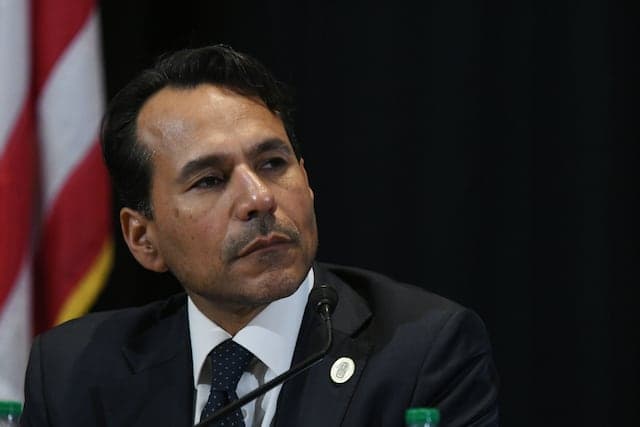
Robert Mujica, Director Ejecutivo de la Junta de Control Fiscal. Metro PR Hato Rey 19 de febrero de 2025
FOMB Executive Directir Robert Mujica defended the Fiscal Oversight and Management Board’s record on restructuring Puerto Rico’s debt and emphasized the need for lasting fiscal reforms and stronger budgetary controls as the Island prepares for a post-Promesa future. (Photo: Dennis A. Jones)
Marking 20 years in Puerto Rico, the company invested $650,000 in a new facility, restoring operations nearly eight years after its previous location was destroyed by Hurricane Maria.