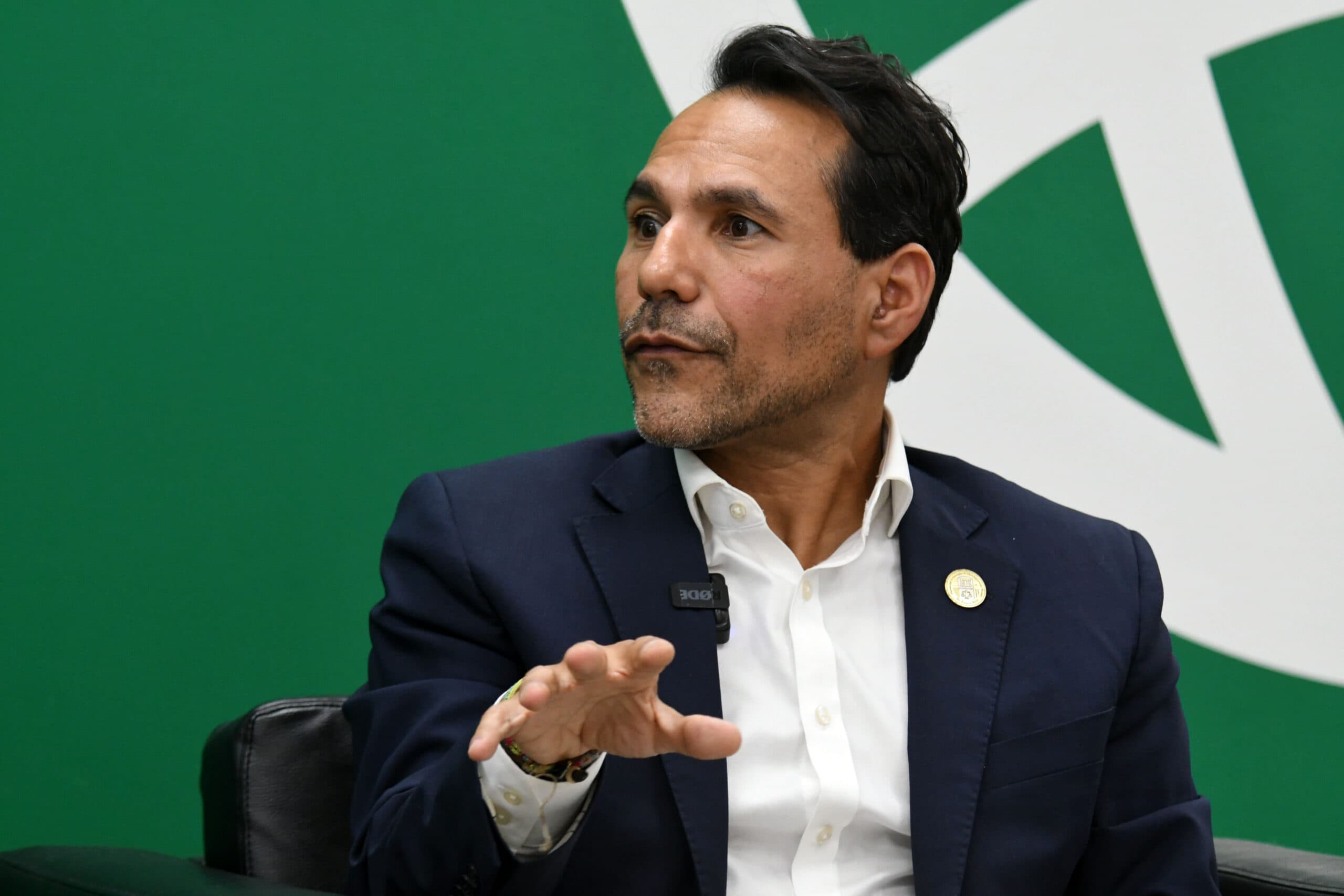
As Alberto Bacó Bagué brings his Blueprint podcast into the Vision News and CB fold, a look back at a career that has tracked the island’s long and unfinished argument over what kind of economy it wants to be
I had probably met him previously, but I do remember well the first time I interviewed Alberto Bacó Bagué in 1990 shortly after he was named president of the Puerto Rico Economic Development Bank and I was a young Caribbean Business reporter assigned to the finance beat. His dapper, dashing persona came right across, as if straight out of Wall Street, the confident lawyer-banker bursting onto the public scene ready to lead Puerto Rico into a new era as a modern, diversified economy.
Thirty-six years later, sitting across from him once more, he still carries that same quality, still pursuing the same vision. The entorno, though, has changed, the conditions swirling around him, and by his own account, key aspects of his own perspective, as well.
The occasion for this conversation is a business one. Caribbean Business has entered into an alliance with El Blueprint, the interview-podcast series Bacó hosts with producer firm Sparkof Studios, bringing its second season onto the CB and Vision News Media print and digital platforms starting next Tuesday, Sept. 8, when Bacó interviews construction-industry leader Rafael Rojo.
For this story, Bacó is the one being interviewed, as he once was so frequently, and as we quickly discovered, his career has followed Puerto Rico’s own journey more closely than our readers likely know, a fairly precise map, actually, of the island’s last three and a half decades of trying to answer a core question: What does the local economy truly aspire to become when it grows up?
A private sector that stopped waiting
To understand why Bacó’s arrival at the EDB in 1990 mattered, it helps to remember what Puerto Rico’s economy had been running on for the previous fifty-or-so years. Operación Manos a la Obra (Operation Bootstrap), the industrialization transformation begun in the 1940s, had worked spectacularly by the numbers. The rise of the island’s per-capita income from 1950 to 1980 was the region’s fastest, on the strength of tax exemptions and cheap labor (cheaper than the rest of the U.S., at least) to pull mainland manufacturing capital onto the island, with government as the recruiter, landlord, incentive granter, infrastructure builder, social safety-net provider, and cheerleader all at once.
By the time Bacó moved from the Government Development Bank for Puerto Rico, where he had spent a year as executive vice president, to the EDB, that model was showing its age. Section 936, the federal tax provision that had underwritten the manufacturing boom, was coming under sustained scrutiny in Washington, a process that would culminate 15 years later in its entire phase-out.
A private-sector coalition arose, ever more restless, after playing a rather subdued role as a junior partner to a government-directed development strategy, and it began pushing, loudly, for a new, albeit elusive model of a more diversified economy, less dependent on federal tax breaks and handouts, with a local government that saw itself more as a facilitator of private initiative rather than its manager and overbearing, bureaucratic regulator.
One of the voices from government cheering on this nascent transition was Alberto Bacó Bagué. And it remains, not by accident, precisely the argument defining his life and work today, if only from different chairs.
Learning the island’s balance sheet
Bacó’s early career inside Puerto Rico’s development-finance apparatus came at a moment when that structure badly needed rethinking. General counsel at the Office of the Commissioner of Financial Institutions from 1986 to 1989, then EVP at the GDB, then three years running the EDB through 1993, he came up learning the island’s balance sheet from the inside, at the time the old growth formula was faltering. I covered slices of that period for this newspaper, mostly from the outside looking in at a young banker who spoke with more certainty about Puerto Rico’s economic future than most of his elders.
He left government in 1993 and spent the following decade in private practice and on corporate boards, doing mergers, acquisitions, capital raises and restructurings, before taking the CEO seat at Marvel International and Bohío International from 2005 to 2011. It was a long private-sector interlude, and by his own telling now, a formative one.
“I’m not the same person,” he confided. “Over the years I’ve picked up experience across a lot of sectors, and that gives me a different set of reflections today.”
Bacó returned to public service in 2013, appointed Secretary of the Economic Development and Commerce Department (DDEC by its Spanish acronym) by then-Governor Alejandro García Padilla, a post he held through the end of the administration in January 2017. I was covering DDEC’s beat more actively by then, and it was striking in our reporting how deliberately he tried to broaden the conversation beyond manufacturing and government stimulus/direction, the model still dominating Puerto Rico’s economic vocabulary nearly 30 years since he first joined the government.
“At DDEC I made it my mission that we wouldn’t talk about manufacturing alone,” he told me, describing the push toward what he calls a development model where every sector gets equal standing. “Now, finally, we’re starting to see the fruits of that diversification.”
As secretary, his agency also became the front door for the resident-investor tax incentives that would go on to remake a slice of the island’s economy and its politics. Between 2013 and 2016, Bacó’s DDEC approved 961 decrees under the then Act 22 (today Chapter 2 of the Act 60 Incentives Code), a move that has become one of the most consequential and contested policy tools in Puerto Rico’s growth playbook.
The end of that four-year run was not gentle. In August 2016, with Puerto Rico’s fiscal crisis at its most acute, weeks after Congress passed PROMESA and stood up the federal oversight management board (FOMB), Bacó added the chairmanship and presidency of the GDB to his DDEC portfolio, a five-month assignment that put him at the helm of the same institution he had once run, this time as one of the architects of the oversight structure marking the local landscape to this day.
The developer’s hat, and the Partnership
What Bacó built after leaving government in 2017 is arguably more revealing of the man than either of his two runs in public office. He founded the Partnership for Modern Puerto Rico that year, a nonprofit built to do something he had concluded government could not do on its own: get the island’s traditional business community, the investor diaspora, and the new wave of Chapter 2 resident investors into the same room, talking to each other instead of past each other.
“We don’t get far alone,” he affirms today, describing the Partnership as the connective tissue Puerto Rico’s development strategy had always been missing. I’ve run into him constantly on that same circuit over the past several years, including events featuring him as panelist and speaker, still making the case for Puerto Rico to a room of prospective investors, usually pulling a few more members into the Partnership by the end of the night.
He has also put his own capital to work. Bacó is co-founder and managing director of RE Capital LLC, a private fund developing hospitality properties on the island, and he is currently building two hotels in Santurce, parallel the likes of Nicholas Prouty and Iván Zavala: the former known for his Ciudadela and La Casa projects anchoring the De Diego Ave. part of Santurce, the latter leading the transformation and growth of the Calle Cerra and Miramar sectors of the neighborhood.
“These investments, mine and others’, generate economic activity, opportunities for small businesses, recurring nightlife that hotels can bring, and a new destination for the visitor economy,” he said, sketching what comes next for the neighborhood in the same breath: reasonably priced housing across income levels, additional urban hotels, and a walkable district built around proximity to amenities. “It’s my developer hat.”
Three circles
The other hats are equally notable. He organizes them, almost architecturally, into three sets of threes. There’s the 3 Circles Method he teaches at Academia Uno del 1%, a course he launched this year covering purpose, mindset and what he calls the 5 Dimensions, a framework he has long applied as the backbone of his own project-development strategy.
In our conversation, he described the same instinct applied to growth itself, a methodology built around three circles of growth: people, business and the island as a whole, radiating outward from the individual to the enterprise to the island.
He further organizes his work as the pursuit of education (via El Blueprint and the Academy), the Partnership and other nonprofit social-impact engagements, and economic development (through his investments, his export-promotion work with Madrid-based CEAPI, and other efforts).
“It’s like a game of Lego,” he said, “stacking blocks toward one final vision.”
Why El Blueprint, why now
El Blueprint, the podcast at the center of this week’s news, fits into the education circle, though Bacó talks about it in more ambitious terms than that.
“It’s a platform of promotion and development,” he said, describing a show built to deconstruct, in his words, the architecture of success behind influential leaders, going past the standard interview format into the mental frameworks and decision-making behind how they got there.
The alliance with Caribbean Business, he said, comes down to shared vision. “The program brings experiences to light and helps find common ground. Hence the use of ‘blueprint.’ The show, these interviews, have given me hope. It’s a platform of promotion and development.”
The island’s next chapter
Bacó doesn’t reach for a single culprit when pondering Puerto Rico’s past and future fate. Manufacturing and reshoring are growing, he said, but so is the visitor economy, the latter with new entertainment and hotel options at every tier, alongside a services-export sector he thinks the island badly underestimates and that includes international insurance and banking, commodities and hedge-fund activity booked from the island, a new generation of import-substituting agriculture, artificial-intelligence and blockchain companies bringing solutions the island can absorb and build on, R&D and innovation work taking place, and more.
“The diversified economy is happening before our eyes, but so many people in government and the private sector seem inclined to miss the trend,” a lament fueling Bacó’s optimism that the new model is within reach.
He is, though, concerned that Puerto Rico’s leaders may assume promotion alone will get the job done. “There’s a tendency to think promotion is enough,” he said. “Education gets overlooked as a priority. We can’t assume people educate themselves and just know, so promotion has to happen with information, with social-capital structures, with linkages, like the Partnership.”
He argues the island doesn’t lack capital so much as it lacks growth sectors and intermediate structures in which to deploy it, and that overregulation and certain policy failures keep chasing away capital that Puerto Rico could otherwise be attracting from around the world, including through a network of overseas independent promotion offices he says the island once built, then quietly let die, and that he believes urgently needs rebuilding alongside Invest Puerto Rico’s current work.
He is also unsentimental about generational change, despite having a few decades on the founders he now mentors. “Younger entrepreneurs think differently than we did when we were 25 to 40 and coming up back in the day,” he said. “We have to treasure that new vision.” And he is blunt about what he thinks the private sector owes the island right now, a theme that runs through everything else he’s building.
“The moment has come for those of us who’ve decided to invest to start collaborating and build tight networks of growth opportunities,” he said. “The private sector has to take on a role of social impact, leadership, commitment, giving the island direction instead of waiting on politicians. You show it by doing, not by talking.”
An invitation
It is, in its way, the same pitch he was making in 1990, when the private sector began showing signs of leadership, updated for an island that has since lived through the 2008-2010 financial crisis, a local debt crisis and bankruptcy, hurricanes, earthquakes, a pandemic, and a still-unresolved argument about what kind of economy it wants to be.
Bacó’s own description of what he’s chasing is symbolized by the image of a giant whale he says is circling the island. When it finally surfaces, people will be shocked by the progress in their midst. It is an invitation for everyone not just to be there when it happens, but to join the whale’s movement and momentum today.
“I encourage people to join the surfacing of that future,” he said, “to be part of that new Puerto Rico.” It is the same invitation he has made most of his adult life. What’s different now is that he is doing it from outside government, with his own capital and sweat on the line, a podcast audience in his ear, and, as of this week, this newspaper’s platform behind him.
After deadly quakes in Venezuela, Colombia and Panama this year and with active faults here at home, the lesson behind yesterday’s ShakeOut Day is the new normal of always-on seismic resilience
Hybrid employees of established companies, a growing self-employed and startup class, and creators are filling meeting rooms, sparking Piloto 151’s latest expansion